Skip to content
Table of Contents
AudioForge AI Review (2026) $43K Premium Bonus Package FREE!
Welcome to my in-depth AudioForge AI Review.
If you’ve been anywhere near the internet marketing space this week, you’ve probably seen the same launch calendar notification I did: a brand-new app called AudioForge AI dropping on September 12, 2026, promising to turn anyone — musician or not — into a Spotify royalty earner using AI-generated songs.
I’ve spent the last few days going through the sales page, the JV (joint venture) partner document, the funnel structure, and the actual claims being made, line by line. This AudioForge AI review is my honest breakdown of what this tool actually is, what it can realistically do, where the marketing gets ahead of reality, and whether the $17 price tag is worth your money.
I’m not going to sugarcoat this, and I’m not going to pretend it’s a scam just to sound edgy either. Both extremes get clicks, and neither is particularly useful to someone trying to decide whether to spend their own money. What follows is the version of this AudioForge AI review I’d want to read myself before buying anything: the real workflow, the real pricing, the claims I could verify, the claims I couldn’t, and where I landed after going through all of it. Let’s just look at what’s actually here.
Disclosure: This post contains affiliate links. If you decide to buy AudioForge AI through a link on this page, I may earn a small commission at no extra cost to you. That said, everything below is my honest take, based on the actual sales materials, JV documents, and public information I could verify. I was not paid to write a positive review, and I’ll tell you exactly where I think this offer oversells itself.
AudioForge AI Review: AudioForge AI Product Snapshot
AudioForge AI – Product Snapshot
AI-Powered Music Creation, Publishing and Royalty Platform
Front-End Price: $17
- Product AudioForge AI
- Vendor Peter Onwe
- Category AI Music & Audio Software
- Use Case AI Music Creation, Publishing & Royalties
- Distribution 200+ Music Platforms
- Best For Creators, Musicians, Marketers & Digital Entrepreneurs
- Front-End Price $17
- Music Creation AI-Generated Music
- Lyrics AI-Assisted Lyrics
- Vocals AI Vocal Generation
- Distribution 200+ Platforms
- Commercial Use Commercial Rights
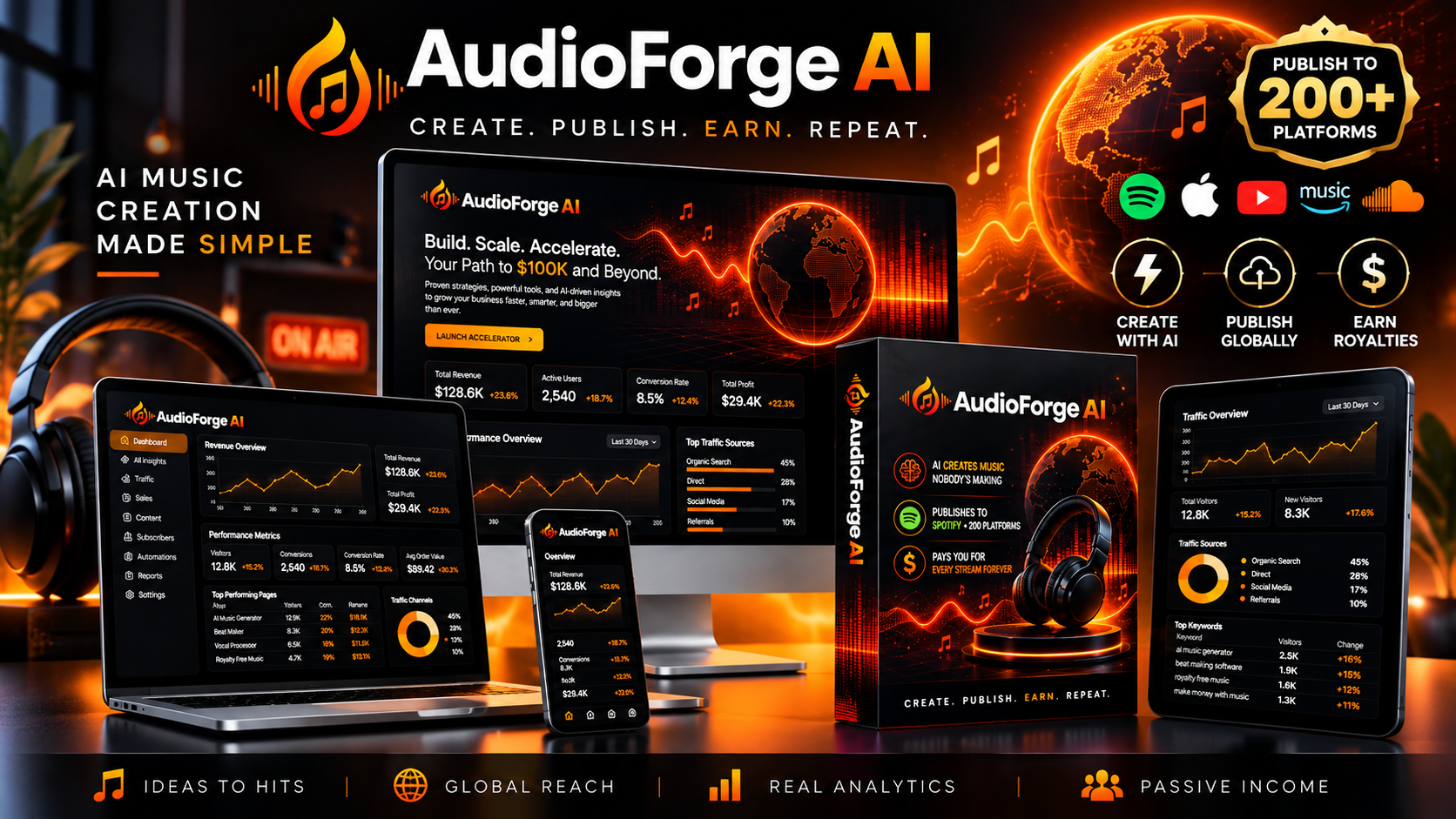
Try AudioForge AI with the protection of the available 30-day refund period.
AudioForge AI is presented as an AI-powered music platform designed to help users create music, develop songs and publish their tracks across multiple music platforms. It combines music creation and publishing functionality with tools intended to support a streamlined music production workflow.
Key Functionality:
AudioForge AI is promoted around AI music generation, lyrics, vocals, music production, mastering and distribution. The platform is also positioned around publishing music to 200+ platforms and building a catalog that can potentially generate streaming royalties. Users should review the current sales page for the latest feature availability, usage limits and distribution terms.
Launch Information:
Vendor: Peter Onwe
Launch Date: 2026-Sep-12
Launch Time: 11:00 EDT
Front-End Price: $17
30-Day Money-Back Guarantee:
The offer includes a 30-day money-back guarantee. Buyers should review the current checkout and refund terms before purchasing.
Affiliate Disclosure:
This page contains affiliate links. If you purchase AudioForge AI through the link on this page, I may earn a commission at no additional cost to you. This does not affect the information, analysis or opinions presented in my review. I aim to provide an honest and balanced assessment of the product, including its potential benefits, limitations, pricing considerations and suitability for different users.
Important:
AudioForge AI does not guarantee specific streams, royalties, income, sales or other financial results. Actual results can vary significantly depending on music quality, genre, audience, discoverability, platform policies, distribution terms and individual marketing efforts.
AudioForge AI Review: Who Created AudioForge AI?

Meet the Creator
Peter Onwe is the vendor behind AudioForge AI, an AI-powered music platform designed to help users create, develop, publish and monetize music across digital music platforms.
AudioForge AI Review: Demo Video
AudioForge AI Review: Should You Buy AudioForge AI?
If you want the short version before we go deep, here it is.
AudioForge AI is a real, functional concept: an app that scans Spotify for low-competition genres, generates AI music to fill that gap, and pushes it out to 200+ streaming platforms in a few clicks. The core workflow is legitimate and matches how a growing number of independent “AI artists” are actually building catalogs in 2026.
Where it gets shaky is the income framing. The $10,000-a-month examples, the “legacy you can pass to your kids” language, and some of the “success stories” blur the line between illustration and reality harder than they should. The per-stream royalty math on the sales page is actually close to accurate — but getting real listeners to a brand-new, anonymous AI catalog is the part the page glosses over.
At $17 for the front end, the downside risk is low. The real cost of this product is the 11-OTO funnel behind it, which is where I’d slow down before clicking “yes” on autopilot.
AudioForge AI Review: The Bigger Picture – Why AI Music Tools Are Suddenly Everywhere
To judge AudioForge AI fairly, it helps to understand why this specific type of product is showing up in launch calendars right now. AI-generated music isn’t a fringe experiment anymore. Tools like Suno and Udio turned “type a prompt, get a song” into something anyone can do in under a minute, and by 2026 that shift has produced real chart activity, real record deals, and real controversy across the music industry.
At the same time, the broader AI content boom has trained an entire generation of online marketers to expect a familiar pattern: find an underserved niche, use AI to fill it at scale, distribute everywhere at once, and let the platform’s own algorithm do the discovery work. That’s the exact playbook behind faceless YouTube channels, AI-written blog networks, and print-on-demand stores — and now it’s being applied to streaming royalties.
This matters for how you should read AudioForge AI’s sales page. It isn’t a wildly novel idea dressed up as software. It’s a fairly predictable next step in a pattern we’ve already watched play out in half a dozen other content categories, which means we already have a rough sense of what tends to work, what tends to underdeliver, and what claims tend to get inflated along the way. Keep that pattern in mind as we go through the rest of this AudioForge AI review.
AudioForge AI Review: What Is AudioForge AI?
AudioForge AI is a cloud-based software tool built around a three-stage workflow: find a low-competition music niche on Spotify, generate a batch of original AI tracks for that niche, and distribute the finished catalog to Spotify, Apple Music, YouTube Music, and 200+ other platforms in one click.
It’s created by Peter Onwe, who positions this as his third major launch in the “AI niche discovery” format, following two earlier products in the Amazon KDP and Etsy print-on-demand spaces. According to the JV materials, those two prior launches reportedly generated over $45,000 and $50,000 in revenue respectively, with the vendor citing a 60%+ conversion rate across both.
The pitch behind AudioForge AI is straightforward: instead of finding a gap in a book category or a printable niche, the app finds a gap in a Spotify micro-genre — something like ambient sleep music or lo-fi study beats — where listener demand exists but very few creators are actively publishing. It then uses generative AI to fill that gap with original tracks, complete with lyrics, vocals, cover art, and metadata, and monetizes the whole thing through streaming royalties instead of one-time sales.
That’s the pitch in one paragraph. The framing throughout the sales materials leans heavily on permanence and legacy — “royalties forever,” “a retirement asset,” “something you can pass down” — which is a noticeably different emotional register than the usual “make money fast” internet marketing pitch. Whether that framing is earned by what the software actually does is really the central question this review is trying to answer. Now let’s get into what’s actually inside the box.
AudioForge AI Review: How Does AudioForge AI Actually Work?
Here’s the step-by-step process, based on the demo and product walkthrough described in the sales materials.
Step 1: Find a Profitable Micro-Genre
You either click a single button or type in a keyword, and the Spotify Market Scanner pulls a ranked shortlist of micro-genres. Each one comes with an “opportunity score” that estimates competition level, listener demand, and an approximate timeline to your first playlist placement.
This is genuinely one of the more useful parts of the tool, at least conceptually. Spotify has thousands of micro-genres and sub-genres — things like “sleep ambient,” “brown noise for study,” “dark academia piano” — and manually researching which of these have real search volume versus which are dead ends is time-consuming even for people who do this professionally.
What I’d want to know before trusting this scanner completely is where its underlying data actually comes from. Spotify doesn’t offer an official public API for genre-level demand and competition metrics, so any tool making claims like this is either scraping public playlist and chart data, licensing a third-party analytics feed, or estimating from a smaller sample than the phrase “scans Spotify” implies. None of that makes the feature useless — it likely still beats pure guesswork — but it’s worth treating the opportunity scores as directional guidance rather than hard data.
Step 2: Generate the Music
Once you pick a genre, you choose how many tracks you want — anywhere from 5 to 25 per batch — and the app generates original instrumentals, AI vocals (for genres that need them), and full lyrics where relevant. Every track is meant to be unique, not looped or pulled from a sample library.
In practice, this step is where AI music tools tend to be judged most harshly, and fairly so. Instrumental, mood-driven genres (ambient, lo-fi, meditation, focus music) are where current-generation AI audio holds up best, because there’s no lead vocal performance to expose the seams. Anything closer to mainstream pop, rock, or hip-hop vocals is a much harder bar to clear, and I’d go in expecting the tool to shine in the “background music” categories rather than anything meant to be a foreground listening experience.
Step 3: Review and Publish
You preview every track in a built-in player before anything goes live. You can regenerate any track you don’t like with no limit on attempts. Once you’re happy with a batch, AudioForge AI auto-generates the titles, cover art, genre tags, and playlist pitch descriptions, then pushes the finished catalog out to Spotify, Apple Music, YouTube Music, and 200+ other platforms with one click.
The “no limit on regenerations” detail is worth pausing on, because it’s the single biggest practical difference between a tool like this and a pure credit-metered generator like Suno or Udio. If regeneration really is unlimited on the front-end tier, that removes the anxiety of burning through paid credits every time a track comes out sounding off — though it’s also exactly the kind of “unlimited” claim worth testing yourself in the first few days of your refund window, before you build a whole strategy around it.
Step 4: Collect Royalties
From there, every stream on every platform is supposed to generate a royalty payment, deposited automatically according to your distributor’s payout schedule, for as long as the tracks stay live.
On paper, this is a clean four-step loop. The honest question is what happens between step 3 and step 4 — specifically, how many actual humans are going to find and stream a brand-new, anonymous catalog with zero existing audience. We’ll dig into that later in this AudioForge AI review.
AudioForge AI Review: What the Dashboard Experience Actually Looks Like
Based on the walkthrough described in the sales materials, the day-to-day experience is meant to center around the “Audio Empire Command Dashboard” — a single screen showing every project, every published track, and stream counts across your whole catalog, alongside a suggested next niche to try based on what’s already gaining traction for you.
This kind of centralized dashboard is a smart design choice for anyone planning to publish more than a handful of releases, because tracking performance across 200+ individual platforms manually would be its own part-time job. The real test, which no amount of sales copy can settle in advance, is how quickly and accurately the dashboard actually reflects stream data pulled back from every one of those distribution partners — royalty and stream reporting from smaller platforms is notoriously slow and inconsistent industry-wide, well beyond anything specific to this tool.
AudioForge AI Review: AudioForge AI Features – Full Breakdown
There’s a long feature list attached to this launch, so let me group it into what actually matters and give you my honest read on each piece.
Spotify Market Scanner + Opportunity Score Reports
This is the research engine. It continuously checks Spotify for micro-genres with real listener activity but thin competition, then hands you an ease-of-entry score, a rough revenue estimate, and a playlist placement timeline before you generate a single track.
If this scanner is even reasonably accurate, it solves the single biggest problem new AI-music creators actually have: not knowing what to make. Most people who fail at this don’t fail because the music is bad — they fail because they picked a saturated genre nobody was going to discover them in.
The Music Lyric Writer & Lyric-to-Song Pipeline
For genres that need vocals, the app writes complete, genre-matched lyrics automatically. This is standard for AI music generators in 2026 and works about as well as you’d expect — fine for instrumental-adjacent genres like lo-fi or ambient pop, less convincing for anything that leans on genuine songwriting craft or emotional specificity.
Original Beats & Instrumental Producer + Human-Grade AI Vocal Engine
Every track gets an original instrumental (not looped or sampled) and, where needed, AI vocals tuned to the mood of the track. The sales page is careful to frame these as “human-grade,” which is doing some marketing lifting — AI vocal quality in 2026 is genuinely good for background/ambient genres, but it’s not yet indistinguishable from a trained human vocalist on anything vocally demanding.
The Multi-Track Creator & Unlimited Regeneration Engine
You can batch-generate 5 to 25 tracks per run and regenerate any track as many times as you want at no extra cost. This matters more than it sounds like it should, because the realistic path to meaningful royalties here is volume — a handful of tracks earning fractions of a cent per stream isn’t a business, but a few hundred tracks across a well-chosen niche starts to be a different conversation.
The Live Preview Studio
A built-in player with waveform previews so nothing gets published without your approval first. This is a genuinely good design decision — plenty of competing AI music tools push you straight to export with no listening checkpoint.
The Streaming Title Generator, AI Cover Art Designer & Genre/Mood Auto-Tagger
These three work together to solve the “packaging” problem — titles, artist names, cover art, and genre tags that are actually optimized for how Spotify’s discovery algorithm surfaces new music, instead of generic file names and stock-photo covers. Several of the beta tester quotes in the sales material specifically call this out as the most useful part of the tool, and that tracks with what I’ve seen from other AI-music workflows — the packaging step is where most solo creators get lazy and lose discoverability.
The ISRC & Copyright Assistant
Every track gets an ISRC code and copyright metadata assigned automatically. This is unglamorous but genuinely important — without proper ISRC assignment, royalty tracking across platforms gets messy fast, and this is the kind of detail beginners typically don’t know they need until a payment doesn’t show up.
The 200+ Platform Auto-Publisher
One click distributes the finished catalog to Spotify, Apple Music, YouTube Music, Amazon Music, Deezer, Tidal, Pandora, TikTok, and dozens more. This is the biggest time-saver in the whole app if it works as advertised, since manually uploading to even a handful of these platforms one at a time is genuinely tedious.
The Audio Empire Command Dashboard
A single screen tracking every project, every track, and every stream across your whole catalog, with a suggested “next niche” recommendation based on what’s already performing. Useful for anyone planning to scale past a handful of releases.
Anonymous Artist Mode & Full Commercial Rights License
You can release under any artist name with no camera, no voice, and no personal brand required, and every track ships with full commercial rights included. Both of these check out as fair, standard inclusions for this category of tool — most AI music generators in this price range bundle commercial licensing by default in 2026.
Track Length Selector & The Auto-Mastering Engine
The Track Length Selector adjusts each generation to match what actually performs in a given genre — a two-minute clip for one niche, a full one-hour ambient loop for another. Paired with the Auto-Mastering Engine, which is supposed to bring every track up to Spotify’s loudness standard automatically, detect and remove silence, and correct clipping, this pair handles two things that genuinely trip up beginner music creators: getting duration wrong for the genre, and submitting a track that technically fails a platform’s audio-quality checks before a single listener ever hears it.
Genre & Mood Auto-Tagger & The Playlist Pitch Writer
Every track gets tagged with a genre and mood label the moment it’s created, which is what actually tells Spotify’s discovery system who to show the track to. The Playlist Pitch Writer then generates a ready-to-use description for submitting into curated playlists. Neither of these is flashy, but both directly affect whether a track has any realistic shot at organic discovery — get the tagging wrong, and even a genuinely good track can sit at zero streams indefinitely.
The Release Scheduler
Rather than dumping an entire batch live at once, this lets you stagger releases over time on a set schedule. From a pure discoverability standpoint, this is a smart inclusion — a steady release cadence is one of the few things that reliably helps a new catalog build momentum on any platform, streaming or otherwise, versus a single large upload that spikes and then goes quiet.
Cloud-Based Access
The app runs entirely in the browser, with no software to install or update, and works from a laptop, tablet, or phone. This is standard for 2026-era SaaS tools and not a differentiator on its own, but it does mean there’s no local hardware requirement or technical setup standing between you and actually using it.
The 30-Day Confidence Guarantee
A straightforward 30-day, no-questions-asked refund window is attached to the front-end purchase. Compared to the vague or conditional guarantees you sometimes see in this space, a flat 30-day window with a single-email refund process is a genuinely fair term, and it’s the main reason I don’t think the $17 entry point carries much real risk.
AudioForge AI Review: Key Features Summary
- AI-powered music creation for original tracks
- AI-assisted lyrics generation and development
- AI vocal generation for music production
- Music mastering tools for polished audio output
- Publishing and distribution across 200+ music platforms
- Commercial rights for eligible music created with the platform
- Royalty-focused tools and music monetization potential
- Cloud-based workflow accessible without complex music production software
- Suitable for creators, musicians, marketers, and digital entrepreneurs
- Designed for ambient, lo-fi, meditation, focus, and background music projects
AudioForge AI Review: AudioForge AI Pricing, OTOs & the Full Funnel Breakdown
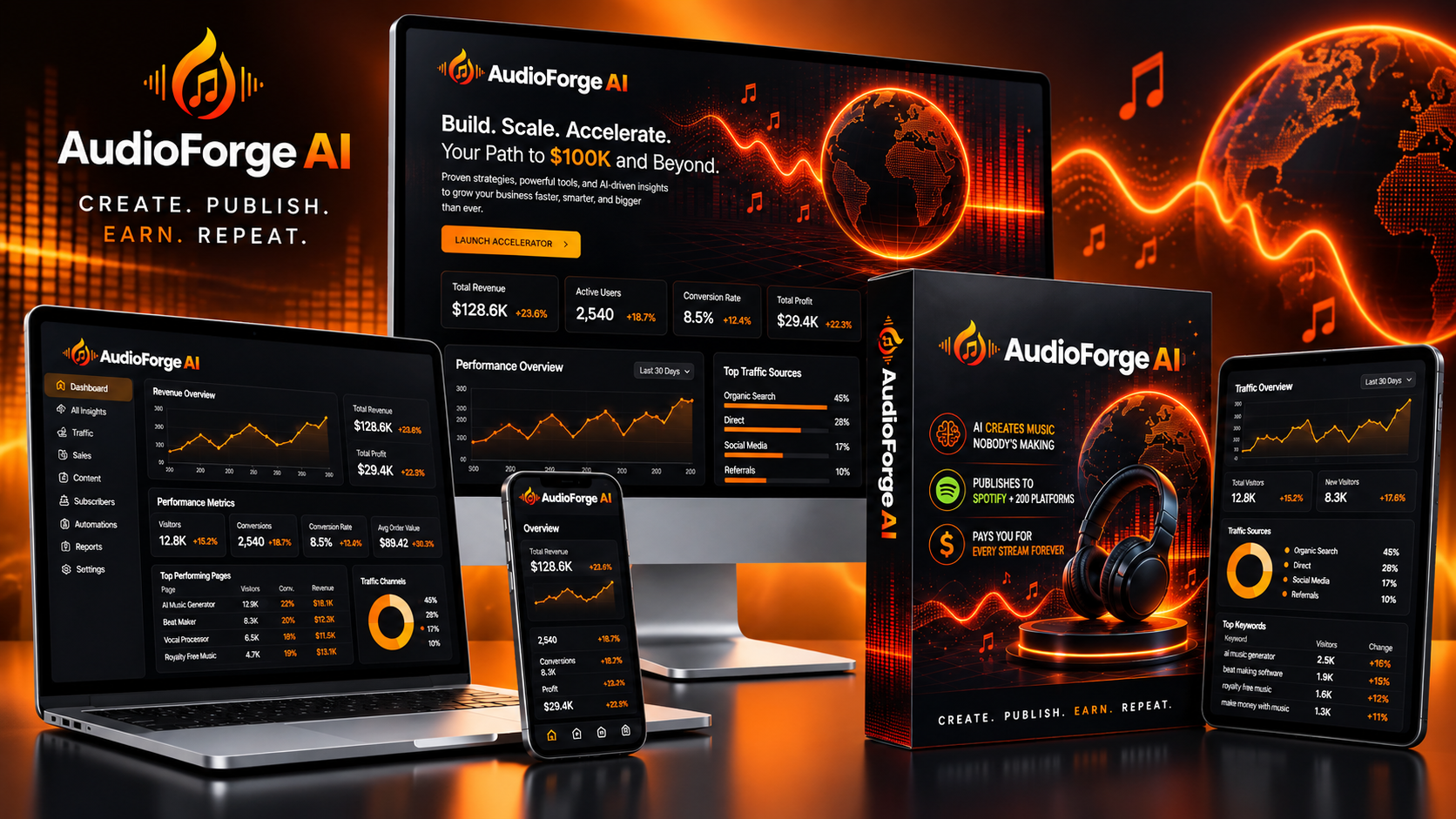
AudioForge AI – Starter
The core AudioForge AI application with the main research, AI music creation, packaging, and distribution workflow, with limited track generation.
30-Day Streaming Success Kit
An onboarding and training add-on intended to help buyers understand the streaming-focused workflow and get started with the platform.
Unlimited Version
Removes the generation caps from the starter version, making it more suitable for users who want to build a larger music catalog.
Album Art & Discovery Suite
Adds additional tools focused on cover artwork and discovery-related elements needed to package music releases more effectively.
Royalty Niche Vault
Provides a pre-researched niche database designed to help users identify music niches with potential demand and lower competition.
Advanced Music Studio
Expands the production workflow with deeper music editing and production capabilities beyond the core platform.
Streaming Domination
Adds additional distribution-focused functionality intended to support a broader streaming publishing strategy.
Platform Multiplier
Provides expanded platform reach for users who want to distribute their music catalog across more destinations.
Audio Content Creator
Adds extra audio content creation tools designed to extend the types of content users can produce from their music assets.
DFY Music Catalog
Provides a done-for-you, pre-made music catalog intended for buyers who want ready-made assets rather than building every release from scratch.
Agency License
Designed for users who want to offer music creation and catalog services to clients as part of an agency or service-based business.
Reseller Account
Provides reseller-oriented access intended for users who want to resell the AudioForge AI software rather than only use it for their own music projects.
Whitelabel License
The highest-priced upgrade in the documented funnel, designed for users who want to rebrand and resell the software under their own brand.
That’s thirteen separate purchase decisions in a single checkout flow. To be fair to the vendor, this is a completely standard structure for this corner of the software launch world — it’s not unique to AudioForge AI, and I’ve flagged the exact same pattern in other reviews on this site.
My honest take: the $17 front end is a fair, low-risk way to actually test the core tool. The “Unlimited Version” (OTO 1) is the one upgrade that seems genuinely necessary if you plan to use this seriously, since a capped free-tier-style generation limit isn’t going to build a meaningful catalog. Everything past OTO 3 or so starts moving into “nice to have if you’re building an agency around this” territory rather than “needed to use the product as advertised.”
It’s also worth sitting with the sales page’s own cost comparison table for a second, since it’s actually a reasonable framing to borrow (even if the specific numbers are a stretch). The page compares AudioForge AI’s $17 price against hiring freelancers separately for genre research, songwriting, vocals, production, mastering, cover art, metadata, and upload work — arriving at a combined estimate north of $1,500 for a single small catalog done manually.
That comparison is directionally fair: hiring separate freelancers for each of those steps genuinely does add up fast, and it’s a real reason all-in-one AI tools have found a market. Where I’d push back is the assumption baked into the table that a freelancer-built catalog and an AI-generated one are interchangeable products. A human songwriter, vocalist, and producer working together are very likely to produce a higher ceiling of creative quality than any current AI pipeline, even at ten times the cost. The fair comparison isn’t “AI tool vs. freelancers for the same output” — it’s “AI tool for volume and speed vs. freelancers for quality and originality,” and which one you actually need depends on what you’re trying to build.
If funnel structures like this are new to you, it’s worth spending ten minutes with our affiliate marketing tutorials hub before you buy anything in this space — understanding how OTOs, order bumps, and commission tiers work will save you from either overbuying or under-buying relative to what you actually need. And if you want a broader, product-agnostic checklist for evaluating any digital software launch before you hand over your card details, GrowDigitalHub’s guide to choosing the best online solutions is a genuinely useful outside resource to bookmark alongside reviews like this one.
AudioForge AI Review: The Bonuses – Are They Actually Worth Anything?
Every purchase during launch week reportedly includes four bonus apps: CashAI (a ClickBank promotion tool), TraffixAI (a free traffic tool), Zyntri (a Facebook-based “income machine”), and Xyro (an X/Twitter traffic tool), with a combined claimed value of $258.
I’ll be direct about this part: bundled bonus software in this niche is almost always the weakest part of any launch, and I’d go into these four expecting basic, entry-level utility rather than anything transformative. They’re not why you’d buy AudioForge AI, and I wouldn’t let a stacked bonus value figure ($2,645 in “real-world value” against a $17 price) influence your decision either way. Those value figures are marketing math, not appraisals.
If you’re specifically interested in building out a stack of traffic and promotion tools, it’s worth comparing what’s bundled here against dedicated tools built for that single purpose — our Agentic Affiliate review and CampaignBuilders review cover two options that are built around funnel and campaign automation specifically, rather than as a bolt-on bonus.
AudioForge AI Review: Real Numbers – What Might a Realistic AudioForge AI Catalog Actually Earn?
The sales page includes its own royalty projection table, and to its credit, it’s labeled as illustrative rather than a guarantee. Still, I wanted to build a more grounded version of that same table using verified 2026 royalty rates, so you can plan against something a little more conservative than a best-case sales page scenario.
Using the widely cited real-world range of roughly $0.003 to $0.005 per stream, here’s what three different outcome scenarios might look like for a catalog of 100 tracks over its first year, before any distributor cut:
| Scenario | Avg. Monthly Streams per Track | Monthly Catalog Royalty | Annual Catalog Royalty |
|---|---|---|---|
| Conservative (no promotion, no playlist placements) | 50–150 | $15–$75 | $180–$900 |
| Moderate (a few playlist adds, steady release schedule) | 500–1,500 | $150–$750 | $1,800–$9,000 |
| Optimistic (one or two tracks catch a real playlist wave) | 3,000–10,000+ | $900–$5,000+ | $10,800–$60,000+ |
The gap between these scenarios isn’t really about the AI or the software — it’s almost entirely about discovery. A 100-track catalog sitting quietly with no playlist placements and no external promotion will land somewhere near the conservative row, full stop, regardless of how good the tool that made it is. The optimistic row is real and does happen, but it happens to a small percentage of any given catalog, AI-generated or not, and it’s driven by playlist algorithms and listener behavior that no upload tool can control.
This is also where the 1,000-stream-per-track annual threshold that several distributors and Spotify itself now enforce becomes relevant — tracks that don’t clear that bar within a rolling window can earn nothing at all, no matter how many total tracks sit in your catalog. Volume helps your odds, but it doesn’t guarantee any individual track crosses that line.
None of this means the model is broken. It means the “$10k+/month” framing on the sales page describes the optimistic tail of the distribution, not the median outcome — and any honest AudioForge AI review needs to say that plainly rather than let the excitement of the sales copy carry over unchecked.
AudioForge AI Review: 5 Things Nobody Tells You About AI Streaming Royalties
Before we get into the specific claims on the AudioForge AI sales page, it’s worth laying out a few realities about streaming royalties in general that apply to any AI music generator for passive income you might consider — not just this one.
1. Payouts are pooled, not fixed. Spotify doesn’t pay a flat rate per stream. It collects total subscription and ad revenue, then divides an artist royalty pool proportionally based on each track’s share of total platform streams that month. Your actual per-stream rate moves depending on how the overall pool and total stream count shift, which is why every royalty estimate you’ll ever see is a range, not a guarantee.
2. Where your listeners are matters more than how many you have. A stream from a Premium subscriber in the US or UK is worth meaningfully more than a stream from a free, ad-supported listener in a market with lower ad rates. Two catalogs with identical stream counts can post very different royalty totals depending purely on listener geography.
3. Minimum stream thresholds are real and growing more common. Several distributors, and Spotify itself, now require a track to clear a minimum number of streams within a rolling period before it earns anything at all — a policy explicitly aimed at curbing exactly the kind of low-engagement, mass-uploaded catalogs that volume-based AI tools can produce.
4. Your distributor takes a cut before you ever see a payout. Depending on which distribution partner ends up handling your AudioForge AI catalog behind the scenes, expect some percentage taken off the top before royalties reach your account — the “you keep 100% of every royalty” framing on the sales page glosses over this standard industry mechanic.
5. Discovery is the actual bottleneck, not creation. This is the single most important point in this entire review. AI has made the creation step nearly free and instant. It has done nothing to solve the decades-old problem of getting a brand-new, unknown catalog in front of real listeners. Every tool in this category — AudioForge AI included — is selling you the easy 20% of the problem while implying it’s solved the hard 80%.
AudioForge AI Review: Let’s Fact-Check the Big Claims – What’s Real and What’s Marketing
This is the section I think matters most in an honest AudioForge AI review, because the sales page makes some specific, checkable claims. I went and checked them.
Is the $4–$5 per 1,000 streams number accurate?
Yes, actually. The royalty table on the sales page (roughly $4–$5 per 1,000 monthly plays) lines up closely with real-world 2026 data — independent distributors and royalty trackers put Spotify’s average payout at around $0.003 to $0.005 per stream, which works out to about the same range. This is one of the few places where the sales copy isn’t exaggerating the raw math.
What the page doesn’t mention is the harder part of that equation: reaching those stream counts in the first place. A brand-new, anonymous track with no existing fanbase, no playlist placements, and no promotional push doesn’t just accumulate thousands of monthly streams on its own. Spotify also introduced a rule in recent years requiring a minimum stream threshold before a track earns any royalties at all, specifically to cut down on exactly the kind of mass-upload, low-engagement catalogs this tool is designed to produce quickly.
Does Spotify actually allow AI-generated music?
Yes, with real and growing conditions attached. Spotify has publicly confirmed it doesn’t ban AI-assisted music, but it has rolled out increasingly specific policies around disclosure and labeling. In September 2025, Spotify announced it would start identifying and labeling AI-generated tracks in music credits using an industry-standard disclosure system, specifically to cut down on “AI slop” and spam uploads.
That policy has kept expanding. As of August 2026, Spotify began labeling “AI Persona” profiles and excluding their tracks from algorithmic recommendations — meaning fully synthetic artist projects, exactly the kind AudioForge AI is built to create, may get less algorithmic push over time, not more. This is a genuinely important detail that isn’t mentioned anywhere in the sales materials, and it’s the single biggest reason I’d temper expectations around long-term discoverability.
Interestingly, mass-produced AI content running into friction with the platform it’s published on isn’t unique to music. Google’s own search spam policies explicitly call out “scaled content abuse” — generating large volumes of low-effort content primarily to game a ranking or discovery system — as something it actively penalizes, regardless of whether the content is AI-written or human-written. Spotify’s direction with AI Persona labeling reads like the same instinct applied to music discovery instead of search results.
Are the “AI music project” success examples real?
This is where the sales page gets genuinely inconsistent, and it’s worth calling out directly.
The page presents examples like Enlly Blue, BOI WHAT, Masters of Prophecy, Cherry 葵 Nightcore, Mikeeysmind, Aventhis, and The Velvet Sundown with specific revenue figures ($380,000, $340,000+, $652,000, $2 million, and so on), then later includes a disclaimer stating plainly that “these are all fictional AI music brands created by ordinary people like you.”
Here’s the problem: The Velvet Sundown is not fictional. It’s a real AI-generated band that went viral on Spotify and became a widely covered case study in music journalism around AI-generated content. Lumping a documented real-world case into the same “fictional” disclaimer as clearly invented brand names is sloppy at best and misleading at worst.
Similarly, “Breaking Rust” — used elsewhere as an example — is also real: an AI country act that genuinely reached #1 on Billboard’s Country Digital Song Sales chart in late 2025. But even that headline needs context. As reporting at the time pointed out, that chart tracks digital purchases, not streams, and it only took a few thousand paid downloads to top it — a very different achievement than topping the actual Hot Country Songs streaming chart. Framing it as simply “hit #1 on Billboard” without that context overstates what actually happened.
The Xania Monet $3 million Hallwood Media deal, which the page also references, is real and well documented by Billboard’s own reporting — but it’s worth noting Xania Monet’s lyrics were written by a real human songwriter with a genuine personal voice behind them, and the project attracted significant industry backlash specifically because of concerns around AI displacing human artists. It’s an outlier case being used to suggest a repeatable outcome, which it isn’t.
My take: mixing real, verifiable outlier events with invented example brands, under a single blanket “fictional” disclaimer, is the kind of thing that erodes trust once you actually check it — and it’s exactly the kind of detail an honest review needs to flag.
Can a Music Catalog Really Be Sold as an Asset “Worth Hundreds of Thousands”?
The sales page floats the idea that a large enough catalog could eventually be sold outright, pointing to Xania Monet’s record deal as an example of what’s possible. It’s true that music catalog sales are a real, well-established part of the industry — major artists have sold their entire back catalogs for enormous sums over the years, and that market exists because a catalog with a long, proven earnings history is a genuinely valuable, income-generating asset to a buyer.
The gap between that reality and this pitch is scale and track record. Catalog buyers pay for years of demonstrated, stable royalty income from recognizable, often chart-tested material — not for a freshly generated batch of anonymous AI tracks with no streaming history. It’s not impossible that a stand-out AI catalog could eventually attract acquisition interest the way Xania Monet did. It’s also not something a beginner should treat as a realistic plan when deciding whether to buy this tool.
What About the Diane, Frank, Margaret, and Robert Stories?
The sales page also features four named “success stories” — a retired music teacher, a widower, a 71-year-old whose family doubted her, and a factory worker building a legacy for his grandkids — each with a specific track count and monthly royalty figure attached. Unlike the AI-brand revenue examples, these aren’t explicitly labeled fictional anywhere on the page.
I want to be careful here, because I have no way to verify whether these are real customers, composite characters, or fully invented personas — and I’m not going to claim certainty I don’t have either way.
What I can point out is the pattern: all four stories follow the exact same structural beats common to direct-response marketing — an emotional hook (grief, doubt, retirement, legacy), a moment of skepticism, a specific and satisfying track count, and a monthly dollar figure that lands in a similarly narrow, aspirational-but-believable range. That doesn’t prove they’re fabricated. It does mean they’re doing a marketing job as much as an informational one, and I’d weigh them accordingly rather than treating them as independent proof of typical results.
What Beta Testers Actually Said (And What It Tells Us)
The sales page includes eight separate beta tester quotes, and reading through all of them together is actually more useful than reading any single one in isolation. A clear pattern emerges: almost every quote praises the packaging and workflow (titles, tags, cover art, the multi-platform publisher, the preview studio) rather than the raw musical quality of the output itself.
That’s a meaningful signal either way you read it. On one hand, it suggests the automation and distribution layer — the actual differentiator of this tool versus a plain AI music generator — genuinely works as intended for early testers. On the other hand, the near-total absence of specific commentary on how the songs actually sound, or how they performed once live, leaves the two questions that matter most to your wallet — audio quality and real discoverability — the least addressed part of the entire testimonial section.
AudioForge AI Review: AudioForge AI Advantages and Disadvantages
What I actually like:
- The core three-step workflow (research → generate → distribute) is a real, coherent product, not vaporware
- The niche-discovery-first approach is smarter than most AI music tools, which generate first and hope someone streams it
- Unlimited regeneration and a real preview player before publishing are genuinely good UX decisions
- $17 front-end price is low-risk for what you get access to
- Full commercial rights and one-time pricing (no recurring subscription trap on the front end) match what’s standard for legitimate tools in this category
- 30-day refund window gives you room to actually test it before committing further
Where I’d push back:
- The income examples blend real events with openly labeled “fictional” ones in a confusing way
- No mention anywhere of Spotify’s evolving AI Persona and disclosure policies, which directly affect long-term discoverability
- The 11-OTO funnel is a lot to navigate, and several upsells overlap in function
- Realistic stream volume for a brand-new anonymous catalog is presented far more optimistically than current market conditions support
- “Normally $67/month” vs “normally $97” pricing anchors are inconsistent on the same page
Digging a Little Deeper Into the Cons
The “no mention of Spotify’s AI Persona policy” point is worth sitting with for a second, because it’s not a minor omission. A sales page selling a tool built specifically to publish anonymous, AI-generated artist catalogs at volume should probably acknowledge that the platform it depends on has spent the last year building specific detection and labeling systems aimed at exactly that pattern. Leaving it out doesn’t make the tool non-functional, but it does mean buyers are making a purchase decision without a fairly important piece of context about where the platform is heading.
The funnel size is a softer criticism, since it’s genuinely an industry norm rather than something unique to this launch. Still, “industry norm” and “buyer-friendly” aren’t the same thing, and thirteen separate purchase decisions in one checkout session is a lot to evaluate in the moment, especially for anyone new to this kind of launch structure.
AudioForge AI Review: Pros & Cons Summary
Pros
- Research-first workflow helps identify potentially lower-competition music niches before generating tracks.
- Combines music research, generation, packaging, and distribution in one workflow.
- Unlimited regeneration and a preview player make it easier to review tracks before publishing.
- $17 front-end price provides a relatively low-cost way to test the core platform.
- One-time front-end pricing and commercial rights are useful for creators building a music catalog.
- 30-day refund window provides time to test the platform before committing further.
Cons
- The income examples can make the earning potential appear more predictable than it realistically is.
- Discoverability remains the biggest challenge for a new catalog, even after distribution.
- The 11-OTO funnel creates many additional purchase decisions and some upgrades overlap in function.
- The sales page uses inconsistent pricing anchors, including $67/month and $97 references.
- Large-scale publishing of similar AI-generated tracks can create discoverability and platform-policy concerns if handled poorly.
- The platform’s stated capabilities do not guarantee streams, listeners, royalties, or income.
AudioForge AI Review: Comparisons With Alternatives
| Platform | Best For | Music Focus | Vocals | Key Advantage | How It Differs From AudioForge AI |
|---|---|---|---|---|---|
| AudioForge AI | AI music creation and publishing | Full music workflow, research, generation, packaging and distribution | Yes | Research-to-generation-to-distribution workflow | More focused on building and publishing a music catalog with a royalty-oriented workflow. |
| AIVA | Film, game and cinematic scoring | Instrumental, orchestral and cinematic composition | No | Strong orchestral composition and MIDI-oriented workflow | Better suited to composers and scoring projects than a royalty-focused music publishing workflow. |
| SOUNDRAW | YouTube, podcasts, advertising and creator content | Customizable royalty-free background music | No | Creator-focused background music workflow | More focused on customizable production music for content creators than generating a large artist-style catalog. |
| Beatoven.ai | Video, podcast and social-media background music | Mood-based instrumental scoring | No | Fast creation of background cues around mood and content | Better suited for content scoring than building a music catalog intended for streaming royalties. |
| Mubert | Apps, creators and adaptive audio | Generative music, loops and continuous audio | Limited | Strong fit for adaptive music and API-based workflows | More oriented toward continuous audio, integrations and creator applications than a complete music-publishing funnel. |
AudioForge AI Review: Who Is AudioForge AI Actually For?
Based on everything in the sales materials and the realistic limitations we’ve covered, here’s who I think gets genuine value from this:
- Retirees and pre-retirees looking for a low-effort side income project, with realistic expectations about the timeline (this is explicitly the demographic the marketing leans on hardest, and it’s a fair fit if expectations are calibrated correctly)
- People already comfortable building faceless digital income streams — if you’ve done faceless YouTube channels, print-on-demand, or KDP publishing, this is a similar skill set applied to a new asset class
- Freelancers and small agencies wanting to add a “DFY AI music catalog” service line for clients, using the Agency License tier
- Content creators diversifying income sources who already understand that this is a long-game, volume-based play, not a quick win
If you’re already running other faceless content projects, it’s worth thinking about this as one more channel in a broader stack rather than a standalone business. For instance, creators doing faceless video content with tools like Reel Remix or automated video production through UnfoldVideo are working from the exact same underlying philosophy — anonymous, AI-assisted content published at volume across platforms that reward consistency over personal brand.
One more honest consideration: this is genuinely not a fit for anyone who needs income on a specific timeline — covering a bill next month, replacing a paycheck by a set date, or anything with real financial pressure attached. The realistic version of this business, even in a best-case scenario, is a slow-compounding side project measured in months and years, not weeks. If your circumstances require faster or more predictable income, this specific category of product isn’t the right tool for that job, no matter how good the software itself turns out to be.
AudioForge AI Review: Who Should Skip This
- Anyone expecting the $10,000+/month examples to represent a typical or fast outcome
- Anyone unwilling to publish dozens or hundreds of tracks before seeing meaningful royalty totals
- Musicians or songwriters looking for a creative tool rather than a volume-based income system
- Anyone who isn’t prepared to navigate an 11-step upsell funnel and wants a single, simple purchase decision
Each of these deserves a quick word. If you’re a working musician, this tool is very likely to feel restrictive rather than empowering — you’re trading creative control for automation, which is the opposite of what most musicians actually want from a music tool. And if funnel fatigue is a real concern for you, it’s worth deciding your OTO budget cap before you ever land on the order page, since upsell momentum is a well-documented psychological effect and it’s much easier to hold a line you set in advance than one you’re trying to figure out mid-checkout.
AudioForge AI Review: A Word on “Passive Income” and Realistic Expectations
The phrase “passive income” does a lot of heavy lifting on this sales page, and it’s worth being precise about what that term actually means here. Once a track is published, the streaming and royalty collection genuinely is passive — you don’t have to do anything for an existing track to keep earning whatever it earns. But building the catalog large enough, and promoted well enough, to generate income worth noticing is not passive at all. It’s front-loaded, repetitive work: researching niches, generating and vetting batches of tracks, scheduling releases, and manually pitching playlists.
This is true of essentially every “passive income” digital product category — Kindle publishing, print-on-demand, affiliate sites, and now AI music all share this same structure. The income becomes passive after a genuinely active building phase, not instead of one. Going in with that framing rather than the sales page’s framing will save you from the most common source of disappointment with this entire category of tool.
AudioForge AI Review: How to Actually Get the Best Results If You Buy It
If you decide to move forward, here’s how I’d approach it based on everything covered in this AudioForge AI review, rather than the “three clicks and you’re done” framing on the sales page:
- Test the refund window deliberately. Spend your first week generating and listening critically to real output across two or three different genres before committing to any OTO beyond the Unlimited version. Judge the actual audio quality yourself rather than taking the sales page’s word for it.
- Pick one or two niches and go deep rather than wide. The opportunity scanner may surface a dozen promising micro-genres, but a catalog of 200 tracks spread across ten different genres builds far less momentum in any single one than 200 tracks concentrated in two.
- Treat the release scheduler as mandatory, not optional. A staggered release cadence is one of the few genuinely evidence-backed ways to build discovery momentum on a streaming platform, and dumping an entire batch live in one day works against you.
- Do at least some manual playlist outreach yourself. The playlist pitch writer creates the description — it doesn’t submit it anywhere. Actually researching and pitching independent curated playlists in your genre is manual work the software doesn’t automate, and skipping it is likely the single biggest reason a catalog underperforms.
- Track your numbers independently of the dashboard for at least the first few months. Cross-check what the in-app dashboard reports against your actual distributor statements early on, simply so you know whether the reporting is accurate before you’re relying on it at scale.
- Set a real timeline expectation. Budget for three to six months of consistent publishing before judging whether this is generating meaningful income for you — not the 30 days the refund window covers.
AudioForge AI Review: Is AudioForge AI Legit or a Scam?
Based on everything reviewed here, I don’t think “scam” is the right word for this. The core technology described is achievable with 2026-era AI music generation and automated distribution tools, the vendor has a documented (if self-reported) launch history, and there’s a genuine 30-day money-back guarantee attached.
What it is, more accurately, is a fairly typical internet-marketing-style software launch: a real underlying tool wrapped in a heavier-than-necessary income narrative, an aggressive upsell funnel, and a handful of sloppy or misleading claims mixed in with the accurate ones. That’s a very different thing from a scam, but it’s also not the “print money in your sleep” pitch on the sales page.
If you approach it as a legitimate tool for building an experimental, long-term content catalog — and not as a guaranteed income system — I think it’s a fair $17 bet with real refund protection behind it.
AudioForge AI Review: How This Fits Into a Broader AI Content & Passive Income Strategy
If you’re building out a stack of AI-assisted content tools rather than betting on one product, it’s worth seeing where AudioForge AI actually fits. It’s a content-generation-and-distribution tool, similar in spirit to video-focused tools like ViralRobot AI, which handles a comparable research-to-publish loop for short-form video instead of music.
If discoverability and search visibility matter to whatever you’re building around this (a review site, a YouTube channel about your catalog, a blog documenting the journey), our SEnuke AI review covers a tool built specifically around that layer, which AudioForge AI doesn’t touch at all — it gets your music onto platforms, but it does nothing to help anyone actually find your catalog through search.
For a broader look at how the AI tools landscape is evolving beyond music specifically, DigitalTrendsWave’s roundup on AI automation and productivity tools is a solid, non-biased starting point if you want context on where a tool like this sits relative to the broader category.
It’s also worth noting how fast the “AI does the content, AI does the packaging” model is spreading across marketing generally. HubSpot’s 2026 State of AI in Marketing data shows content and media creation as the single most common use case for AI tools among marketers today — AudioForge AI is really just that same industry pattern applied to a new content type (streaming audio) rather than blog posts or ad copy.
AudioForge AI Review: What I’d Like to See Improved in Future Updates
A few honest suggestions, for what they’re worth to the vendor or to anyone comparing this against a future version:
- Name the actual distribution partner. Buyers deserve to know exactly which aggregator is handling their royalty payments and what cut, if any, is taken before the money reaches them.
- Acknowledge Spotify’s AI Persona and disclosure policies directly, rather than leaving buyers to discover this on their own after they’ve already published a catalog.
- Separate the “fictional” case studies from the real ones more clearly, ideally with individual labeling rather than one blanket disclaimer buried partway down the page.
- Publish real, verifiable customer results after launch, rather than relying solely on beta tester quotes and hypothetical royalty tables. A tool this new has no post-launch track record yet, and that’s fine — but it should be presented as new, not implied to already have years of proven outcomes behind it.
AudioForge AI Review: Final Thoughts
AudioForge AI isn’t a scam, and it isn’t the effortless royalty machine the sales page frames it as either. It’s a genuinely usable piece of software sitting at the intersection of two trends that are both real in 2026: AI-generated music quietly becoming a legitimate (if messy) part of the streaming ecosystem, and internet marketers packaging that trend into software faster than most buyers can fact-check the claims around it.
If you go in treating the $17 front end as a low-risk experiment in a genuinely new content category — not as a guaranteed income stream — I think there’s real value here, especially in the niche-research and distribution automation. Just budget your expectations, and your wallet, around the OTO funnel before you get three upsells deep on launch-day momentum.
The most useful mindset shift, if you do decide to buy this, is to stop thinking of it as a “how to make money with AI generated music” shortcut and start thinking of it as a content production tool that removes the most tedious 80% of an otherwise legitimate long-term project. The remaining 20% — genre strategy, release consistency, and at least some manual playlist outreach — is still on you, and no software launching in 2026, this one included, has actually automated that part yet.
Buyers who understand that going in tend to walk away from tools like this satisfied. Buyers expecting the sales page’s income examples to be their own experience within 30 days tend to walk away disappointed, request a refund, and write the exact kind of angry review that makes it harder for the next person to find an honest, calibrated take like this one.
That’s really the gap this AudioForge AI review has tried to close — giving you the calibrated version before you spend a dollar, not after.
A solid AI music creation and publishing platform with a strong research-to-distribution workflow, but discoverability and realistic royalty expectations remain important considerations.
For more breakdowns like this one, you can browse the rest of our digital product reviews, and if you want a wider-lens perspective on evaluating AI marketing tools generally before buying anything in this space, TechPulseHub’s in-depth AI and digital product review guide is a solid outside resource worth bookmarking.
This review reflects the sales page, JV documentation, and public information available as of the September 12, 2026 launch date. Pricing, bonuses, and OTO structures on affiliate launches sometimes change after the initial launch window closes — always confirm current pricing on the official order page before purchasing.
AudioForge AI Review: Get Instant Access + Premium Bonuses Worth $43,000 FREE!
Get AudioForge AI + 17 Exclusive Bonuses
Purchase AudioForge AI through my qualifying affiliate link and receive my complete package of 17 Exclusive RidhTek Reviews Bonuses at no additional cost after purchase verification.
AI Traffic Blueprint System
Learn practical strategies for using AI to develop targeted traffic campaigns and attract potential customers for your digital products, services and online offers.
Advanced Keyword Research Guide
Discover practical methods for finding relevant, searchable and potentially profitable keywords for websites, content, SEO and digital marketing campaigns.
High-Converting Content Framework
Use a structured content framework to create useful, engaging and conversion-focused content for digital products, services and marketing campaigns.
Free Traffic Growth Strategy
Explore practical SEO and organic traffic strategies designed to improve search visibility and build a more sustainable flow of visitors without depending entirely on paid advertising.
Affiliate Monetization Blueprint
Learn ways to structure affiliate promotions, content, offers and supporting assets for a more organized approach to affiliate marketing and online monetization.
Authority Site Growth Guide
Explore strategies for developing an authoritative website, publishing useful content and building a stronger long-term presence around your chosen market or niche.
AI Automation Workflow System
Discover practical AI-assisted workflows that can help streamline repetitive marketing, content and digital-business tasks while reducing unnecessary manual work.
Lead Generation Playbook
Explore practical lead-generation approaches for finding prospects, creating stronger offers and developing a more consistent system for attracting potential customers.
Personal Branding Strategy
Learn practical ways to strengthen your personal brand, communicate your expertise and build greater trust across your website, content and digital marketing channels.
Blog Monetization Blueprint
Explore different ways to turn useful blog content into monetization opportunities through affiliate offers, digital products, services and other online-business models.
Product Launch Checklist
Use a practical checklist to organize important steps involved in preparing, promoting and launching a digital product, marketing campaign or online offer.
Content Repurposing Guide
Learn how to transform existing content into additional formats and distribution opportunities so you can get more value from the content you already create.
Conversion Optimization System
Explore practical techniques for improving landing pages, service offers, calls to action and conversion opportunities across your digital marketing campaigns.
AI Copywriting Swipe File
Get ready-to-adapt copywriting ideas and promotional templates that can help you create clearer, more relevant and persuasive marketing messages.
Analytics & Tracking Guide
Learn how to monitor important website, traffic and marketing metrics so you can understand campaign performance and make better data-informed decisions.
Agency Scaling Framework
Explore strategies and resources for packaging digital services, attracting clients, improving operations and developing a more scalable agency service model.
Long-Term Passive Income Strategy
Explore online business models and systems that can potentially support longer-term revenue generation around digital services, automation, content and affiliate marketing.
How To Claim Your 17 RidhTek Reviews Bonuses
- Purchase AudioForge AI through the qualifying affiliate link or CTA button on this page.
- Complete your purchase through the official checkout and save your purchase receipt, transaction ID or purchase confirmation.
- Email your proof of purchase to contact@digital.ridhtekreviews.com or ridhtekreview@gmail.com.
- Your purchase will be verified by RidhTek Reviews.
- After successful verification, your complete package of 17 Exclusive RidhTek Reviews Bonuses will be delivered separately.
- You can then use the bonus resources alongside AudioForge AI to support your AI music, content, SEO, affiliate marketing, traffic and online-business activities.
The 17 bonuses listed above are exclusive resources from RidhTek Reviews and are not official AudioForge AI vendor bonuses.
Pricing, features, bonuses, availability and offer terms may change according to the vendor’s current promotion. Please review the official sales page and checkout for the latest information before purchasing.
AudioForge AI Review: Frequently Asked Questions
Want to build restaurant websites faster? Check out my Restaurant Agency Studio Review for its features, pricing, pros, cons, and limitations.
Thinking about building an AI-powered community? Read our complete iGloo App AI Review to see its features, pricing, pros, cons, and overall value.
Discover what our Veganicious Review reveals about the vegan PLR content bundle, commercial use, and reselling options.
Looking for more AI tools and digital product reviews? Check out our latest reviews.
Follow Us On