Skip to content
Table of Contents
ProductsPilot Review (2026) $43K Premium Bonus Package FREE!
Welcome to my in-depth Affinova Review.
Every few months, a launch arrives that promises to turn a complete beginner into a digital product seller. Most of them are a single AI image generator wearing a new logo. So when ProductsPilot appeared on the JVZoo calendar, we approached it with the same skepticism we bring to every launch.
This ProductsPilot Review is our attempt to separate what the software actually does from what the marketing says it does. Those two things are not always identical, and readers deserve to know where they diverge.
ProductsPilot is a cloud-based tool that claims to find profitable niches, build complete digital product sets, write marketplace listings, and then push traffic toward those listings. The vendor is Abhi Dwivedi of VineaSX Solutions, a name that has appeared on JVZoo leaderboards for years.
The core promise is bold: pick a niche, pick a look, wait about four minutes, and you own a finished product ready to sell. It also promises seven free traffic channels working on your behalf. That is a lot of ground for a $37 front-end offer to cover.
In this review we walk through every part of the offer. We look at how the workflow operates, what each of the four AI agents is supposed to do, and what Traffic Builder really automates. We examine the pricing and the upsell funnel in detail.
We also flag inconsistencies we found between the sales page and the vendor’s own documentation. An honest review has to include those. You will also find a full section on advantages and a full section on disadvantages, so you can weigh both sides.
If you are researching whether this AI digital product creator deserves a place in your toolkit, read on. If you only want the short version, jump to the verdict near the end. Otherwise, settle in, because we cover a lot.
Disclosure: This ProductsPilot Review contains affiliate links. If you buy through them, we may earn a commission at no extra cost to you. We have not tested the software hands-on. This review is based on the official sales page, the vendor’s JV documentation, and public launch materials, and we say so wherever it matters.
ProductsPilot Review: ProductsPilot Product Snapshot
ProductsPilot Product Snapshot
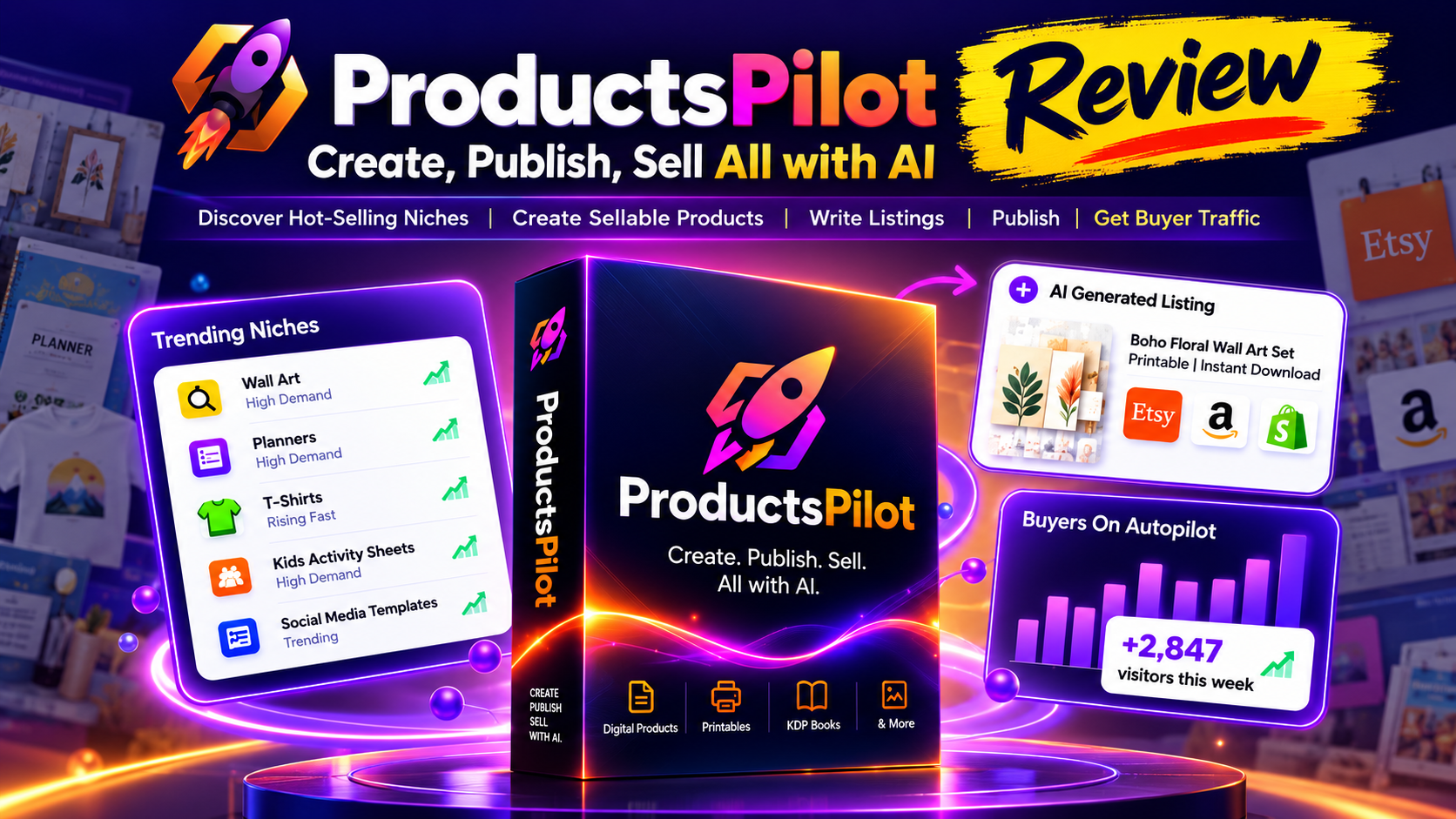
An AI-powered platform designed to help users discover product opportunities, create digital products, generate listings, publish them, and work toward attracting buyer traffic.
ProductsPilot Review: Who Created ProductsPilot?
Meet the Creator Behind ProductsPilot
Learn more about the person behind ProductsPilot and the platform featured in this ProductsPilot Review 2026.

Abhi Dwivedi
Abhi Dwivedi is the creator associated with ProductsPilot, an AI-powered platform focused on helping users discover digital product opportunities, create products, generate listings, publish them, and work toward attracting buyer traffic.
ProductsPilot Review: FE VSL, Demo & Webinar Recording Videos Of ProductsPilot
Explore the ProductsPilot video resources below, including the front-end VSL, platform demonstration, and full webinar recording. Watch them in sequence to get a better understanding of the platform, its workflow, and the features presented in the promotional materials.
01 ProductsPilot FE VSL
Continue with the front-end video sales letter to learn more about ProductsPilot, its core proposition, and the features highlighted in the promotional presentation.
02 ProductsPilot Demo
Watch the ProductsPilot demo to see the platform in action and get a visual overview of the workflow and functionality presented in the demonstration.
03 ProductsPilot Webinar Recording
Finish with the full ProductsPilot webinar recording for a longer-form presentation covering the platform and the material presented during the webinar.
ProductsPilot Review: What Is ProductsPilot?
ProductsPilot is a web application that automates the creation and promotion of digital downloads. Think printable wall art, planners, wedding invitations, worksheets, PDF guides, and craft files. It runs in a browser, so nothing needs installing.
The vendor describes it as an “AI Product-To-Payday engine.” Marketing language aside, the practical description is simpler. You choose what to make, and the software generates a full product package around that choice.
The package is not a single image. According to the documentation, it includes a matching set of pieces, print files in the sizes buyers commonly ask for, lifestyle mockups, a ZIP file with a usage guide, and written listings for your chosen marketplaces.
What separates it from a plain image generator is the second half. After the product exists, a module called Traffic Builder creates promotional assets and distributes some of them across channels like Pinterest and Google Web Stories.
The whole system is organized around four “agents”: a Research Agent, a Design Agent, a Listing Agent, and a Traffic Agent. We break each one down later in this ProductsPilot Review.
One important framing point. ProductsPilot does not sell you a business. It sells you a production and promotion tool for a business model that already exists. Selling digital files on marketplaces is a real, established activity, but the results depend on your niche, your consistency, and market conditions.
That distinction matters when you read the phrase “passive income digital products.” A file can indeed sell repeatedly without being remade. But “passive” describes the fulfilment, not the effort of finding buyers. Keep that difference in mind as you read on.
ProductsPilot Review: The Market ProductsPilot Is Built For
To judge any tool, you need to understand the market it serves. Digital products, meaning files a customer downloads rather than receives by mail, are a genuine and growing category.
The sales page cites Mordor Intelligence figures placing the global digital goods market at about $124.32 billion in 2025, with a forecast of roughly $511.43 billion by 2031. It also cites Etsy’s own reporting of 93.5 million active buyers.
Market forecasts should always be read with caution. They are projections, and different research firms define “digital goods” differently. Still, the direction is consistent across sources: digital downloads are a sizeable, established segment of online commerce.
If you want to understand how search visibility and marketplace demand interact, Google’s own SEO Starter Guide is a solid, neutral primer. Marketplace listings live or die on discoverability, so it is worth a read.
For a broader view of how content and digital offers fit into marketing strategy, the HubSpot Marketing Blog publishes regular, practitioner-level guidance that is useful context for anyone entering this space.
One caution the sales page itself hints at: Etsy’s seller count reportedly grew faster than its buyer count. More sellers chasing similar demand means competition is real. A tool that speeds up production does not remove competition. It only lets you enter the race faster.
For anyone who wants to sell digital products on Etsy, that competitive reality is the single most important thing to absorb before spending money on any tool, this one included.
ProductsPilot Review: The Fee Arithmetic Behind Digital Products
The most persuasive argument in the launch materials is the margin math. It is worth examining because it is verifiable rather than hyped.
Etsy’s published fee structure includes a $0.20 listing fee and a 6.5% transaction fee, plus payment processing. You can confirm the current figures on Etsy’s official fees page, and you should, because fee schedules change.
On a $20 download, the transaction fee is $1.30 and the listing fee is $0.20. Add payment processing and the seller keeps roughly $18. Nothing was manufactured, shipped, or stocked, so there is no cost of goods to subtract.
That is a real structural advantage over physical products. The same file can sell repeatedly without any additional production cost.
The honest counterpoint: the margin is high, but volume is not automatic. A file with a 90% margin that sells zero copies earns zero dollars. The math is only attractive if buyers actually find and purchase the product.
That gap between margin and sales is exactly where the traffic and listing quality matter. It is also where most first-time digital sellers struggle, and where ProductsPilot aims its features.
ProductsPilot Review: How ProductsPilot Works – The Four-Step Workflow
The vendor’s workflow is intentionally short. Understanding it helps you decide whether the promised simplicity is realistic.
Step 1: Pick a niche
The app opens on a list of niches scored for demand and competition. You can choose the top recommendation, sort the list yourself, or type a custom idea for live analysis. The vendor says custom niche analysis takes about ten seconds.
The concept is sensible. Many beginners fail by producing something nobody searches for. A scoring layer at least forces a moment of validation before production begins.
The caveat: we do not know the data sources behind these scores. The documentation does not explain how “demand” is calculated. Treat the scores as a helpful starting signal, not a guarantee.
Step 2: Pick a look
Next, you see four style directions rendered as actual pictures. Palette, layout, typography, and mood are coordinated across the set. You can re-roll for new options as often as you like, according to the sales page.
This is the design decision the whole product is built around. You are choosing between finished options, not writing prompts. For non-designers, that is a meaningful reduction in friction.
Step 3: Wait for generation
The vendor says about four minutes of machine time. The product assembles itself: a matching set, print files, mockups, a ZIP package, and listings.
Generation time will vary with server load, especially during launch week. The vendor itself notes a priority queue on the Unlimited upgrade “under launch load,” which quietly implies that front-end users may wait longer at peak times.
Step 4: Publish and promote
For Gumroad, publishing is one click through an API. For Etsy and other platforms without a suitable publishing API, you receive a finished listing pack and paste it in yourself, which the vendor estimates at about three minutes.
Then Traffic Builder begins working the seven channels. We cover those in detail below.
Overall, the workflow is short and logical. Whether output quality matches the promise is something each buyer will need to judge from real samples.
ProductsPilot Review: Meet the Four AI Agents
The vendor organizes the product into four agents. This is partly a marketing framework, but it also maps neatly onto the real steps of running a digital product shop.
Agent 1: The Research Agent
This agent handles niche discovery. Its documented features include an unlimited-use Niche Finder, seasonal intelligence, idea validation, and competition scoring.
The seasonal piece deserves a mention. The sales page notes that in September the tool pushes Christmas and Q4 categories, because listings need time to be indexed before a season arrives. That reflects real marketplace behavior. Seasonal products usually need to be live well ahead of peak buying.
Idea validation lets you enter your own niche and see it scored before you invest time. Competition scoring is meant to steer you away from the most crowded categories on day one.
Our honest view: research tooling is only as good as its underlying data. Without visibility into the data source, we would treat the scores as directional. Cross-check promising niches manually on the marketplace itself before committing.
Agent 2: The Design Agent
This is the production engine. It generates a coordinated set of pieces from a single locked style seed, so the items look like they belong together. The vendor emphasizes that cohesive sets sell for more than random single images.
Documented output details include print-shop resolution exports, US Letter and A4 versions where relevant, bleed and trim marks on print items, and working hyperlinked tab navigation in digital planners. A sizing guide is written into every ZIP.
These details matter more than they sound. Wrong paper sizes, missing bleed, and low resolution are common causes of buyer complaints in printable categories. If the tool genuinely handles them, that reduces refund risk.
The sales page states that the sample products shown were made with the standard image engine, on the same plan being sold. That is a fair and useful disclosure, because it sets expectations about quality on the $37 tier.
You can also remake any single piece without rebuilding the whole product, according to the vendor. That is a practical feature if one image in a set looks off.
Agent 3: The Listing Agent
Once a product exists, the Listing Agent creates lifestyle mockups by compositing your product onto licensed scene photography. It also writes the listing title, description, tags, category, and attributes for each marketplace, and suggests a price band.
Mockups are arguably the most underrated element. On a marketplace, the first image largely decides whether anyone clicks. Beginners often upload a flat picture of a PDF and wonder why nothing happens.
The agent also runs trademark screening against USPTO data before a listing can go live. You can explore the official database yourself at the USPTO trademark search to understand what this check is guarding against.
It also writes the Etsy AI disclosure into the listing, which we discuss further in the compliance section.
Price bands are “based on what the category actually sells at.” Again, we would like to see the data source, but suggested ranges are a helpful guardrail against underpricing out of nervousness.
Agent 4: The Traffic Agent
The fourth agent drives the Traffic Builder module. It is the feature most heavily emphasized in the launch materials, and the one that most distinguishes ProductsPilot from a plain design tool. We give it its own section below.
ProductsPilot Review: The Nine Product Types
ProductsPilot covers a broad range of digital product categories. Eight are on the front end, and a ninth is an upgrade.
Front-end categories
- Wall art: quote prints, botanical, abstract, line art, nursery art, affirmations, seasonal. Typically 12 to 20 pieces.
- Planners: daily, weekly, monthly, budget, meal, fitness, habit, gratitude. Roughly 15 to 40 pages.
- Templates: social kits, pin sets, resumes, invoices, proposals, price sheets, decks. About 10 to 20 pieces.
- Invitations: wedding suites, birthdays, showers, graduations, menus, place cards, signage. Usually 6 to 12 pieces.
- Kids and education: coloring pages, worksheets, flashcards, chore and reward charts. About 15 to 30 pages.
- Digital planners: hyperlinked GoodNotes and iPad planners with working tab navigation, 30 to 60 pages.
- PDF reports and guides: mini-guides, checklists, workbooks, lead magnets.
- Craft files: SVG cut files for Cricut and Silhouette, digital papers, patterns, clipart, stickers.
Upgrade category
- Low-content books: puzzle books, coloring books, journals, and logbooks, with an interior and a KDP-ready cover. This is only available via the Elite Marketplace Multiplier upgrade.
A clarification the vendor itself asks affiliates to make, and one we support: Amazon KDP low-content books are not part of the $37 front end. The sales page lists “KDP Book Interiors” in a gallery of sellable products, which could confuse a skimming reader. Buyers wanting that category should plan for the upgrade.
The vendor also states that the templates category ships as finished print-ready files, not editable Canva templates. If you specifically want editable Canva-style templates, this is important to know before buying.
Breadth is a genuine strength. When one niche cools off, you can move to a different category the same afternoon. Diversification within digital products lowers the risk of betting everything on a single trend.
ProductsPilot Review: Marketplaces and Publishing Options
ProductsPilot organizes selling destinations into tiers, and understanding which sits where avoids surprises.
On the front end: Gumroad and Etsy. Gumroad supports one-click publishing through its API. Etsy receives a written listing pack, staged field by field, which you paste yourself. You can review Gumroad’s pricing and fees before deciding how it fits your plan.
On the Elite Marketplace Multiplier upgrade: Shopify and Printify publishing, plus written listings for Amazon KDP, Teachers Pay Teachers, Creative Market, Design Bundles, Payhip, and Notion.
With no marketplace at all: you own the files with full commercial rights, so you can sell from your own website, email list, or social bio.
One trust point is worth highlighting. The vendor says ProductsPilot never logs into your marketplace accounts and never asks for a marketplace password. Where a proper publishing API exists, it uses it. Otherwise you paste the listing yourself.
We consider this a sensible design. Tools that ask for marketplace credentials introduce account-security risk. Keeping you in control of your own shop is safer, even if the Etsy step is slightly manual.
The trade-off is convenience. If you hoped for fully automatic Etsy publishing, that is not what is offered. Budget a few minutes per listing for the manual step.
ProductsPilot Review: Traffic Builder – The Seven Channels Examined
Traffic Builder is included in the front end and is the headline differentiator. It is also where we advise the most careful reading, because the sales page and the JV document describe it slightly differently.
The JV document draws a clear line: five channels run automatically, and two are “find-and-draft.” We rely on that more precise description throughout this section.
1. AI-driven social micro-content (automated)
The tool turns each product into image and caption packs for Instagram, Facebook, X, LinkedIn, and Threads, sized for each platform. The sales page says it is “posted on a schedule,” while the JV document frames it as ready-to-post packs. The exact posting mechanics may differ, so confirm inside the app.
2. AI-generated Pinterest pins and boards (automated)
The system creates a board, then builds 8 to 12 pins per product, each pairing a different piece with a different search-led headline. It then drips them out toward your live listing.
Pinterest is a legitimate fit for printables. The sales page cites Pinterest reporting of 619 million monthly users and more than 80 billion monthly searches. You can learn how the platform works for businesses on the Pinterest for Business site. This is the core of the Pinterest traffic automation appeal.
3. Automated Google Web Stories (automated)
The tool builds a Google Web Story from your product artwork and publishes it. Web Stories can appear in Google Discover and some Search results. Google documents the format in its Web Stories guidance.
Eligibility to surface is not the same as guaranteed visibility. Treat this as a low-cost extra lane, not a promise of traffic.
4. Automated PDF guides (automated)
The system generates a free, useful guide tied to your product, such as a styling guide or a budget reset, that links back to your listing. It then distributes the guide to document-sharing sites. It can double as a lead magnet.
5. Automated video syndication (automated)
Product mockups become a short vertical video, syndicated to YouTube Shorts, Instagram Reels, TikTok, and Pinterest video. No filming is needed.
6. AI-powered Q&A outreach (find-and-draft)
The AI locates questions on Quora, Reddit, and niche forums where your product is a relevant answer, then drafts a reply. You read it, edit it, and post it yourself.
7. AI-enhanced link-building and guest posting (find-and-draft)
The AI finds relevant blogs and resource pages, then drafts the outreach email and a guest article. You send it.
The distinction between automated and drafted channels matters. The sales page mentions that outreach channels “draft and you approve what goes out.” That is the responsible design. Auto-posting into forums often violates platform rules and can get accounts banned.
We want to be direct about a reasonable expectation. Automated distribution generates activity, not guaranteed sales. Traffic from pins, stories, and short videos tends to build gradually, and results vary widely by niche and quality.
Still, packaging seven promotional workflows into the front-end price is a legitimately unusual value. Most creation tools stop when the file is finished, and that is where many new sellers stall.
ProductsPilot Review: Why the File Quality Details Matter
The vendor repeatedly stresses print-file quality, and this is a point where we largely agree with the emphasis. In printable categories, technical mistakes drive refunds and bad reviews more than design taste does.
Consider the list of documented specifications. Print-shop resolution avoids fuzzy output. Both US Letter and A4 formats serve American and international buyers. Bleed and trim marks matter for invitations sent to a printer. Working hyperlinks matter in digital planners, where a picture of tabs is useless.
Computed spine widths on KDP covers, available on the marketplace upgrade, address another classic beginner error.
A sizing guide inside every ZIP is a small touch with real value. Buyers who understand what they downloaded contact support less and refund less.
The important caveat is that we have not opened these files ourselves. We are describing documented specifications, not verified output. The best step for any buyer is to generate a first product during the refund window and inspect the files at full size, print one, and check the tab links.
ProductsPilot Review: Compliance and Safety Features
New sellers often get into trouble not because of poor products, but because of policy mistakes. ProductsPilot builds in two protections worth understanding.
Trademark screening
Before a listing can go live, the tool checks it against USPTO trademark data. If something is flagged, the vendor says a safe alternative is supplied. Listing content that infringes a mark is a common cause of shop suspensions.
Trademark screening reduces risk but cannot eliminate it. USPTO data covers US registrations, and other jurisdictions and unregistered marks exist. Treat the check as a helpful filter, not a legal clearance.
Etsy AI disclosure
Etsy expects sellers to disclose AI-assisted items. The sales page says ProductsPilot writes that disclosure into the listing automatically. Etsy publishes its expectations in its Creativity Standards, and policies evolve, so read them yourself.
A reasonable worry is whether disclosure hurts sales. The vendor argues that buyers of printables care more about whether the file looks right and prints cleanly. That argument is plausible, but we have no data to confirm it either way.
The vendor also candidly acknowledges platform risk in its own FAQ, stating that anyone claiming zero platform risk is not being straight. We appreciated that honesty. Marketplace rules can change, and a shop can be closed.
The vendor’s mitigations are sensible: files live in your account, you sell on two platforms from day one, and the same products can be listed elsewhere.
ProductsPilot Review: Ownership and Commercial Rights
ProductsPilot states that you receive full commercial rights on everything you create. That means you can sell, bundle, and price files however you like, with no royalties or revenue share.
The sales page also says files remain yours permanently, with product history, re-download access, and bulk ZIP export. Cloud-based tools always carry some dependency risk, so exporting your files regularly is smart practice.
One separate point: the sales page mentions a bonus commercial license allowing you to sell ProductsPilot’s product-building services to others. The exact scope and terms of that license should be read in the vendor’s Terms of Service before you plan a service business around it.
Owning the output outright is important for sellers who want to build a brand beyond a single marketplace. It means an account suspension does not erase your catalogue.
ProductsPilot Review: Key Features Summary
- AI-Powered Product Discovery: Discover digital product opportunities and potential niches with AI-assisted research.
- Digital Product Creation: Create digital products with AI-assisted tools and workflows.
- AI-Generated Product Listings: Generate product listing content designed to help present digital products for sale.
- Product Publishing: Publish created digital products through the platform’s supported workflow.
- Buyer Traffic Tools: Access features focused on attracting potential buyers to published products.
- AI-Assisted Workflow: Bring product research, creation, listing, publishing, and promotion-related activities into one workflow.
- Multiple Digital Product Opportunities: Explore different types of digital products and potential market opportunities.
- Beginner-Friendly Approach: Designed to simplify several steps involved in creating and selling digital products.
- Integrated Product Workflow: Move from product idea and creation toward listing, publishing, and buyer acquisition within the broader platform workflow.
- All-in-One Platform Concept: Combines several digital product creation and selling activities within a single ProductsPilot environment.
ProductsPilot Review: ProductsPilot Pricing and Funnel Breakdown
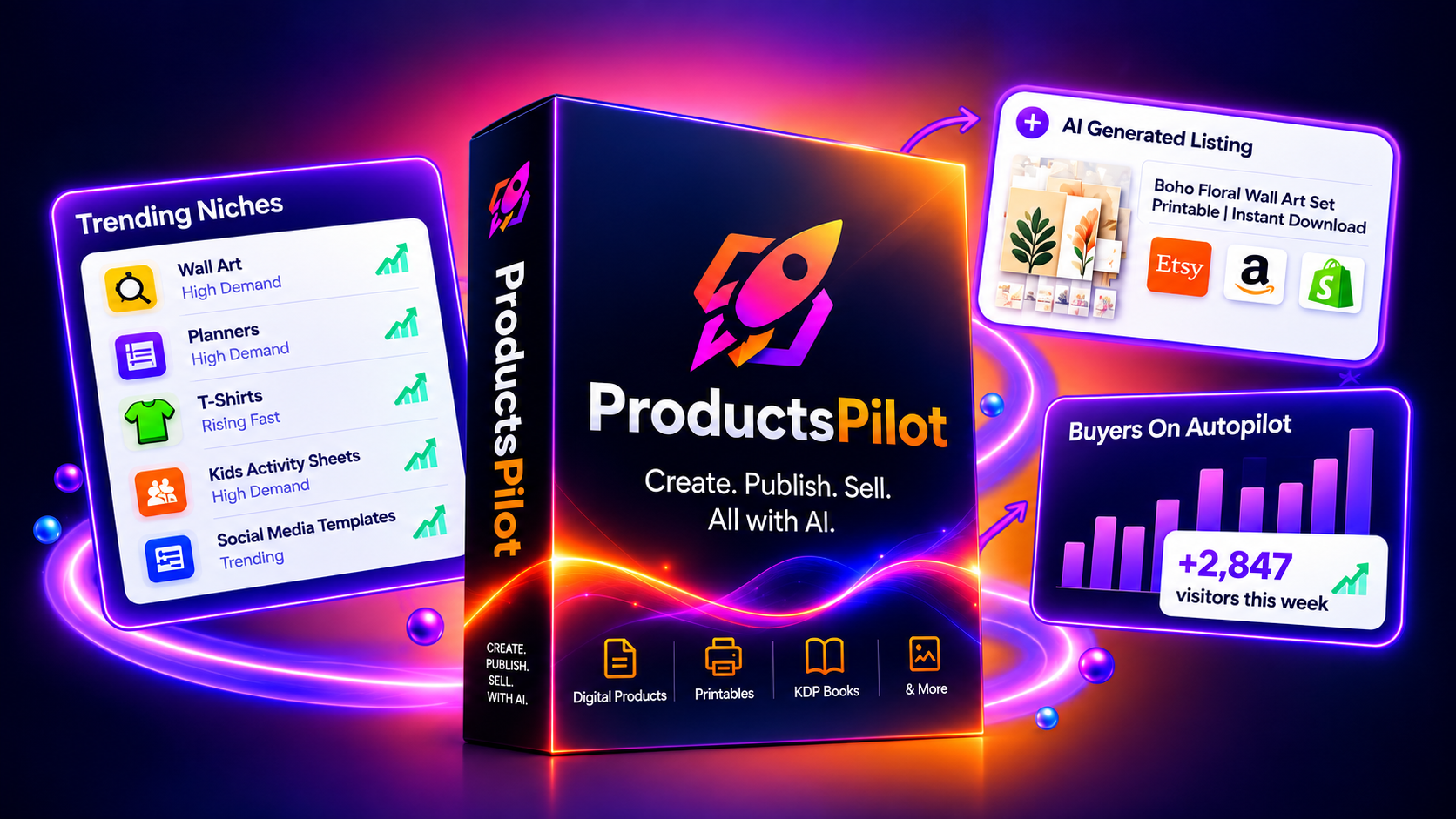
ProductsPilot is offered through a front-end purchase followed by optional upgrades, bundles, agency features, marketplace expansion options, and lifetime access. The prices and product descriptions below are based on the supplied ProductsPilot funnel details.
ProductsPilot
$37- AI Agents: Includes 4 AI agents for the core ProductsPilot workflow.
- Product Types: Supports 8 digital product types.
- Monthly Capacity: Allows up to 15 products per month.
- Shop Access: Includes access for up to 2 shops.
- Core Purpose: Provides the entry-level ProductsPilot environment for creating and working with digital products.
FastPass
$230/Yr- Upgrade Access: Includes all 4 listed ProductsPilot upgrades.
- Bonus App Licenses: Includes 3 bonus app licenses.
- Bonuses: Includes all bonuses associated with the FastPass offer.
- Funnel Position: Offered immediately after the front-end purchase.
- Annual Pricing: The supplied funnel lists the price at $230 per year.
Gold DFY Vault
$197- Finished Products: Includes a collection of 500 finished digital products.
- DFY Positioning: The offer is designed around ready-made product assets rather than requiring every product to be created from scratch.
- Eligibility: Available only to FastPass, Bundle, and Lifetime buyers.
- Offer Type: Presented as a separate paid vault within the ProductsPilot funnel.
Unlimited
$67/Yr- Unlimited Products: Removes the standard product quantity limitation described in the front-end offer.
- Premium Engine: Adds access to the premium engine.
- Bulk Functionality: Adds bulk capabilities for handling product-related tasks.
- API Access: Includes API functionality.
- Annual Pricing: The supplied funnel lists the upgrade at $67 per year.
Diamond Storefront
$97/Yr- Branded Shop: Provides a branded storefront for presenting products.
- Buyer Capture: Includes functionality intended to capture buyer information.
- Marketplace Cut: The supplied description states that the storefront has no marketplace cut.
- Storefront Focus: Designed for users who want a more direct branded selling environment.
- Annual Pricing: Listed at $97 per year.
Platinum Agency
$97/Yr- Multiple Shops: Supports up to 25 shops.
- White-Label: Includes white-label capabilities for agency-oriented use.
- Client Reports: Provides client reporting functionality.
- Team Access: Includes access designed for team-based workflows.
- Agency Focus: Intended for users managing multiple storefronts or client projects.
- Annual Pricing: Listed at $97 per year.
Elite Marketplace Multiplier
$67/Yr- KDP: Adds KDP low-content publishing capabilities.
- Additional Marketplaces: Includes access to 7 more marketplaces according to the supplied funnel description.
- Marketplace Expansion: Focuses on extending product distribution beyond the core ProductsPilot selling environment.
- Publishing Focus: The offer is particularly relevant to users interested in additional publishing and marketplace channels.
- Annual Pricing: Listed at $67 per year.
Bundle Deal
$317/Yr- Annual Bundle: Provides a bundled annual ProductsPilot offer.
- Direct Purchase: The supplied link takes visitors directly to the bundle offer.
- Bundle Contents: The exact included components should be confirmed on the current bundle offer page before purchase.
- Discount Eligibility: The supplied coupon code PILOT is associated with a $50 discount on the eligible annual bundle offer.
- Annual Pricing: Listed at $317 per year before any applicable discount.
Lifetime Bundle
$497- One-Time Payment: The offer is listed as a single upfront payment.
- No Renewal: According to the supplied funnel description, the lifetime offer does not require recurring renewal.
- Long-Term Access: The offer is structured for buyers seeking lifetime access rather than annual billing.
- Direct Offer: The supplied link leads directly to the Lifetime Bundle offer.
- Pricing: Listed at $497 as a one-time payment.
MegaBundle
$77- Order Bump: Presented as an additional purchase option on the ProductsPilot bundle pages.
- Bundle Extension: Designed to supplement the main bundle purchase.
- Purchase Location: Available through the supplied bundle-page order-bump link.
- Pricing: Listed at $77.
- Included Items: The exact contents should be confirmed on the current checkout page before purchase.
ProductsPilot is presented with a 14-day money-back guarantee. Review the current purchase terms for the exact conditions that apply to your order.
ProductsPilot Review: Pricing and Value – An Honest Calculation
Let us look at the numbers without the hype.
At $37, the front end costs less than most single design-tool subscriptions for one month. If it produces even one sellable product that earns back the price, the payback is quick.
The sales page benchmarks against freelancers at $25 to $150 per hour and Pinterest virtual assistants at $600 to $900 per month. Those comparisons are cited to DDIY 2026 pricing guides. They make a fair point about the cost of outsourcing.
But there is a subtle issue. The comparison assumes you would have hired those people. Many beginners would not have. For them, the real comparison is not “ProductsPilot versus a freelancer” but “ProductsPilot versus doing nothing.”
The vendor also states the price rises in stages during launch and moves to monthly pricing afterward. The sales page says what you buy at launch stays one-time. That claim is only verifiable through the vendor’s terms.
The full-funnel path is a different story. Front end plus FastPass plus the Vault, or the Bundle plus the Vault, reaches into the hundreds of dollars, with annual renewals. Those costs need to be justified by real sales, not projected ones.
Our practical advice: start with the front end only. Use the 14-day refund window to test. Upgrade later only if you hit a specific limit you can name.
A simple break-even example
Suppose you price one product at $10 on Etsy. After the $0.20 listing fee and a 6.5% transaction fee, you keep roughly $9.15 before payment processing, which varies by region.
At that rate, recovering the $37 front-end price takes a handful of sales, not hundreds. That is a low bar in principle.
The catch is that those handful of sales still have to happen. Break-even depends on listing quality, traffic, and niche demand, none of which any tool can promise. Use the example as a planning aid, not a forecast.
ProductsPilot Review: The Bonuses
The front end includes five bonuses, valued by the vendor at a combined $1,785. We treat those “values” as marketing figures, not market prices.
- Red-Carpet Live Profit Workshop: a single live session walking through niches, pricing, and realistic first-month expectations. A recording is provided.
- 30 Proven Niche Blueprints: thirty researched niches with demand picture, price band, seasonal spikes, and style direction.
- The Listing Vault: listing patterns, title structures, tag groupings, and description frames per category.
- Founding Members Community: a private group for owners to compare what is selling.
- The First 30 Days Checklist: a one-page day-by-day plan.
The most practical of these are the niche blueprints and the checklist. They reduce decision paralysis, which is the actual bottleneck for many beginners.
The workshop’s date is described only as “shortly after launch,” so confirm timing after purchase.
If you buy through an affiliate, you may also see extra bonuses from that affiliate. Evaluate those on whether they fill gaps rather than duplicate features.
ProductsPilot Review: Scrutinizing the Claims
An honest review must look critically at the marketing. Here is where we slow down.
The income examples
The sales page displays several third-party success stories, such as people who reportedly earned tens or hundreds of thousands selling digital products. These are not ProductsPilot users. They illustrate the wider market, not this software’s results.
The vendor’s own JV documentation is refreshingly direct. It states that ProductsPilot has no access to anyone’s marketplace sales data, so no income projections are published, and affiliates are asked not to invent any. We fully agree with that stance.
The sales page also includes a headline asking, “What if you could make an extra $1000-3000 per month.” That is phrased as a hypothetical, but it still nudges expectations. Readers should treat it as aspiration, not forecast.
The case study
The sales page presents Cody Berman, who opened a printables shop in August 2024. It says his first month brought in $185, and that he passed $1,000 a month on day 116 with over 350 listings. These figures are the vendor’s presentation of a public case.
It is an instructive story precisely because it is modest. It shows a slow build driven by listing volume, not overnight success. The page itself warns that anyone showing ten thousand dollars in week one is selling something untrue.
That candor is credible. But it also means realistic timelines are measured in months, and the person in that case still created hundreds of listings.
The beta testers
The testimonials from beta testers, such as Marcus T. and Sarah K., describe fast setup and good files. They are vendor-supplied and cannot be independently verified. Read them as illustrative, not conclusive.
The “world’s first” language
Phrases like “world’s first AI Product-To-Payday engine” are promotional. We have no way to verify uniqueness claims, and we do not rely on them in our assessment.
ProductsPilot Review: Inconsistencies We Found in the Materials
We reviewed the sales page and the JV document side by side. Several details do not match. None is fatal, but you should verify them at checkout.
Bundle contents. The sales page describes the Bundle with items like “Profit Engine,” “Agency Unlimited,” and “Turbo Growth.” The JV document lists Unlimited, Diamond Storefront, Platinum Agency, and Elite Marketplace Multiplier. These are different upgrade names and features.
Etsy sales figure. One page cites $10.46 billion in marketplace sales for 2025, while another mentions $11.9 billion. These may measure different things, but the sources should be clarified.
Cart close time. One document says 11:59 PM ET and another says 11:59 PM PT.
KDP on the front end. A product gallery on the sales page lists “KDP Book Interiors,” while the JV document says KDP is not on the front end.
Traffic Builder wording. Some sales-page lines imply automatic sending for outreach and link-building, while the JV document says they are draft-only. We trust the more conservative JV description.
Discount language. Both “72% off” and “73% off” appear, and the sales page says the front end has no coupon while the price rises in stages.
Sales-page duplication. One of the four workflow steps appears to be repeated word for word, which suggests the page was assembled quickly.
These issues are common in fast-moving launches, and they do not by themselves indicate bad faith. But they reinforce a simple rule: rely on the checkout page and the vendor’s support desk for final answers, not on any single marketing document.
ProductsPilot Review: ProductsPilot Advantages – What It Does Well
Now that we have covered the features, let us pull the strengths together in one place. Each advantage below is based on documented capabilities, and we note the limit of each one.
1. It covers the whole workflow in one place
Most beginners juggle a niche research tool, an image generator, a listing writer, a mockup app, and a scheduler. ProductsPilot puts research, creation, listing, and promotion in one dashboard.
That reduces the number of logins, exports, and file conversions. For someone who gets overwhelmed by tool stacks, that consolidation is a real advantage.
2. The entry price is low and the risk is limited
At $37 one-time with a 14-day guarantee, the cost of testing is small. Compared with many AI tools that charge monthly from day one, the front end is easy to justify as an experiment.
The refund window matters most. It gives you time to generate a real product and judge the output before your money is fully at stake.
3. It targets a proven, understandable business model
Selling downloadable files is not a speculative new idea. Marketplaces already host huge printable and template categories, and buyers already understand what they are getting.
That means you are not asking customers to learn anything new. The offer is simple: a file, a price, and an instant download.
4. Products are sets, not single images
Cohesive collections tend to look more professional than random one-off images. ProductsPilot builds matching sets from a locked style seed, so the pieces share a palette and layout.
For shoppers browsing a crowded results page, a coordinated set signals effort. It also supports bundle pricing, which can lift the average order.
5. Technical print details are handled
Correct resolution, both paper sizes, bleed and trim marks, working planner links, and a sizing guide are all documented. These are unglamorous details, yet they are what prevent complaints.
If the output matches the specification, you avoid the classic beginner trap of shipping a file that will not print properly.
6. Listings are written for you
Writing a title, description, and tags that suit each marketplace is a skill in itself. The Listing Agent produces those fields, suggests a price band, and lays them out in the order the marketplace expects.
That saves time on every product. It also gives beginners a reasonable starting structure they can edit and improve.
7. Mockups remove a big barrier
Lifestyle mockups composited onto licensed scenes save you from staging photos or learning design software. On a marketplace, the first image drives clicks, so automatic mockups address a genuinely important step.
8. Traffic is part of the package
The most distinctive advantage is that promotion is not left entirely to you. Pinterest pins, Web Stories, PDF guides, video, and social packs are generated from your product artwork.
Many creation tools stop at the file. Including a promotion layer at the front-end price tackles the point where many new sellers give up.
9. Compliance is taken seriously
Trademark screening and automatic Etsy AI disclosure reduce two common causes of shop trouble. The vendor also avoids asking for your marketplace passwords, which limits account-security risk.
These are not exciting features, but they protect the business you are trying to build.
10. You keep ownership and flexibility
Full commercial rights, permanent access to your files, and bulk export mean the assets belong to you. You can sell on marketplaces, on your own site, or to your own list.
Ownership also lets you diversify away from any single platform if its rules change.
11. It supports many niches and categories
Eight categories on the front end let you spread risk. If wall art slows down, you can pivot to planners or worksheets without buying a different tool.
Seasonal intelligence also helps you plan ahead for holiday demand rather than arriving late.
12. The vendor is reasonably candid about limits
The JV documentation says plainly that no income projections exist and that affiliates should not invent any. The sales page also admits platform risk and shares a modest, slow-build case study.
That candor does not make the product perfect, but it is a healthier sign than blanket guarantees.
ProductsPilot Review: ProductsPilot Disadvantages – Where It Falls Short
A fair review gives the weaknesses equal space. These are the drawbacks we would want any buyer to consider before purchasing.
1. We cannot verify output quality from documents alone
This review relies on the sales page and JV materials. We have not generated products ourselves, so we cannot vouch for image quality, mockup realism, or file accuracy.
Sales pages show best-case samples. Your own first product is the only reliable test, which is why the refund window matters so much.
2. Standard image quality has a ceiling
The front end uses the standard image engine. The premium model is reserved for the Unlimited upgrade, which the vendor says delivers a visible improvement.
If your niche depends on high-end artwork, such as premium wedding suites, you may feel pushed toward the paid tier.
3. Monthly limits can constrain volume sellers
Fifteen products a month is decent for a beginner, but the model rewards volume. The sales page’s own case study involved more than 350 listings.
Sellers who want to scale quickly will hit the cap and face the Unlimited upgrade decision.
4. Etsy publishing is manual
Etsy has no publishing path here, so you paste each listing yourself. It takes about three minutes according to the vendor, but that adds up across dozens of products.
If you were hoping for hands-off Etsy uploads, this will disappoint.
5. Two of seven traffic channels need you
Q&A outreach and guest-post outreach only find opportunities and draft the text. You must review and send them. That is the responsible design, but it is not fully automated as some sales-page wording suggests.
6. Automated traffic does not guarantee sales
Pins, stories, and short videos can take time to gain traction, and results vary widely. Activity is not the same as buyers. Beginners who expect quick sales may feel frustrated.
7. The funnel is long and includes recurring charges
FastPass, Unlimited, Diamond Storefront, Elite, and the Bundle are billed annually. It is easy to click through several offers without noticing the renewal terms.
Read every checkout page carefully and total the yearly cost before agreeing to anything.
8. The Gold DFY Vault is gated behind FastPass
The Vault is only shown to FastPass, Bundle, and Lifetime buyers. That is a sales tactic that may make you feel you must buy the bigger package to access it.
You do not have to. Decide based on whether pre-built products fit your plan.
9. Documents contradict one another
We found mismatches about bundle contents, KDP availability, Etsy revenue figures, cart-close timezone, and discount percentages. Small inconsistencies undermine confidence, even if they are honest slips.
10. Templates are not editable
The templates category delivers print-ready files, not editable Canva files. Buyers who expect customizable templates may be disappointed.
11. It depends on third-party marketplaces
Etsy and Gumroad set the rules, fees, and search algorithms. Policy changes on AI-generated content, listing limits, or fees could affect your results at any time.
The vendor itself acknowledges this risk, and no software can remove it.
12. AI-generated art is a crowded space
Because generating images is now easy, many sellers use similar tools. Differentiation through niche selection, style, bundling, and branding matters more than raw speed.
ProductsPilot helps you produce quickly, but it cannot guarantee you stand out.
13. Data sources are not disclosed
Demand scores, competition scores, and price bands are central to the pitch, yet the underlying data sources are not explained. Without that transparency, we treat them as helpful hints, not facts.
ProductsPilot Review: Pros & Cons Summary
ProductsPilot brings several digital product creation and selling activities into one platform, but there are also some limitations and points worth considering before choosing an offer.
Pros
- Combines product discovery, creation, listing, publishing, and buyer-traffic related activities in one workflow.
- Includes AI agents designed to assist with the core ProductsPilot workflow.
- The front-end offer includes 8 digital product types and up to 15 products per month.
- The front-end package includes access for up to 2 shops.
- Multiple upgrade options allow users to expand product capacity, storefront functionality, agency features, and marketplace distribution.
- The Gold DFY Vault provides 500 finished digital products for eligible FastPass, Bundle, and Lifetime buyers.
- The Lifetime Bundle is presented as a one-time payment option without recurring renewal.
- A 14-day money-back guarantee is presented with the offer.
- The supplied funnel includes a $50 discount opportunity on the eligible annual bundle using coupon code PILOT, subject to the current offer terms.
Cons
- The front-end package has a stated limit of 15 products per month.
- Several useful capabilities are positioned behind additional paid upgrades.
- The funnel can become considerably more expensive if you want access to multiple upgrades and bundle options.
- Some advanced features, such as unlimited products, premium engine access, bulk functionality, and API access, require the Unlimited upgrade.
- Agency-oriented functionality such as 25 shops, white-label capabilities, client reports, and team access requires the Platinum Agency upgrade.
- The Gold DFY Vault is restricted to FastPass, Bundle, and Lifetime buyers according to the supplied offer details.
- The exact contents of some bundle and order-bump offers should be checked on the current checkout page before purchase.
- Marketplace expansion through KDP and additional marketplaces is presented as part of the Elite Marketplace Multiplier upgrade rather than the basic front-end offer.
- Users should evaluate the recurring annual costs of upgrades against how frequently they expect to use the additional functionality.
ProductsPilot Review: Comparison With Alternatives
ProductsPilot vs. Other Digital Product Platforms
The following comparison places ProductsPilot alongside several established platforms that can also be used to create, publish, or sell digital products. These alternatives are included for comparison purposes and are not reviewed on RidhTekReviews.Com.
| Platform | Primary Focus | Digital Products | Storefront / Selling | Marketing Features | Key Difference From ProductsPilot |
|---|---|---|---|---|---|
| ProductsPilot AI Product Workflow | AI-assisted product discovery, creation, listings, publishing and buyer-traffic related workflow. | Supplied offer includes 8 digital product types with up to 15 products per month on the front-end plan. | Front-end offer includes up to 2 shops, with additional storefront options available through upgrades. | Buyer-traffic tools and additional marketplace-related functionality are included across the supplied offer and upgrades. | The supplied positioning focuses on bringing several product creation and selling activities into a single AI-assisted workflow. |
| Gumroad Creator Commerce | Selling digital products, memberships, courses and other creator-focused products. | Supports digital downloads, ebooks, courses, memberships and software-related products. | Provides storefront creation, customizable pages, custom-domain support and checkout options. | Includes discounts, affiliates, email broadcasts, automated workflows and sales analytics. | Gumroad is primarily a commerce and creator-selling platform, while ProductsPilot’s supplied positioning emphasizes AI-assisted product discovery and creation as well as selling workflow. |
| Payhip Digital Commerce | Selling digital downloads, courses, coaching, memberships and other products. | Supports ebooks, software, video, audio, design assets and other digital files. | Provides a store builder, custom-domain support, checkout tools and the ability to sell through a website or social channels. | Includes affiliates, coupons, referral discounts, email updates and mailing-list integrations. | Payhip focuses on providing the infrastructure for selling and delivering products, whereas ProductsPilot’s supplied offer emphasizes AI-assisted product research and creation. |
| Etsy Marketplace | Marketplace-based selling of products, including digital downloads. | Digital downloads can be sold through Etsy listings, subject to Etsy’s seller and product policies. | Provides access to an established marketplace rather than primarily functioning as an independent creator storefront. | Seller exposure can come through Etsy search and advertising options, with applicable fees. | Etsy differs from ProductsPilot because it is fundamentally a marketplace, while ProductsPilot is positioned as an AI-assisted product creation and selling workflow. |
ProductsPilot Review: Who Should Consider ProductsPilot
Based on the documented features, the product fits several profiles. Here is how it lines up with each.
Complete beginners who want to try digital products
If you have no design or writing background and want a low-cost entry, the guided workflow and 14-day refund window lower the risk. You make two choices, a niche and a look, and the software handles the rest.
Beginners should still set modest expectations. A first shop takes time to gain traction, and the tool does not change that.
Existing Etsy or Gumroad sellers
If your bottleneck is production speed, 15 products a month and pre-written listings could reduce your workload. Sellers who already understand their niches can use the research scores as a second opinion rather than a guide.
Existing sellers also benefit most from the compliance features, because they already know how costly a suspension can be.
Side-income seekers with limited time
The four-minute generation claim, if accurate, makes a small daily routine feasible. A person with an hour in the evening could plausibly create, review, and list a product in one sitting.
That makes passive income digital products a more realistic side project for people with busy schedules, provided they accept that income builds slowly.
Coaches and course creators
The PDF reports and guides category can produce lead magnets, workbooks, and checklists on demand. Those can be given away to grow an email list or sold as low-priced products.
Because you own the files with full commercial rights, you can use them in your own funnels without paying anyone a cut.
Teachers and educators
Worksheets, flashcards, and reward charts are included on the front end. Teachers Pay Teachers listings require the marketplace upgrade, but the files themselves can be sold on other platforms or through your own channels.
Pinterest-focused marketers
The pin and board automation may appeal to anyone who wants to test printables as a traffic-driven business. Pinterest behaves like a visual search engine, which suits wall art, planners, and invitations.
If you are exploring other ways to build online income streams, our affiliate marketing tutorials explain how to evaluate offers and build sustainable traffic from scratch.
ProductsPilot Review: Who Should Skip It
ProductsPilot is not for everyone, and pretending otherwise would not be honest.
Anyone expecting guaranteed income. No tool can promise sales. The vendor’s own disclaimer says results are not guaranteed, and you should take that seriously.
Sellers who want editable Canva templates. The templates category ships as print-ready files, not editable files.
People who dislike AI-generated art on principle. Every product here is AI-created, and Etsy requires disclosure. If that conflicts with your values or your brand, look elsewhere.
Buyers unwilling to spend time on marketing. Automated channels help, but selling still requires effort, testing, and patience.
Those allergic to upsells. The funnel is long, and several offers carry annual renewals. If you cannot say no to pop-ups, this launch will test you.
Anyone who needs fully automated Etsy publishing. Etsy listings require a manual paste step.
Users who need premium image quality from day one. The standard engine is on the front end, and the premium model is an upgrade.
ProductsPilot Review: Real-World Scenarios – How Different Buyers Might Fare
Since we cannot report our own results, we can at least walk through realistic scenarios. These are illustrations, not predictions, and none involves income figures.
Scenario one: the cautious beginner
A buyer with no shop opens a free Gumroad account, uses the front end, and builds three products in one niche. They inspect the files, fix one image, and publish. They leave the upgrades alone.
In this case the tool functions as a low-cost way to learn how digital products work. Whether sales follow depends on niche choice and patience, but the downside is limited by the refund window and the small price.
Scenario two: the impatient upgrader
A buyer accepts every offer in the funnel in the first hour, reaching several hundred dollars in commitments, including annual renewals. They have not yet made a single product.
This is the riskiest path. The buyer has paid for capacity they have not needed, and the recurring charges start before any proof of concept exists.
Scenario three: the experienced Etsy seller
A seller with an existing shop uses ProductsPilot to expand into two new categories. They rely on the research scores only as a starting point, then verify demand manually.
For this person the tool saves production time and offers a promotion layer they did not have. The main frustration may be the 15-product cap, which could prompt them to consider Unlimited.
Scenario four: the service-minded freelancer
A freelancer wants to offer digital products to local businesses. The front end’s two-shop limit is not enough, so they look at the Platinum Agency upgrade.
Before buying, they would need to read the commercial license terms and test whether clients actually want this service. The upgrade only makes sense once that demand is confirmed.
The pattern across scenarios is the same. Testing small, verifying claims, and upgrading only for a named need produces better outcomes than buying everything at once.
ProductsPilot Review: Building a Long-Term Digital Product Strategy Around ProductsPilot
A tool is only one part of a business. If you plan to use ProductsPilot seriously, it helps to think about strategy before you generate your first file.
Start with a theme, not a random collection. A shop that sells boho nursery art, matching birth announcements, and nursery checklists tells a coherent story. A shop with a dozen unrelated categories confuses both buyers and marketplace search.
Next, think in bundles. Individual files often sell for small amounts, while bundles raise the average order value. Because ProductsPilot builds matching sets, you can package pieces together at different tiers, such as a small set, a full set, and a seasonal pack.
Think about seasons early. The research agent flags seasonal categories, and the sales page notes that listings need time to be indexed before peak demand. Planning holiday products well in advance is one of the few advantages a beginner can genuinely copy from experienced sellers.
Consider owning your audience. Marketplaces control the customer relationship, which is why the Diamond Storefront upgrade exists. Even without it, you can use free PDF guides and lead magnets to invite buyers onto your own email list, then sell directly later.
Finally, treat the tool as an assistant to your judgment. Niche scores, style options, and suggested prices are inputs. The decisions, and the responsibility for results, stay with you.
Sellers who build this way tend to end up with a catalogue that compounds. Each product supports the others through shared style, cross-links, and bundles, which is closer to the real meaning of passive income digital products than a single lucky listing.
ProductsPilot Review: What to Verify in Your First 48 Hours
Because our review is based on documentation, the first two days after purchase are the most valuable testing period. Here is a focused checklist.
Check the output at full size. Open the print files and zoom in. Look for artifacts, odd text rendering, or inconsistent styling across the set.
Print one page. If the product is printable, run a test print on both US Letter and A4 if you can. Confirm margins, bleed, and readability.
Test the digital planner links. Open the PDF in a planner app and tap through the tabs. Broken navigation is a fast route to refund requests.
Read the generated listing carefully. Check the title, tags, and description for accuracy. Remove anything that overstates what the buyer receives.
Confirm the AI disclosure. Make sure the Etsy disclosure appears where the marketplace expects it, and read Etsy’s current policy yourself.
Watch Traffic Builder activity. See what has actually been created and scheduled, and which channels need your approval.
Message support once. Ask a real question and note how quickly and clearly you get an answer.
If anything falls short of what the sales page describes, document it and contact support before the 14-day window closes. Acting early keeps your options open.
ProductsPilot Review: Setting Realistic Expectations
Selling digital products is a legitimate business model, but it is a slow-build one for most people. A tool can speed up production. It cannot manufacture demand.
Consider the mechanics. A new shop has no reviews, no history, and no search ranking. Marketplace algorithms tend to favor listings with sales history. That means early traction is usually the hardest part, whether you use AI or not.
The vendor recommends publishing pace guidance for new accounts, which is a helpful nod to this reality. Flooding a brand-new shop with hundreds of listings overnight can trigger scrutiny on some platforms.
Volume helps, but relevance helps more. Fifteen products aimed at three well-researched niches will usually outperform fifteen scattered ones. Use the niche scoring, but add your own judgment.
Also remember that AI-generated art is now abundant. Differentiation through style, bundling, and clear buyer benefit will matter more over time. The style fingerprinting feature, which aims to prevent your products from looking alike, is a step in the right direction.
Finally, consider time horizons. A reasonable plan measures progress in months, not days. If you need income next week, this is the wrong tool.
ProductsPilot Review: Common Mistakes to Avoid When You Sell Digital Products on Etsy
Whatever tool you use, the same pitfalls catch new sellers again and again. Avoiding them matters as much as any software feature.
Choosing a niche because it looks easy. A crowded category is not made easier by faster production. Look for a narrow angle where you can offer something distinct.
Ignoring your first image. The mockup is your storefront window. Even with automatic mockups, review them for clarity and make sure the product is easy to understand at thumbnail size.
Copying competitors too closely. Study what sells, but do not imitate protected designs. Trademark screening helps, though it does not replace your own judgment.
Underpricing out of fear. Very low prices can signal low quality and squeeze your margin. Use the suggested price band as a reference, then test.
Publishing everything at once. Steady, regular listing is easier to manage and less likely to raise flags on a new account.
Skipping the policy pages. Marketplace rules on AI content, licensing, and intellectual property change. Reading them takes minutes and can save a shop.
Never checking the data. Track views, favorites, and sales per listing. Without numbers, you are guessing which niches deserve more attention.
ProductsPilot Review: A Practical Plan to Get the Most From ProductsPilot
If you decide to try it, here is a sensible approach based on the documented features.
Week one: test and inspect. Generate one product in a category you understand. Download the ZIP and check resolution, sizing guide, and mockups. Print a page if the product is printable. Use the refund window as your quality-control period.
Week two: pick three niches. Use the niche finder, but validate each on the marketplace manually. Look at competing listings, pricing, and review counts.
Week three: build a small shelf. Create products in those three niches, keeping styles distinct. Publish first to Gumroad, then paste the Etsy listings.
Week four: turn on the traffic and watch. Let Traffic Builder run, and review your Pinterest board activity. Note which pins and channels bring clicks.
Month two onward: iterate. Double down on what earns attention, retire what does not, and consider whether any upgrade solves a specific bottleneck.
Keep a simple record of products made, listings published, and sales received. Without tracking, you cannot tell whether the tool is paying off.
For broader ideas on tools that help marketers automate workflows and stay productive, this AI tools review guide from Digital Trends Wave offers additional context on smart automation.
If you are still learning how to evaluate online solutions before buying, Grow Digital Hub’s digital products review guide walks through a useful decision framework.
And for marketers who want a deeper look at AI software in general, TechPulse Hub’s in-depth AI tools review is a helpful companion read.
ProductsPilot Review: Questions to Ask Yourself Before You Buy
Instead of relying on hype, run through this short checklist. Your answers will tell you more than any sales page.
Do you understand that the tool creates and promotes files but does not guarantee buyers? If not, pause.
Are you willing to inspect the first product critically and request a refund if it falls short? The 14-day window only helps if you use it.
Have you read the checkout page for every upgrade, including renewal terms? Annual billing is easy to miss.
Do you have a niche in mind, or at least the patience to research three of them manually? Software scores are a starting point only.
Can you commit a few hours a week for at least a few months? Slow-build timelines are normal in this business.
If you answered yes to most of these, you are the kind of buyer who can get value from the front end. If not, waiting costs you nothing.
ProductsPilot Review: Support, Guarantee, and Access
ProductsPilot is cloud-based and runs in a browser on a laptop, tablet, or phone. Nothing needs installing. A laptop is easier for the listing steps.
The vendor offers a 14-day money-back guarantee. The FAQ on the sales page describes the refund process as submitting a support ticket for review. That phrase is softer than “no questions asked,” so read the official Refund Policy before buying.
Support runs through a Help Scout docs site, and the vendor advertises 24/7 human support. We suggest testing support early by asking a specific question and noting the response time.
Also confirm what happens to accounts if you cancel a recurring upgrade. Some features may lock when a subscription lapses, while the front-end files you already made should remain yours.
ProductsPilot Review: Where ProductsPilot Fits in Our Recent Coverage
We want to place this launch in context without comparing it to specific alternatives. In the past few months we have reviewed a range of AI-driven launches, each aimed at a different kind of buyer.
Some target media and streaming businesses, like our CastleFlix AI review. Others focus on local marketing, such as our Local Media Empire review, or on affiliate income, such as our Affinova review.
We have also covered tools built around audience engagement and personalization, including our CueVue review, our FableFox AI review, and our PersonAIble review.
What stands out about ProductsPilot in that landscape is its focus. It aims at one concrete, well-understood business model: selling downloadable files. That clarity makes it easier to evaluate than tools that promise vague, all-purpose income.
That focus is a strength, but it also narrows the audience. If digital products do not interest you, nothing here will change that.
ProductsPilot Review: Final Verdict – Is ProductsPilot Worth It?
This ProductsPilot Review comes down to a simple question: does a $37 tool that automates digital product creation, listing, and promotion deserve a try? Based on the documented features and the risk-limiting refund window, our answer is a cautious yes for the right buyer.
The front end offers a lot for the price. A guided workflow, eight product categories, marketplace listings, compliance safeguards, and seven traffic channels form a genuinely broad package. The emphasis on print-ready details and traffic, not just image generation, shows the vendor understands where beginners actually get stuck.
The caution is equally clear. ProductsPilot is a production and promotion tool, not an income guarantee. Sales depend on niche choice, quality, consistency, and time. The upsell funnel is long, and several offers renew annually.
Our recommendation is straightforward. If you are curious about selling digital products and want a low-cost way to test the model, the front end is a reasonable experiment. Generate one product, inspect the files closely, and let the refund window protect you.
If you are considering the larger bundles, wait. Prove the basics first, then upgrade only for a specific, named need.
Before you buy, double-check the current price, the exact contents of any bundle, and the refund policy at checkout, given the inconsistencies noted above.
Thank you for reading our full ProductsPilot Review. Our goal is always the same: give you the facts, flag the risks, and let you decide with clear eyes.
ProductsPilot Review: Get Instant Access + Premium Bonuses Worth $43,000 FREE!
ProductsPilot + 17 Exclusive Premium Bonuses
Purchase ProductsPilot through RidhTek Reviews and receive my complete package of 17 Exclusive Premium Bonuses at no additional cost. These bonuses are designed to complement your digital product creation, content, traffic generation, audience growth, monetization and online business workflow.
These bonuses are exclusively provided by RidhTek Reviews and are available to verified buyers who purchase ProductsPilot through an eligible affiliate link.
AI Traffic Blueprint
A practical blueprint for using AI-assisted strategies to develop traffic sources and attract targeted visitors to your online properties.
Keyword Research Guide
A practical guide for finding relevant keywords, identifying search opportunities and planning content around targeted search terms.
Content Framework
A structured content framework for planning useful, engaging content that can support audience growth, search visibility and online promotion.
Organic Traffic Growth
Practical strategies for developing sustainable organic traffic through content, search optimization and consistent publishing.
Affiliate Monetization Guide
Strategies and practical guidance for incorporating affiliate marketing into an online business and developing additional monetization opportunities.
Authority Website Blueprint
A framework for building an authority-focused website with useful content, targeted topics and a structured approach to long-term online visibility.
AI Automation Workflows
Practical workflow ideas for using AI and automation to streamline repetitive online business, content creation and marketing tasks.
Lead Generation System
A practical system for developing lead-generation opportunities, attracting prospects and creating pathways for turning visitors into potential customers.
Brand Building Strategy
Strategic guidance for developing a recognizable online presence, building credibility and creating a consistent brand experience across digital channels.
Blog Monetization Guide
Practical ideas for turning valuable blog content into monetization opportunities through products, affiliate marketing, lead generation and other online models.
Product Launch Checklist
A practical checklist covering important preparation, content, promotional and operational steps for launching a digital product more systematically.
Content Repurposing System
A framework for turning existing content into multiple useful formats so you can extend its reach and get more value from every piece of content you create.
Conversion Optimization Tips
Practical conversion-focused ideas for improving landing pages, calls to action, offers and the overall visitor journey.
Copywriting Swipe Collection
Ready-to-adapt copywriting frameworks and promotional examples for headlines, offers, content and audience engagement.
Analytics & Performance Guide
Guidance for tracking useful performance signals, understanding audience behavior and making more informed content and marketing decisions.
Agency Growth Toolkit
A framework for packaging online services, working with clients and developing an agency-style business around digital marketing and online solutions.
Passive Income Blueprint
A long-term framework for developing online income opportunities through digital assets, automation, content and scalable business systems.
Use Your ProductsPilot Discount
Apply coupon code PILOT to receive a $50 discount on the eligible ProductsPilot annual Bundle offer during the promotional period.
Discount availability, pricing and promotional terms are subject to the vendor’s current offer.
14-Day Money-Back Guarantee
ProductsPilot is advertised with a 14-day money-back guarantee. Refund eligibility remains subject to the vendor’s current refund policy and applicable purchase terms.
How To Claim Your 17 Bonuses
- Purchase ProductsPilot using one of the purchase buttons below.
- Complete your purchase through the official checkout.
- Save your purchase receipt or transaction details.
- Contact RidhTek Reviews with your purchase information for verification.
- After successful verification, your 17-bonus package can be delivered to you.
Bonus Disclosure: These 17 bonuses are exclusively provided by RidhTek Reviews and are not part of the official ProductsPilot product. Bonus availability is subject to successful purchase verification through an eligible affiliate link. Please contact RidhTek Reviews after purchase to claim the bonus package.
ProductsPilot Review: Frequently Asked Questions
01 What is ProductsPilot? +
ProductsPilot is a cloud-based application designed to help users research digital product ideas, create digital products, prepare marketplace listings and promote those products through its Traffic Builder feature. The documented workflow is built around four AI agents covering research, design, listings and traffic.
The platform is intended for people interested in selling downloadable products such as wall art, planners, templates, invitations, educational products, PDF guides and craft files.
02 How much does the ProductsPilot front-end offer cost? +
The documented front-end price is $37 one-time, although the vendor states that the launch price may increase in stages. The front-end package includes access to the core ProductsPilot workflow subject to its stated limits.
The front-end documentation lists 15 products per month, two shops and eight product categories. Buyers should verify the current price and exact inclusions on the checkout page before purchasing because launch pricing and promotional terms can change.
03 What does the ProductsPilot front end include? +
According to the supplied vendor documentation, the front end includes eight product categories, a limit of 15 products per month and two shops. The documented categories include wall art, planners, digital planners, templates, invitations, kids and education products, PDF reports and guides, and craft files.
The front end also provides marketplace listing support for Etsy and Gumroad, commercial rights for created files, and access to the documented Traffic Builder system.
04 Does ProductsPilot automatically publish products to Etsy and Gumroad? +
The documented publishing workflow differs between the two marketplaces. Gumroad is described as supporting one-click publishing, while Etsy uses a guided listing process that requires the user to paste the prepared information.
Therefore, it would not be accurate to describe the front end as fully automatic publishing to both marketplaces. Users should also follow the current rules and requirements of each marketplace before publishing AI-assisted content.
05 What is the ProductsPilot Traffic Builder? +
Traffic Builder is the promotional component of ProductsPilot. The vendor documentation describes seven traffic channels. Five are presented as automated promotional channels, including social micro-content, Pinterest pins and boards, Google Web Stories, PDF guides and video syndication.
The remaining two channels involve Q&A outreach and guest-post pitches. These are described as find-and-draft functions rather than fully automatic posting systems, meaning the user still needs to review and publish the material.
06 Does ProductsPilot guarantee sales or passive income? +
No. ProductsPilot should not be treated as a guarantee of sales, revenue or passive income. The software is a production and promotion tool, while actual results depend on factors such as niche selection, product quality, pricing, marketplace demand, competition, traffic, consistency and the policies of the platforms being used.
The supplied review materials specifically emphasize that ProductsPilot does not sell a guaranteed business or guaranteed income. Users should evaluate the business model independently and treat revenue claims as separate from the software’s documented features.
07 Does ProductsPilot have a money-back guarantee? +
The vendor documentation states that ProductsPilot comes with a 14-day money-back guarantee. The supplied materials indicate that refund requests are handled through support.
Because refund conditions can change, buyers should review the current refund policy and applicable terms at checkout before purchasing. The guarantee should not be interpreted as a promise of business results.
08 Are ProductsPilot upgrades one-time purchases? +
Not all of them. The front-end offer is documented as a one-time $37 purchase, while several upgrades use annual pricing. For example, the supplied funnel information lists Unlimited at $67 per year, Diamond Storefront at $97 per year, and the FastPass Bundle at $230 per year.
The documented Bundle Deal is $317 per year, while the Lifetime Bundle is listed at $497 one time. Because recurring charges can apply to upgrades, buyers should check the billing frequency shown on each checkout page before completing an order.
09 Is ProductsPilot suitable for beginners? +
ProductsPilot is designed around a guided workflow that combines niche research, product creation, listing preparation and promotion. That structure may be useful for someone who wants these activities organized in one browser-based platform.
However, beginners still need to understand the marketplace they are using, review AI-generated output, validate product ideas, check listings for accuracy and follow marketplace policies. The software reduces some production steps but does not remove the need for human review and business decisions.
10 Was ProductsPilot tested hands-on for this review? +
No. This review is based on the official ProductsPilot sales materials, vendor documentation, JV information and public launch materials rather than independent hands-on testing of the software.
That distinction is important when evaluating claims about output quality, workflow performance, traffic generation or actual sales results. Buyers should use the available refund period to test the software personally and determine whether its output and workflow meet their requirements.
Discover how AIProspectGenie can simplify business prospecting, lead analysis, and personalized outreach in our complete AIProspectGenie Review 2026.
Want to uncover buyer-intent conversations on Reddit? Check out my in-depth BuyerEngine AI Review.
Read my Blog2Vid Review to discover how it turns blog posts into AI-powered videos.
Looking for more AI tools and digital product reviews? Check out our latest reviews.