Skip to content
Table of Contents
Local Media Empire Review (2026) $43K Premium Bonus Package FREE!
Welcome to my in-depth Local Media Empire Review.
If you’ve spent any time researching how to build an online audience in 2026, you’ve probably noticed a quiet shift happening. Fewer people want to build their next business entirely on rented platforms like Facebook or Instagram, and more people are asking how to build something they actually own — an email list, a website, a brand that doesn’t disappear the moment an algorithm changes. That’s exactly the gap Local Media Empire is trying to fill, and it’s the reason this Local Media Empire Review exists.
This review walks through the entire platform: what it is, who built it, how the AI local newsletter software actually works, what each pricing tier unlocks, and — most importantly — an honest look at where it shines and where it falls short. Our goal with every review on Ridhtek Reviews is the same: give you enough real information to make your own informed decision, without the usual launch-day hype.
We’ll be going deep into the features, the funnel, the realistic use cases, and the monetization angle, so if you’re trying to decide whether this is the best local newsletter platform 2026 has to offer for your situation, you should have everything you need by the end.
Disclosure: This review is based on the official product materials, demo access, and creator-provided documentation for Local Media Empire. Ridhtek Reviews may earn a commission if you purchase through links on this page, at no additional cost to you. Our opinions are our own and reflect an honest assessment of the product’s features, pricing, and realistic use cases.
Local Media Empire Review: Local Media Empire Product Snapshot
Local Media Empire Review 2026
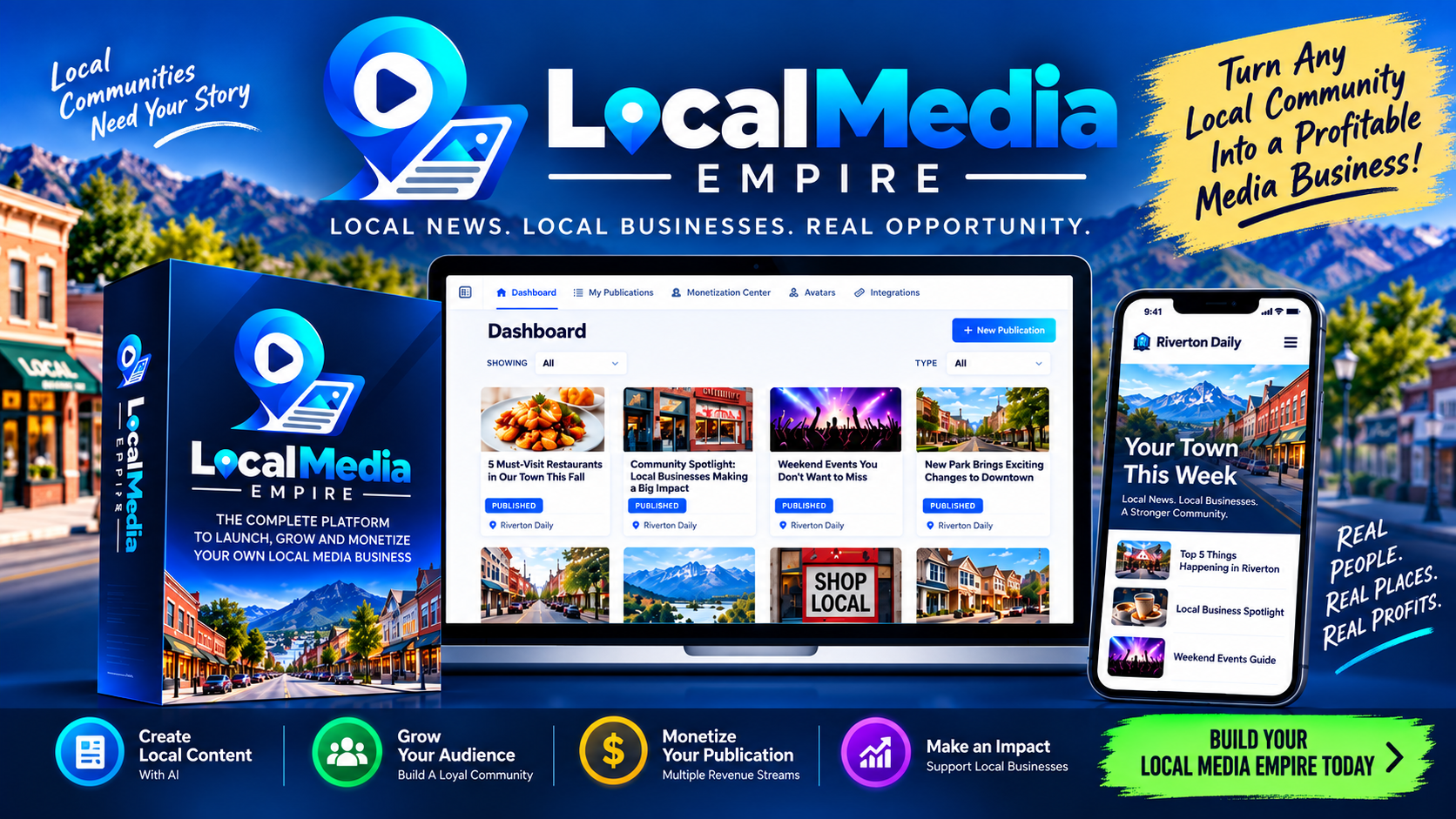
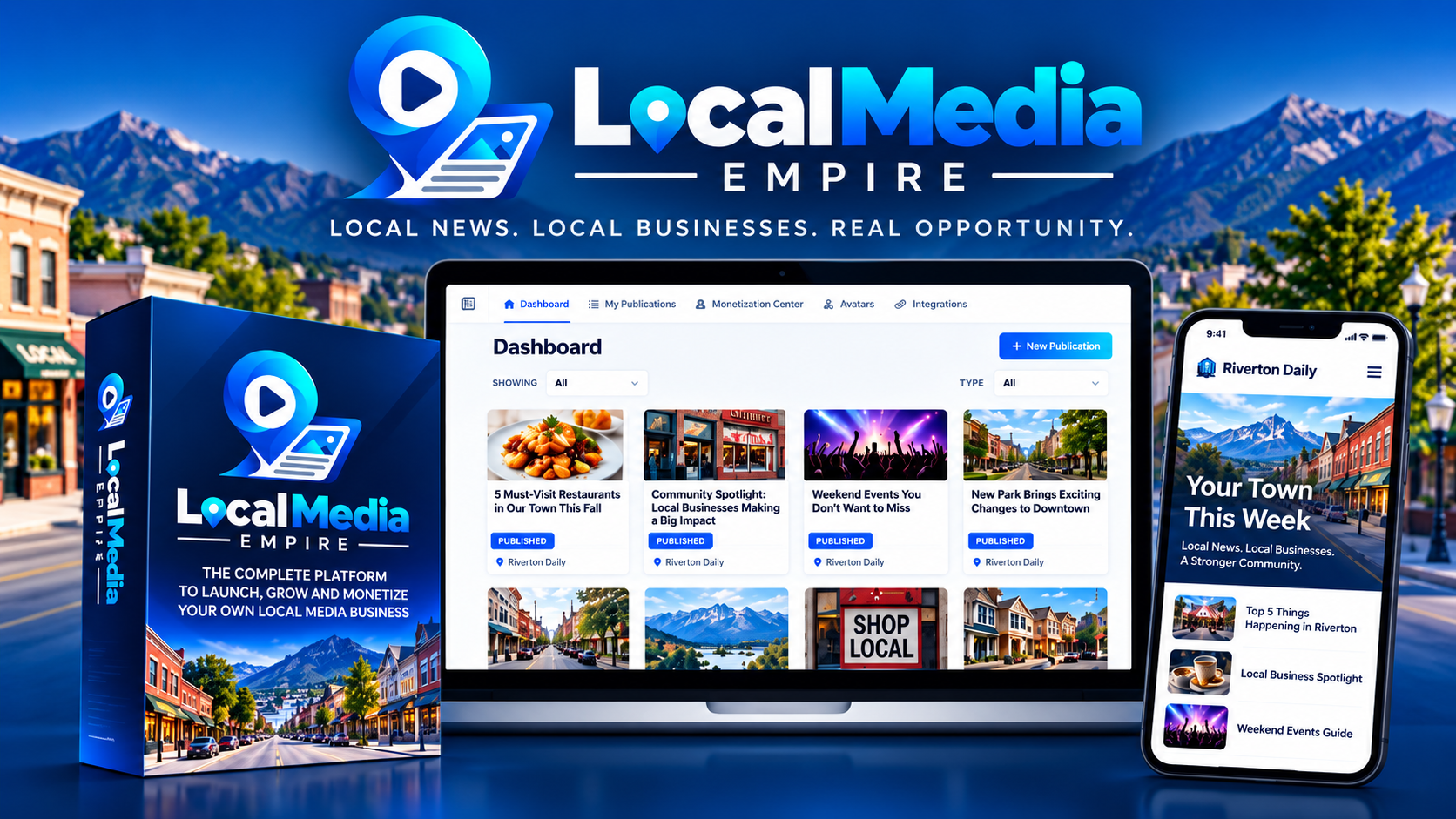
An AI-powered local publishing platform designed to help users create local content, build a branded media publication, grow an email audience, and explore multiple monetization options.
What You Get With Local Media Empire
Create locally focused articles and content with AI-assisted research and writing tools.
Build a professional local publication with custom branding and domain support.
Create newsletter issues and publish content through email and the web.
Capture subscribers with signup forms and manage a growing local audience.
Built-in SEO, schema and sitemap features are designed to support discoverability.
Higher tiers add advertising, directory, lead-generation and client-service capabilities.
Local Media Empire Front-End
AI-assisted local article creation and content research.
Create a branded local media website and use a custom domain.
Create and schedule newsletter content for your audience.
Subscriber capacity according to the supplied launch information.
Local Media Empire Details
Local Media Empire Review: Who Created Local Media Empire?
The People Behind Local Media Empire
Learn more about Karthik Ramani and Chad Nicely, the names associated with the development, marketing, and launch of Local Media Empire.

A History Of Software & Marketing Projects
Karthik Ramani and Chad Nicely have appeared together in public launch materials for software products including MemberHub and EverLesson. Earlier JV materials identified Karthik in development/JV relations and Chad in launch and strategy roles. Their public project history spans membership platforms, online education, marketing software, SaaS products, affiliate launches, and more recent marketing technology.
Local Media Empire Review: Sales & Demo Videos Of Local Media Empire
Discover what Local Media Empire is designed to do, how the system works, and the overall opportunity it provides for building and managing a local media business.
Watch the Local Media Empire demo to get a closer look at the platform, its workflow, and how the system can be used in a practical local media business setup.
Local Media Empire Review: What Is Local Media Empire?
Local Media Empire is a SaaS platform designed around one core idea: local communities generate a constant stream of newsworthy, useful, shareable content — new restaurants, weekend events, business openings, school updates, local deals — and most of it never gets organized into anything people can subscribe to. Traditional local newspapers have shrunk or disappeared in thousands of towns, leaving an information gap that big national platforms don’t fill.
The platform positions itself as a way for an individual, side-hustler, or small agency to step into that gap. Instead of hiring reporters or spending hours every week researching and writing, users lean on AI to help draft locally-focused articles, which then get organized into a branded media website and delivered to subscribers as a newsletter. It’s essentially trying to compress what used to require a small editorial team into a workflow one person can run in a couple of hours a week.
Under the hood, the platform combines a handful of distinct tools that are normally sold separately: an AI writing assistant, a website builder tuned for publishing, an email newsletter system, subscriber capture pages, and (depending on the tier) an advertising sales system and a business directory builder. Rather than stitching together five different subscriptions, everything sits inside one dashboard.
It’s worth being upfront about what this is not. It’s not a fully autonomous news operation that runs itself with zero oversight, and it’s not going to have the investigative depth of an actual local journalist. What it is, more realistically, is a content and publishing framework — the AI helps with the heavy lifting of drafting and organizing, but the person running the publication still needs to guide it, fact-check anything published, and build the actual local relationships that make a community publication worth reading.
Local Media Empire Review: Why Local Media Is Having a Moment
To evaluate whether Local Media Empire is worth your time, it helps to understand why “local media” is being pitched as an opportunity at all in 2026. Local newspapers have been closing at a steady pace for over a decade, and many of the towns that lost them never got a proper digital replacement. Local Facebook groups filled some of that gap, but they’re noisy, poorly organized, and owned by a platform that can change the rules at any time.
At the same time, small businesses still desperately need a way to reach nearby customers without paying Google or Meta for every single click. A well-run local newsletter sits right in the middle of that gap: it gives residents a genuinely useful, curated source of local information, and it gives local businesses an advertising channel that’s cheaper, more targeted, and more trusted than a generic paid ad.
This is also why the “own your audience” argument shows up so often in the marketing for this kind of tool, and it’s not entirely spin. If you build an email list of local subscribers, that list works whether or not an algorithm decides to show your content that week. You can reach the same 2,000 people in your town next month, next year, or five years from now, for free, any time you choose to hit send.
None of this means starting a local newsletter is easy money. It still requires consistency, genuinely useful content, and real effort to build trust in a community. What Local Media Empire is really offering is a way to remove the biggest technical barriers — the website, the newsletter software, the content research — so the person running the publication can spend more of their limited time on the parts that actually require human judgment.
Local Media Empire Review: Inside Local Media Empire – How It Actually Works
Based on the platform walkthrough and demo materials, here’s the general workflow a new user would go through.
Step 1 — Choose a local market. You start by picking the town, city, or region your publication will cover. This becomes the identity of your brand — for example, something like “801 Insider” for Salt Lake City or “Cache Valley Locals” for Northern Utah, both of which are examples of publications reportedly already running on this system.
Step 2 — Set up your branding. From there, you build out your publication’s identity: name, logo, color scheme, and a custom domain if you want a fully professional look rather than a generic subdomain.
Step 3 — Let AI help build content. The AI writer and content research tools scan for local news, events, and business updates relevant to your chosen market, then help draft articles around them. You’re able to review and edit before anything goes live, which matters — AI-generated drafts should always get a human pass, both for accuracy and to make sure the tone matches your publication.
Step 4 — Assemble your newsletter. Articles get pulled into a newsletter builder, where you can arrange stories, add local business highlights, and format an issue that’s ready to send.
Step 5 — Publish to web and email. Content goes out two ways: it’s published permanently on your media website (which builds an archive over time and can be discovered through search) and delivered directly to your subscriber list via email.
Step 6 — Grow your subscriber base. Signup pages and custom confirmation pages are built into the system, so every visitor to your site has a clear path to subscribing, and you get to control exactly what they see right after they do.
Step 7 — Schedule ahead. Once you’re comfortable with the workflow, you can prep issues in advance and schedule them to go out automatically, which is what makes the “run it in under two hours a week” claim at least plausible for an established publication, rather than something you’d expect in week one.
Local Media Empire Review: Core Features Breakdown
Let’s go deeper into the actual feature set, because this is where a lot of the real decision-making happens.
AI Article Writer & Local Content Research
The centerpiece of the platform is its AI writing and research engine. Instead of starting from a blank page, the system is designed to surface locally relevant topics — new business openings, upcoming events, city announcements — and generate a working draft you can edit. This is genuinely useful for the biggest bottleneck most solo publishers face: consistent content output. Writing several original local articles a week, every week, indefinitely, is the single biggest reason most one-person newsletters quietly die out after a few months.
That said, AI-generated local content has real limits. It can help with structure, tone, and a first draft, but it can’t physically go interview a business owner, verify a rumor, or catch something that’s factually wrong about your specific town unless it’s fed accurate source material. Anyone using this tool responsibly should treat the AI output as a strong first draft, not a finished, publish-ready article. We’ve seen the same pattern play out with other AI writing tools — our FableFox AI review covers a similar content-assist approach and the same editing discipline applies there too.
If you want a broader look at how AI content and automation tools are being used across marketing right now, this guest breakdown on AI tools for smart automation and productivity is a useful outside read for context.
Professional Media Website & Branding
Each publication gets its own branded media website, with support for custom domains, custom branding, and mobile-responsive design. This matters more than it might seem — a newsletter without a permanent home online is just a series of emails that disappear into people’s inboxes. A real website gives your content a searchable archive, a place to send new visitors, and a foundation for building actual domain authority over time.
Newsletter Builder & Publishing
The newsletter builder turns your articles into a formatted issue without requiring you to manually recreate content you already wrote for the website. Publishing happens on two channels simultaneously — the web archive and the direct email send — which is a smart structural choice, since it means every article you write works double duty: it can be discovered later through search, and it goes straight to your existing subscribers immediately.
If you want a genuinely well-respected outside resource on newsletter structure and strategy, HubSpot’s guide to building an email newsletter is worth bookmarking regardless of which platform you end up using — a lot of the fundamentals (segmentation, subject lines, consistency) apply no matter what software is doing the sending.
Subscriber & Audience Management
Signup pages, custom confirmation pages, and centralized audience management are all included from the front-end tier. The platform reportedly supports up to 10,000 subscribers per publication on the base plan, with unlimited subscribers unlocked at the Pro upgrade. For context, most single-town local newsletters realistically top out well below that number, so 10,000 is a generous ceiling for anyone starting out — it only becomes a real constraint if you’re aiming to cover a large metro area or want to run several sizable lists under one publication.
SEO & AEO-Ready Content
The platform markets its content as built with SEO and AEO (answer-engine optimization) in mind — meaning content structured in a way that’s friendly both to traditional search engines and to AI-powered search and chat tools that are increasingly how people find information. Built-in schema markup and sitemap generation are included, which are genuinely important technical SEO basics that a lot of small publishers skip entirely because they don’t know how to implement them manually.
Scheduling & Automation
Once your workflow is dialed in, you can build issues ahead of time and schedule them to auto-publish on a set cadence. This is really the feature that turns “constant manual work” into something closer to a sustainable weekly routine, assuming you’ve already built a repeatable process for sourcing and approving content.
Local Media Empire Review: Key Features Summary
Local Media Empire Review: Pricing Breakdown – Front End, OTOs & Bundle
- Core Local Media Empire software
- Build and manage a local newsletter or media publication
- AI-assisted local content creation
- Create and organize local media content
- Newsletter publishing and scheduling functionality
- Includes the core system needed to get started
- Designed to add audience-growth functionality
- Referral widgets for subscriber acquisition
- Subscriber swap capabilities
- Co-registration features
- Connect with other publishers for cross-promotion opportunities
- Useful for expanding a local publication beyond organic growth
- Focused on local advertising monetization
- Tools for offering advertising placements to local businesses
- Support for newsletter advertising and sponsorship opportunities
- Customer and advertising order management features
- Designed to help turn a local audience into advertising opportunities
- Relevant for users planning to monetize through local businesses
- Creates a local business directory around your publication
- Business discovery functionality for finding local businesses
- Add businesses to your directory as listings
- Supports local business discovery and visibility
- Creates additional opportunities for featured listings and directory monetization
- Extends the publication beyond newsletters into local business discovery
- Combines the Front End with the Pro upgrade
- Includes the Local Advertiser tools
- Includes the Local Directory functionality
- Provides a combined route instead of purchasing these upgrades separately
- Individual prices for the three upgrades total $361
- Bundle pricing therefore reduces the combined cost by $64
The Local Media Empire offer uses a multi-step funnel. The $37 Front End provides the core product, while the Pro, Local Advertiser and Local Directory options add separate functionality. The $297 bundle combines the three main upgrades into one purchase.
Local Media Empire Review: A Closer Look at the Local Advertiser Upgrade
Since monetization is usually the real reason someone buys a tool like this, the Local Advertiser OTO deserves its own breakdown. The core idea is simple: once you have even a modest local audience, nearby businesses will often pay for visibility in front of it, especially if your subscriber base is genuinely local and engaged rather than a generic national list.
The included tools — automatic ad scheduling, rotation, and self-service advertiser accounts — matter because manually managing ad bookings, invoices, and banner swaps for even five or six local advertisers becomes a real time sink very quickly. Automating that part of the process is what makes running local ads sustainable for a one-person operation instead of turning into an unpaid second job.
The built-in billing and automatic invoicing are also worth calling out specifically, since a lot of “newsletter monetization” advice online stops at “just sell ads” without addressing the actual admin work of collecting payment and tracking who owes what. Having that handled inside the same platform reduces one of the more tedious parts of running this as an actual business.
Local Media Empire Review: A Closer Look at the Local Directory Upgrade
The Local Directory OTO is less about immediate cash flow and more about long-term compounding traffic. A directory of local restaurants, salons, home services, and other businesses generates a large number of individually indexable pages — and pages like “Business Name + City + hours/address” are exactly the kind of long-tail search queries people type constantly.
The AI and Apify-powered business discovery is meant to speed up the tedious part of directory building — manually researching and entering hundreds of local businesses one at a time. Combined with automatic sitemap inclusion and schema optimization, the goal is for these pages to get picked up and indexed by search engines without a lot of manual SEO work on your end.
Business claiming is a smart addition too, since it opens a natural door to outreach: once a local business’s listing exists on your directory, reaching out to let them know they can claim and enhance it is a much warmer conversation starter than a cold pitch, and it can double as a lead-in to selling them an ad placement through the Local Advertiser tools.
Local Media Empire Review: The Local Client Version – Turning This Into an Agency
OTO 4 is aimed at a different type of buyer entirely — not someone who wants to run their own local newsletter, but someone who wants to build and manage local publications for other people as a paid service. This is a fairly common pattern in the “agency” corner of digital marketing: take a capable piece of software, package it as a done-for-you service, and sell it to local businesses or professionals who don’t have the time or interest to run it themselves.
The two built-in packages — a $297 newsletter-only setup and a $497 newsletter-plus-directory setup — give a rough starting price anchor if you’re new to pricing this kind of service. In practice, once you have a proven process and a portfolio of real client results, most people running agency-style offers like this raise their prices well above the starter numbers baked into the funnel.
This tier will only make sense for people who are comfortable with client work — communication, expectations management, and ongoing delivery — rather than people who just want a low-maintenance side project. If managing other people’s expectations isn’t something you enjoy, it’s completely reasonable to skip this OTO and stick to running your own publication.
Local Media Empire Review: Who Is Local Media Empire Really For?
Based on everything above, here’s a realistic breakdown of who this platform tends to make the most sense for.
Side-hustlers and solopreneurs looking for a project that compounds over time rather than another one-off flip. A local publication is a slow build, but unlike a lot of “make money online” products, the audience and content archive you create genuinely accumulate value the longer you stick with it.
Existing local business owners who want a low-cost way to build direct-reach marketing instead of only depending on paid ads. If you already run a local business, launching a companion newsletter for your town gives you a channel that markets your own business while also being genuinely useful to the community.
Realtors, agents, and local professionals who rely on visibility and trust within a specific geographic area. A newsletter naturally positions you as a connected, informed local presence, which is exactly the kind of reputation that referral-driven professions benefit from.
Marketing consultants and small agencies who want a productized service they can resell, particularly if you go the Local Client Version route. Our Restaurant Agency Studio review covers a related niche-agency angle worth comparing if you’re weighing different local-business service models.
Existing content creators or bloggers with an established local following who want to formalize that audience into an owned email list and a more structured publishing schedule.
Local Media Empire Review: Who Should Think Twice
To keep this review honest, it’s just as important to flag who probably shouldn’t buy this.
If you’re looking for something completely passive — a tool that requires zero ongoing effort or oversight — this isn’t it. AI can draft content, but a real person still needs to review it, run outreach to local businesses, and actually grow the list. Anyone expecting a “set it and forget it” income stream is going to be disappointed, regardless of how the marketing is worded.
If you live in an extremely small town with very little actual local business activity, the advertiser and directory monetization angles may be limited simply because there aren’t enough businesses in your immediate market to sell to. That doesn’t kill the newsletter idea entirely, but it does change the realistic revenue ceiling.
And if you already have zero interest in your local community — the businesses, events, and people in it — this probably isn’t the right project for you. The publications that actually succeed in this space tend to be run by people who are genuinely plugged into their town, not people treating it as a purely mechanical content-output exercise.
Local Media Empire Review: Advantages of Local Media Empire
- Genuinely underserved niche. Local media is a real gap left by shrinking local newspapers, and it’s not a saturated “make money online” angle.
- Reasonable front-end price. At $37, the core toolkit is accessible without a big upfront financial commitment.
- AI removes the biggest bottleneck. Consistent content output is the main reason solo publications fail, and the AI writer directly targets that problem.
- Multiple monetization paths. Advertising, directory listings, affiliate promotion, lead generation, and a client-service model are all supported within the same ecosystem.
- Owned audience, not rented reach. Every subscriber you collect is yours to reach again, independent of any algorithm.
- SEO/AEO foundation built in. Schema markup and sitemap generation handle technical SEO basics most solo publishers never get around to implementing.
- Scales into an agency offer. The Local Client Version gives a realistic path to turning this into a resellable service rather than just a personal project.
Local Media Empire Review: Disadvantages and Limitations
- It’s a new platform. Beyond the handful of existing publications mentioned in the launch materials, there isn’t yet a long public track record to point to, which is worth factoring in for any newer SaaS tool.
- AI content still needs human editing. Anyone treating AI drafts as publish-ready without review risks factual errors or a tone mismatch with their audience.
- Funnel pricing adds up. The full stack — front end plus all three main OTOs — moves well past the $37 headline price if you want every feature.
- Success depends heavily on the operator. Two people using the identical software could get completely different results depending on how consistently they publish and how well they build local relationships.
- Smaller towns may limit ad revenue potential. The advertiser and directory monetization tools are only as strong as the number of local businesses actually available to sell to.
Local Media Empire Review: Pros & Cons Summary
- Focused on building a local media and newsletter business
- Combines content creation, audience building and monetization concepts
- Multiple upgrades provide additional functionality as the business develops
- Local Advertiser option adds a dedicated monetization component
- Local Directory expands the model into local business listings
- Bundle option combines the main upgrades at a lower combined price
- Can be relevant for users interested in local business marketing
- Structured around a specific local-media business model
- The complete funnel can cost considerably more than the $37 Front End
- Several useful capabilities are positioned as paid upgrades
- The model requires building and growing a local audience
- Monetization depends on attracting local businesses and advertisers
- Results can vary depending on the chosen market, audience and execution
- Users looking only for a basic newsletter tool may not need the full funnel
- Local directory functionality may require ongoing effort to maintain useful listings
- The overall offer is more relevant to a business-building use case than casual newsletter publishing
Local Media Empire Review: Real-World Use Case Scenarios
To make this more concrete, here are a few realistic scenarios of how someone might actually use Local Media Empire.
Scenario 1 — The side-hustle publisher. Someone picks their own hometown, spends a few weekends setting up branding and their first handful of articles, and starts sending a weekly newsletter to friends, family, and local Facebook groups to build the first 100–200 subscribers. Growth is slow at first, but the archive of articles keeps compounding on search.
Scenario 2 — The local business owner. A café or salon owner starts a community newsletter alongside their existing business, using it to promote local events and quietly cross-promote their own shop, while occasionally selling ad space to a couple of neighboring businesses to offset costs.
Scenario 3 — The niche-stacker. Someone already running review or niche content sites — similar to how we cover niche digital products here, including our CueVue review and our Veganicious review — adds a hyper-local publication as a completely separate project, diversifying beyond affiliate and review content into an owned local audience.
Scenario 4 — The agency operator. A marketing consultant uses the Local Client Version to set up and manage 5–10 client newsletters for different local businesses, charging the $297–$497 setup packages (or their own custom pricing) plus an ongoing management fee.
Local Media Empire Review: How You Could Realistically Monetize a Local Publication
Monetization is where a lot of “start a newsletter” advice gets vague, so let’s get specific about the paths this platform actually supports.
Local advertising is the most direct route, using the OTO 2 tools to sell banner placements on your site and inside your newsletter emails to nearby businesses. This tends to work best once you have at least a few hundred genuinely local, engaged subscribers — advertisers care about relevance and engagement far more than raw list size.
Directory listings and featured placements through OTO 3 give you a second, more passive revenue stream — businesses can pay for enhanced listings or featured placement within your directory, separate from newsletter ad space.
Lead generation for local professionals is another angle explicitly mentioned in the product’s own positioning — using your publication to generate qualified leads for realtors, contractors, or financial advisors, then charging for those leads directly rather than (or in addition to) selling ad space.
Affiliate promotion is a smaller but still viable stream, recommending relevant local or national products/services to your subscribers. If you’re newer to affiliate marketing generally, our affiliate marketing tutorials hub is a good place to get up to speed on the fundamentals before layering it into a publication like this.
Reselling the platform as a service through the Local Client Version rounds out the list, turning the whole system into a productized offer for other local businesses rather than a single publication you run yourself. Our Personaible review touches on a similar productized-service angle if you want to compare how a different tool approaches the same reselling model.
Realistically, most successful operators in this space end up combining two or three of these streams rather than relying on just one — a mix of a couple of local advertisers, some directory revenue, and occasional lead-gen or affiliate income tends to be a more resilient model than betting everything on a single channel.
Local Media Empire Review: SEO, AEO, and Getting Found – A Deeper Look
One of the more overlooked parts of a tool like this is the SEO foundation, so it’s worth spending a bit more time here. Every article you publish through the platform becomes a permanent, indexable page on your media website, which means your content library is doing double duty — it’s read once as a newsletter send, and then it keeps working indefinitely as a piece of searchable content.
The built-in schema markup matters more than most beginners realize. Structured data (the kind defined by schema.org) helps search engines and AI-powered answer engines understand exactly what a page is about — a business listing, an event, a news article — which improves your odds of showing up correctly in both traditional search results and the newer AI-generated answer boxes that are becoming a bigger share of how people search.
If you want to build a real understanding of SEO fundamentals beyond what any single tool automates for you, Moz’s Beginner’s Guide to SEO is still one of the most respected free resources for learning how search engines actually evaluate content, and it pairs well with whatever platform you’re publishing on.
For local-specific visibility, don’t overlook the basics outside the platform itself — claiming and properly filling out a Google Business Profile for your publication (yes, publications can have one too) can help your brand show up in local search results alongside the actual businesses you’re covering.
If you’re a marketer evaluating multiple AI and digital tools side by side — not just for local media but across your broader toolkit — this outside roundup on in-depth AI tools and digital product reviews for marketers is a useful companion read while you’re doing your research.
Local Media Empire Review: Getting Started – A Simple Action Plan
If you decide to move forward, here’s a realistic first-month plan rather than trying to do everything at once.
Week 1: Pick your market, set your branding, and publish your first 3–5 articles to start building the website archive before you even worry about subscribers.
Week 2: Build your signup page and confirmation flow, then start manually inviting your existing network — friends, family, local Facebook groups, community pages — to subscribe.
Week 3: Send your first two or three newsletter issues on a consistent day and time, and start paying attention to what content actually gets opens and clicks.
Week 4: Once you have a repeatable rhythm, start scheduling issues in advance and begin light outreach to one or two local businesses about early advertising or directory placement, even at a discounted “founding advertiser” rate to get your first case studies.
This isn’t the only way to approach it, but starting narrow — a handful of great articles and a small, real audience — tends to work better than trying to launch with a huge content library and zero subscribers on day one.
Local Media Empire Review: Comparison With Alternatives
| Feature | Local Media Empire | Beehiiv | Substack | Ghost |
|---|---|---|---|---|
| Primary Focus | Local media and newsletter business model | Newsletter publishing, growth and monetization | Publishing, subscriptions and audience discovery | Website, publishing, newsletters and memberships |
| Newsletter Publishing | ✓ | ✓ | ✓ | ✓ |
| Audience Growth Tools | ✓ | ✓ | Platform discovery and recommendations | Membership-focused |
| Referral / Recommendation Tools | Included in selected upgrade | Built-in referrals and recommendations | Recommendations and network discovery | Primarily through integrations/custom setup |
| Advertising / Sponsorship Focus | Local advertiser functionality | Ad network and sponsorship tools | Primarily paid subscriptions | No native ad marketplace |
| Paid Subscriptions | Business model focuses on local monetization | Available on eligible plans | ✓ | ✓ |
| Local Business Directory | ✓ | Not a core feature | Not a core feature | Requires customization |
| Local Advertising Workflow | Dedicated functionality | General newsletter monetization tools | Not a primary focus | Requires additional setup |
| Website / CMS | Local media-focused system | Newsletter website included | Publication website included | Full publishing CMS |
| Analytics | Business-specific functionality | Advanced newsletter analytics | Publication and subscriber analytics | Audience and membership analytics |
| Platform Model | One-time purchase with paid upgrades | Subscription-based platform | Free publishing with revenue share on paid subscriptions | Self-hosted or managed subscription platform |
| Notable Difference | Combines local media, advertising and directory concepts | Strong emphasis on newsletter growth and monetization | Strong emphasis on publishing and paid audience subscriptions | Strong website ownership and publishing flexibility |
Local Media Empire Review: My Honest Final Verdict
So, is Local Media Empire worth it? Based on everything covered in this Local Media Empire Review, the honest answer is: it depends heavily on you, not just the software.
The platform itself is a genuinely reasonable piece of engineering for the problem it’s trying to solve. It bundles tools that would otherwise require several separate subscriptions — AI writing assistance, a website, a newsletter system, subscriber management, and (in the upgraded tiers) advertising and directory infrastructure — into one dashboard at an accessible starting price. The underlying opportunity, building an owned local audience in a market where local news coverage has genuinely shrunk, is real and not just marketing spin.
Where the honest caveats come in: this is still a new platform without years of public track record, the AI can’t replace human judgment and local relationship-building, and the full value of the system (advertiser tools, directory, client version) requires stacking additional purchases beyond the $37 front end. None of that makes it a bad product — it just means you should go in with realistic expectations about the actual time and effort required, rather than expecting a fully passive income stream.
If you’re someone who’s genuinely interested in your local community, comfortable using AI as an assistant rather than a replacement for your own judgment, and willing to put in consistent effort over months rather than expecting results in week one, Local Media Empire is a reasonable, well-priced starting point for building something you actually own. If you’re looking for a completely hands-off passive product, this — like most tools in this category — isn’t going to deliver that.
Closing Thoughts
Local media is one of the more genuinely interesting niches in the online business space right now, precisely because it isn’t oversaturated the way so many “make money online” categories are. Local Media Empire gives you a practical, reasonably priced way to test that opportunity without a massive upfront investment or technical learning curve. Whether it turns into a meaningful side income or a full local media brand really comes down to consistency, genuine community involvement, and how well you use the AI tools as an assistant rather than a shortcut.
If you’re weighing this against other niche digital products and platforms before you commit your time, it’s worth browsing a few more of our breakdowns — including our Igloo App AI review — to see how different tools in the broader AI and local business space compare before deciding where to focus your energy.
Local Media Empire Review: Get Instant Access + Premium Bonuses Worth $43,000 FREE!
Local Media Empire + 17 Exclusive Premium Bonuses
Purchase Local Media Empire through RidhTek Reviews and receive my complete package of 17 Exclusive Premium Bonuses at no additional cost. These bonuses are designed to complement the local media, newsletter, audience-building and monetization capabilities of Local Media Empire.
Why I’m Including These Bonuses
Local Media Empire provides the core tools for creating and growing a local media publication, but building a sustainable publication also requires content planning, audience growth, SEO, monetization, outreach and marketing systems.
That’s why I’ve assembled these 17 Exclusive Premium Bonuses. They are designed to give you additional resources, templates, strategies and practical systems that can complement your Local Media Empire workflow.
These bonuses are exclusively provided by RidhTek Reviews and are available to verified buyers who purchase through my affiliate link.
17 Exclusive Premium Bonuses
A practical bonus package covering local marketing, content, SEO, audience growth, monetization and business development.
Local Media Launch Blueprint
A practical roadmap for planning and launching a local media publication from the ground up.
Local Market Research Guide
Identify promising local markets, audience interests and content opportunities before you launch.
Local Content Planning System
Plan consistent local articles, stories, events and community-focused content.
AI Content Prompt Library
Ready-to-use AI prompts for generating local content ideas, drafts, headlines and promotional material.
Newsletter Growth Blueprint
Practical strategies for attracting new subscribers and building a more engaged local email audience.
Local Audience Engagement Kit
Ideas and templates for encouraging readers to interact with your publication and community content.
Local SEO Keyword Guide
Find relevant local search terms and content angles that can help attract targeted organic traffic.
Local SEO Optimization Checklist
A practical checklist for optimizing local articles, pages and business-focused content.
Local Advertiser Outreach Kit
Outreach ideas and messaging frameworks for approaching relevant local businesses.
Local Media Monetization Blueprint
Explore practical monetization routes including advertising, sponsorships, listings and lead generation.
Local Advertising Sales Templates
Reusable templates for presenting advertising opportunities and communicating with prospective sponsors.
Social Media Promotion Kit
Content ideas and promotional frameworks for sharing local stories across social media channels.
Content Repurposing System
Turn one local story into multiple content formats for newsletters, websites and social channels.
Local Copywriting Swipe File
Ready-to-adapt copy frameworks for headlines, promotions, advertiser outreach and audience engagement.
Audience Analytics Guide
Track useful audience and content signals to understand what your readers respond to.
Local Media Agency Framework
A framework for packaging local media services for businesses, organizations and professional clients.
Local Media Growth Strategy
A long-term framework for developing your publication, growing your audience and expanding monetization opportunities.
How To Claim Your 17 Bonuses
- Purchase Local Media Empire using the button below.
- Complete your purchase through the official checkout.
- Save your purchase receipt or transaction details.
- Contact RidhTek Reviews with your purchase information for verification.
- After verification, your 17-bonus package can be delivered to you.
Bonus Disclosure: These 17 bonuses are exclusively provided by RidhTek Reviews and are not part of the official Local Media Empire product. Bonus availability is subject to successful purchase verification through my affiliate link. Please contact RidhTek Reviews after purchase to claim the bonus package.
Local Media Empire Review: Frequently Asked Questions
Local Media Empire is an AI-powered platform designed to help users build, publish, and monetize a local media publication or newsletter. It combines AI-assisted content creation, local content research, website publishing, newsletter functionality, subscriber management, and monetization tools in one platform.
The front-end offer is priced at $37 one time. Additional upgrades are available, including Pro at $67, Local Advertiser at $97, Local Directory at $197, and a Local Client Version at $297 or $497 depending on the package. A $297 bundle is also offered according to the supplied product information.
The platform includes AI-assisted article writing and local content research. However, AI-generated content should still be reviewed, edited, and checked for accuracy before publication. The platform can reduce the amount of manual content creation, but it does not eliminate the need for human oversight.
Yes. The platform is designed to create a branded local media website and newsletter publication. The supplied product details include custom domain support, subscriber signup and confirmation pages, newsletter creation, email and web publishing, scheduling, SEO and AEO optimization, schema, and sitemap functionality.
The front-end version is described as supporting an audience of up to 10,000 subscribers per publication. The Pro upgrade increases the capability to unlimited subscribers and also adds other publishing and audience-related features.
Yes. The Local Advertiser upgrade adds tools for selling local advertising, including banner ad placements, newsletter and website ad placements, ad scheduling and rotation, advertiser accounts, billing and invoicing features, and an advertising sales page. Actual revenue will depend on factors such as audience size, advertiser demand, local market conditions, and the user’s sales and outreach efforts.
A local business directory is included through the Local Directory upgrade. The supplied information describes AI and Apify-assisted business discovery, rich business listings, categories, business claiming functionality, SEO and schema features, and automatic sitemap inclusion.
The platform is designed to simplify several technical and content tasks involved in running a local publication. That can make it accessible to users who are new to local media publishing. However, users should still expect to learn the platform, review AI content, build an audience, and handle local promotion and relationships.
Yes. The Local Client Version is specifically positioned for client work and includes client management features and client logins. The supplied offer describes options for setting up a newsletter-only client package or a newsletter plus directory package, making it relevant to users who want to provide local media services to clients.
No. While Local Media Empire can automate or simplify parts of content production, publishing, newsletters, and monetization, running a local media property still requires ongoing work. Content should be reviewed, audiences need to be developed, advertisers may need to be contacted, and local relationships generally require human involvement.
See how ProductsPilot approaches product discovery, creation, listings, and publishing in this ProductsPilot Review.
Before trying an AI affiliate website builder, check out my Affinova Review for a closer look at its features, pricing, OTOs, and bonuses.
Discover the key features and practical considerations covered in our CastleFlix AI review, including its AI-powered OTT platform builder.
Looking for more AI tools and digital product reviews? Check out our latest reviews.
Follow Us On