Skip to content
Table of Contents
WP Sync Review (2026) $43K Premium Bonus Package FREE!
Welcome to my in-depth WP Sync Review and Feature Breakdown!
Is WP Sync actually a useful WordPress automation plugin, or is it simply another marketing product promising to replace Zapier, Make and other automation platforms?
That is the question I wanted to answer in this detailed WP Sync review.
WP Sync is being launched as a WordPress-based automation system designed to connect leads, customers, buyers, forms, payment platforms, email marketing services, webinars, CRMs, spreadsheets, chat platforms and other tools without requiring users to maintain a separate monthly automation subscription.
According to the vendor’s launch materials, WP Sync supports up to 147 app connections, unlimited automations, direct API-to-API connections, scheduled actions, filters, field mapping, activity logging and automatic synchronization. The central proposition is simple: instead of renting automation by the task every month, you install WP Sync on your WordPress website and use it as your automation bridge.
But there is an important distinction between what a product claims to do and what an independent reviewer can responsibly say it does.
So this review takes a more balanced approach.
I will explain what WP Sync is, how it works, what it connects to, how the pricing works, how it compares with Zapier, Make and Pabbly, who should consider it, who should avoid it, what I like about the offer, what concerns I would investigate before buying, whether the one-time pricing makes sense, and whether WP Sync is really a good fit for affiliate marketers, agencies, WordPress site owners and online businesses.
I will also separate vendor claims from my analysis wherever appropriate.
Affiliate Disclosure: This article contains affiliate links. If you purchase through these links, I may earn a commission at no extra cost to you. This does not influence my review. All opinions shared here are based on independent research, product walkthroughs, and real-world evaluation.
WP Sync Review : Complete Product Overview
⚡ WP Sync Product Snapshot
WordPress Automation & Multichannel App Integration Platform
💰 Front-End: $47 One-Time | 💎 Complete Bundle: $147 One-Time
- Creator Kevin Fahey
- Launch Manager Neil Napier
- Product WP Sync
- Category Software
- Platform WordPress
- Automation Model Self-Hosted
- Marketplace JVZoo
- Front-End $47
- Complete Bundle $147
- App Connections 147+
- Automation Unlimited
- Guarantee 30 Days
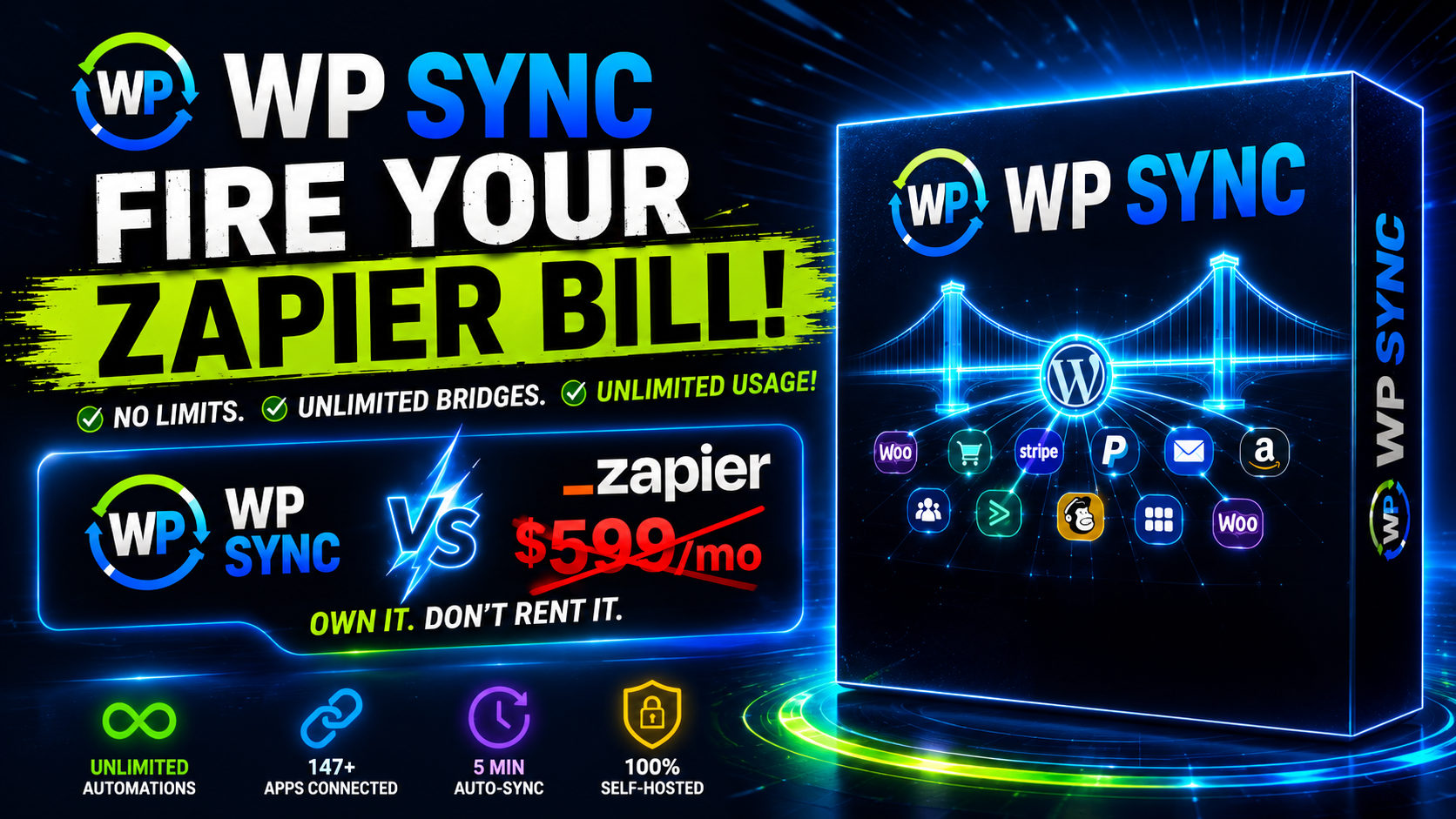
Get WP Sync from $47
Complete Bundle available for $147 • 30-Day Money-Back Guarantee
One-Time Launch Price 💎 Get WP Sync Bundle – $147
Complete Bundle • One-Time Launch Price
WP Sync is offered with a 30-day money-back guarantee according to the supplied offer information. This gives buyers an opportunity to evaluate the product with reduced purchase risk. Always review the current refund terms, license terms and pricing at checkout before purchasing.
⚡ WordPress Automation Platform:
WP Sync is positioned as a WordPress-based automation and integration platform designed to connect multiple applications and automate data workflows. The supplied product information highlights 147+ app connections, unlimited automations, no task meter, direct API connections, filters, field mapping, scheduling, activity logs and other automation features.
🔗 147+ App Connections:
According to the supplied product materials, WP Sync supports connections across email marketing, CRM, payments, e-commerce, affiliate platforms, lead-generation tools, webinars, calendars, productivity platforms and other business applications. Always verify that the specific apps and workflow requirements you need are supported before purchasing.
💼 Affiliate Disclosure:
Some links on this page are affiliate links. If you purchase WP Sync through these links, RidhTek Reviews may earn a commission at no additional cost to you. This does not increase the price you pay and helps support our continued publication of independent software reviews.
📌 Honest Review Disclaimer:
WP Sync is reviewed based on the supplied product, sales and launch information. Features, integrations, pricing, bonuses, license terms and launch offers may change. Any vendor-provided income, savings or performance examples should not be interpreted as guaranteed results. Your actual experience may vary depending on your WordPress environment, integrations, traffic, workflow configuration and other factors.
WP Sync Review : Who Created WP Sync?
👨💻 Meet the Minds Behind WP Sync

Kevin Fahey
Neil Napier
Neil Napier is identified as the launch manager for WP Sync and is associated with the product’s launch and affiliate promotion.
WP Sync is positioned as a WordPress automation solution designed to connect multiple applications, automate data workflows and provide features such as app integrations, filters, field mapping, scheduling and activity tracking.
WP Sync Review : Sales Video (FE) & Demo Video
WP Sync Review : What Is WP Sync?
WP Sync is a WordPress-based automation and integration plugin designed to move information between different online applications.
In simple terms, imagine that you have a lead coming from Facebook.
Normally, you may need to move that lead into your email marketing system, CRM, Google Sheets, chatbot platform or another tool.
You can do that manually.
Or you can use an automation service.
WP Sync is designed to automate that process directly from your WordPress environment.
The vendor describes WP Sync as a Zapier alternative that lives inside WordPress. The supplied JV materials state that it can connect sources and destinations, move contacts and other data, use direct API connections and operate without a traditional task-metered model.
The vendor specifically claims:
- Up to 147 app connections
- Unlimited automations
- No task meter
- Self-hosted operation inside WordPress
- Direct API connections
- Five-minute synchronization for certain sources
- Instant triggers for supported push sources
- Filters
- Custom field mapping
- Scheduled delays
- Date/time releases
- Activity logging
- Dry-run testing
- Refund and cancellation triggers
- Multiple destinations from one source
The official product information also positions WP Sync around email marketing, affiliate marketing, lead generation, e-commerce, webinars, forms, payments, CRMs and team communication.
That makes the product considerably more interesting than a simple “connect two apps” plugin.
The real idea is to create a central automation bridge for a WordPress-powered business.
WP Sync Review : Why Does WP Sync Exist?
To understand WP Sync, it helps to understand the problem it is trying to solve.
Modern online businesses rarely use just one application.
A typical affiliate marketer might use:
- WordPress
- A landing page builder
- Facebook Lead Ads
- AWeber
- GetResponse
- ActiveCampaign
- Google Sheets
- ManyChat
- JVZoo
- WarriorPlus
- ClickBank
- Calendly
- Zoom
- Slack
An e-commerce business might use:
- WordPress
- WooCommerce
- Stripe
- PayPal
- Email marketing
- CRM
- Customer support
- Google Sheets
- Slack
- Accounting software
A coach might use:
- WordPress
- Webinar software
- Calendly
- Email marketing
- Payment processing
- CRM
- Course platform
- Community platform
The problem is that these systems do not always communicate with each other automatically.
That is where automation platforms became popular.
Instead of manually exporting data from one application and importing it into another, you create a workflow.
For example:
Facebook Lead → Email List → Google Sheets → ManyChat
Or:
JVZoo Sale → Customer List → Tag Buyer → Follow-Up Sequence
Or:
WooCommerce Purchase → CRM → Customer Tag → Thank-You Email
Or:
Zoom Registration → Email List → Reminder Sequence
These are useful workflows.
The challenge is how much you pay for the automation layer and where that automation runs.
WP Sync is attempting to offer another model:
Run the automation from WordPress instead of renting a separate task-based automation platform.
That is the central business case.
WP Sync Review : WP Sync WordPress Plugin – How Does It Work?
The basic concept appears straightforward.
You connect the applications you want to use, create an automation bridge, select the source, choose one or more destinations, map the fields and activate the bridge.
The supplied product materials describe a workflow that looks roughly like this:
Step 1: Connect Your Apps
You enter the relevant API credentials or connection details for the application.
For example:
- AWeber
- WarriorPlus
- Zoom
- Google Sheets
- ManyChat
- WooCommerce
The product materials describe this as a simple connection process.
Step 2: Create a Bridge
You choose where the information comes from.
Then you choose where it should go.
You can configure fields, tags, filters and timing.
For example:
Source: Facebook Lead Ads
Destinations:
- AWeber
- Google Sheets
- ManyChat
- Slack
Step 3: Map the Fields
The system can map information such as:
- First name
- Last name
- Phone
- Product
- Tags
- Custom fields
This matters because different applications often use different field names.
Step 4: Activate the Automation
Once the bridge is active, the workflow can operate automatically.
The vendor says some sources synchronize every five minutes, while supported push-based sources can trigger instantly.
This distinction is important.
“Automation” does not necessarily mean every application will update at exactly the same millisecond.
The actual timing depends on the source, integration method, API behavior and workflow configuration.
That is why I would avoid interpreting the five-minute figure as a universal guarantee for every connection.
WP Sync Review : WP Sync Features
Let’s examine the feature set more carefully.
1. Up to 147 App Connections
The vendor’s JV material describes WP Sync as supporting up to 147 connections.
This is one of the biggest selling points.
The connections cover several categories.
Email marketing
The supplied materials list services including:
- AWeber
- ActiveCampaign
- GetResponse
- Mailchimp
- ConvertKit/Kit
- MailerLite
- Drip
- HubSpot
- GoHighLevel
- Brevo
- Klaviyo
- MailPoet
- FluentCRM
- beehiiv
- Customer.io
- and others
This is particularly relevant for list builders.
Commerce and payments
The vendor lists:
- WooCommerce
- Stripe
- PayPal
- ThriveCart
- SamCart
- Gumroad
- Lemon Squeezy
- Shopify
- and other platforms
This creates several interesting workflows.
For example:
WooCommerce → Email List
or:
Stripe → CRM
or:
ThriveCart → Customer Sequence
Affiliate platforms
This is an especially relevant category for affiliate marketers.
The supplied materials specifically mention:
- JVZoo
- WarriorPlus
- ClickBank
That means affiliate marketers can potentially use purchase information as a trigger for follow-up workflows.
However, you should always verify the exact permissions, fields and buyer-data rules associated with the affiliate platform before implementing a production workflow.
Lead generation
WP Sync also targets:
- Facebook Lead Ads
- Instagram Lead Ads
- Forms
- Typeform
- Jotform
- Contact forms
- Webhooks
For a lead-generation business, this can eliminate repetitive CSV exporting and importing.
Webinars and bookings
The materials mention:
- Zoom
- GoToWebinar
- Calendly
- Cal.com
- Amelia
This can be useful for webinar funnels and appointment-based businesses.
Team communication
WP Sync also claims support for:
- Slack
- Discord
- Telegram
This opens up internal notification workflows.
For example:
New Lead → CRM → Slack Notification
2. Unlimited Automations
Another major selling point is unlimited automations.
This is important because task-based systems can become expensive as workflow volume increases.
Suppose you have one lead.
You might want to send that lead to:
- Email software
- CRM
- Google Sheets
- Chatbot
One source can therefore create several actions.
A task-based automation service may count those actions individually.
WP Sync’s positioning is different.
The vendor states that it does not use a task meter for the automation system.
That could make the economics attractive for users running larger numbers of simple repetitive workflows.
But there is a practical consideration.
Unlimited automations does not mean unlimited API capacity from every third-party platform.
Each connected service may have its own API restrictions, quotas, rate limits and account rules.
So “unlimited” should be understood as the absence of a WP Sync task meter, not as a promise that every third-party API has infinite capacity.
That is an important distinction.
3. No Task Meter
This is arguably WP Sync’s strongest commercial advantage.
Traditional automation platforms commonly measure usage.
Zapier, for example, currently uses task-based pricing, and its official pricing documentation describes successful workflow steps as tasks. Its current plans include different task allowances and paid plans, while its billing model has evolved over time.
That does not mean Zapier is bad.
In fact, Zapier is a mature automation platform with a broad ecosystem.
The issue is economics.
If your business sends large numbers of contacts through several destinations, usage-based billing can become part of your operating cost.
WP Sync’s model attempts to remove that particular variable.
Instead of:
More automation = potentially more recurring cost
the pitch becomes:
Buy the software = run the automations without a WP Sync task meter.
That is compelling for certain WordPress users.
4. Self-Hosted Inside WordPress
This is another important differentiator.
The vendor describes WP Sync as living inside your WordPress website.
That means the WordPress site becomes the location from which the automation connections are managed.
There can be advantages to this approach.
You have fewer external dashboards to manage.
You can centralize some automation activity around your existing website.
You can also reduce dependence on a separate SaaS automation subscription.
But there is a trade-off.
Self-hosting means you are responsible for your WordPress environment.
That includes:
- Hosting quality
- PHP compatibility
- WordPress updates
- Plugin conflicts
- Security
- API credentials
- Backups
- Performance
- Troubleshooting
WordPress itself recommends that plugin code be developed and maintained with security in mind, and its official Plugin Handbook covers areas such as data validation, nonces, escaping output and sanitizing input.
Therefore, I would consider the self-hosted architecture both an advantage and a responsibility.
It gives you more control.
It also means you should not treat your WordPress site like an unattended appliance.
5. Five-Minute Auto-Sync
The sales material says WP Sync can automatically synchronize certain connections every five minutes.
That is useful for workflows where instant delivery is not essential.
For example:
Contact Form → Spreadsheet
or:
CRM Data → Another Application
Five minutes is usually acceptable for administrative synchronization.
For time-sensitive marketing workflows, however, I would verify whether the specific integration uses a push mechanism or scheduled polling.
If your business depends on a welcome email being triggered immediately after a lead submits a form, you want to know exactly how that particular source behaves.
This is one of the questions I would ask before deploying WP Sync to a mission-critical workflow.
6. Instant Push Sources
The vendor states that certain push sources can fire instantly.
These include categories such as forms, webhooks, stores, calendars and lead ads.
That is potentially more valuable than a generic five-minute synchronization cycle.
Why?
Because lead response time matters.
Imagine someone submits a lead form.
Your ideal workflow might be:
Lead submits form → email list → welcome email → chatbot → internal notification
The faster that happens, the more useful the automation becomes.
However, the actual delivery time can still depend on the source platform, API, network, email provider and destination platform.
So again, I would treat the product’s timing claims as feature descriptions rather than guarantees of universal real-time delivery.
7. Filters
Filters are a deceptively important feature.
Without filters, automation can become dangerous.
Suppose every purchase goes into one list.
But you sell three products:
- Product A
- Product B
- Product C
You might want:
Product A → A Buyers List
Product B → B Buyers List
Product C → C Buyers List
A filtering system can help separate those contacts.
You might also want rules such as:
- Only buyers of a specific product
- Only leads from a particular campaign
- Only contacts with a particular field
- Only customers above a certain value
- Only users matching a particular tag
The supplied materials state that WP Sync supports filter conditions.
That makes the platform more useful than a simple “copy every record” integration tool.
8. Field Mapping
Field mapping is another practical feature.
Different applications use different data structures.
One platform might call a field:
first_name
Another might call it:
firstName
Another might use:
First Name
A useful integration platform needs to map those fields correctly.
WP Sync’s materials describe per-destination field mapping.
That is important because a single source may need to send slightly different information to different destinations.
For example:
Facebook Lead
could become:
AWeber: Email + First Name + Tag
Google Sheets: Email + Full Name + Phone
ManyChat: Email + First Name
Slack: Name + Email in notification
That kind of flexibility is where automation software becomes genuinely useful.
9. Delays and Scheduling
The vendor states that WP Sync can execute actions:
- Immediately
- After a delay
- At a specified date/time
This is useful for marketing sequences.
For example:
Day 0
Customer purchases.
Day 2
Send an onboarding message.
Day 5
Recommend a complementary product.
Day 14
Invite the customer to a webinar.
Day 30
Send a long-term customer offer.
The important point is that WP Sync is not positioned solely as a data-transfer tool.
It also attempts to provide workflow timing.
That increases its usefulness for marketers.
10. Refund and Cancellation Triggers
One feature I find particularly interesting is the inclusion of refund, cancellation and failed-payment triggers.
This is often overlooked when marketers think about automation.
Most people focus on:
New lead → new customer
But mature automation should also handle:
Refund → remove from buyer sequence
Cancellation → update CRM
Failed payment → notify support
Chargeback → update customer status
That can prevent awkward situations.
For example, you do not want someone who refunded a product to continue receiving promotional emails telling them how wonderful their purchase was.
A good automation system should handle both positive and negative customer lifecycle events.
11. Dry-Run Testing
The supplied WP Sync materials describe a dry-run testing feature.
This is one of the features I would personally consider important in any serious automation product.
Why?
Because automation errors can be expensive.
Suppose you accidentally map the wrong field.
Or you send every customer into the wrong email sequence.
Or you accidentally trigger a promotional campaign for the wrong audience.
A dry-run mechanism allows you to see what the workflow would do before you activate it.
The vendor’s demo description says that a simulation can show the contact, fields, filters and destinations without actually writing the data or sending the messages.
That is a sensible workflow.
I would still recommend testing with non-critical data before putting any automation into production.
12. Activity Log
WP Sync also includes an activity log according to the supplied product material.
This matters because automation without visibility is difficult to troubleshoot.
Imagine a customer says:
“I never received the email.”
Without an activity log, you may need to investigate several systems.
With a log, you may be able to determine:
- Was the contact received?
- Which bridge handled it?
- Was the workflow successful?
- Where was it sent?
- Was it queued?
- Did it fail?
- Was it filtered out?
The vendor describes the activity log as searchable by email, name, bridge or destination.
That is a useful operational feature.
WP Sync Review : Key Features Summary
WP Sync Review : Is WP Sync Really a Zapier Alternative?
This is probably the most important question in this WP Sync review.
My answer is:
Yes, it can reasonably be considered a Zapier alternative for certain WordPress-centric workflows, but I would not say it is a complete one-for-one replacement for every Zapier use case.
That distinction matters.
Zapier is a large automation ecosystem.
WP Sync is being positioned around WordPress.
If your business is heavily built around WordPress, that can actually be an advantage.
But if you run a large enterprise stack across dozens of non-WordPress systems, you should evaluate the integration depth and workflow capabilities carefully before migrating everything.
WP Sync Review : Is WP Sync Better Than Zapier?
I would not answer that with a simple yes.
It depends on the user.
WP Sync may be better for you if:
- You already run WordPress.
- You want automation inside WordPress.
- You dislike recurring automation costs.
- Your workflows are supported.
- You want multiple destinations.
- You value control over your own environment.
- You run affiliate marketing workflows.
- You run lead-generation campaigns.
- You use WooCommerce.
- You operate several WordPress sites.
- You prefer a one-time software purchase.
Zapier may be better if:
- You want a mature SaaS ecosystem.
- You do not want to maintain WordPress infrastructure.
- You use a very broad collection of niche applications.
- You need integrations outside the WP Sync ecosystem.
- You want a cloud-first automation service.
- Your business depends on enterprise-oriented workflow management.
That is why I would describe WP Sync as a specialized alternative, not a universal replacement.
WP Sync Review : Pricing & Funnel Breakdown
- Core WP Sync plugin with the core connection set.
- Bridge any supported source to any supported destination inside WordPress.
- Unlimited automations.
- No task caps according to the supplied offer information.
- Designed for WordPress users who need app-to-app automation.
- Includes all 147+ connections in one install.
- Positioned as the highest-value front-end offer.
- Designed for buyers who need a broader range of integrations.
- Useful for businesses connecting multiple marketing and business platforms.
- The supplied launch material identifies this as the bundle deal.
- Optional reseller order bump.
- According to the supplied offer information, the buyer becomes a seller.
- Positioned to let buyers keep the lion’s share of front-end sales they make.
- Evaluate the reseller license and applicable terms carefully before purchasing.
- Developer licensing for running WP Sync across multiple sites.
- Supplied funnel information identifies a 25-site license.
- Core connection tier.
- Suitable for agencies, flippers and multi-brand operators.
- Developer license with a broader connection tier.
- Designed for users managing multiple WordPress websites.
- Supplied funnel information identifies a 25-site license.
- Relevant to agencies and multi-site operators.
- Highest developer tier listed in the supplied funnel.
- Includes access up to the all-147-connection tier.
- Supplied funnel information identifies a 25-site license.
- Designed for agencies, flippers and multi-brand operators requiring broader integration coverage.
- Tracks and attributes conversions inside WordPress.
- Positioned as a second offer that complements the WP Sync funnel.
- Designed to provide conversion and attribution visibility.
- Pro version of WP Conversion Tracker.
- Includes 5 addons according to the supplied funnel information.
- Designed for users who want expanded conversion-tracking functionality.
- Optional order bump attached to WP Conversion Tracker.
- Supplied funnel information identifies it as a 100% reseller offer.
- Review the reseller terms and applicable license conditions before purchasing.
- Audience-focused add-on to WP Conversion Tracker.
- Shown only to buyers who take OTO 2 according to the supplied funnel structure.
- Designed to extend the WP Conversion Tracker offer with audience-related functionality.
- Multi-site developer license for WP Conversion Tracker.
- 25-site developer tier.
- Designed for agencies and users managing multiple websites.
- Multi-site developer license for WP Conversion Tracker.
- 50-site developer tier.
- Designed for larger agencies and multi-site operators.
- Highest multi-site developer tier listed for WP Conversion Tracker.
- 100-site developer license.
- Designed for larger agencies, operators and multi-brand businesses.
WP Sync is offered with a 30-day money-back guarantee according to the supplied offer information. This gives buyers an opportunity to evaluate the product with reduced purchase risk. Always review the current refund terms, license conditions, pricing and applicable restrictions at checkout before purchasing.
💰 WP Sync Front-End Pricing:
The supplied launch information lists WP Sync Core at $47 and the Complete Bundle with all 147+ connections at $147. The Bundle is positioned as the higher-value front-end option for buyers who need the complete connection set.
🔧 Developer Licensing:
The WP Sync Developer License is offered in three connection tiers at $297, $397 and $497, with the supplied information describing a 25-site license. These offers are positioned for agencies, flippers and multi-brand operators.
📊 Additional Funnel Products:
WP Conversion Tracker is listed at $17 or $67 for the Pro version with 5 addons. Audience Vault is listed at $47, while WP Conversion Tracker developer licensing is offered at $197, $297 and $497 for the 25-site, 50-site and 100-site tiers respectively.
🔀 Funnel Structure:
According to the supplied funnel information, buyers who purchase OTO 2 are shown OTO 3 and OTO 4. Buyers who decline OTO 2 proceed to the thank-you page. The availability and presentation of funnel offers can change, so verify the current checkout flow before purchasing.
💼 Affiliate Disclosure:
Some links in this pricing and funnel section are affiliate links. If you purchase WP Sync or one of the associated offers through these links, RidhTek Reviews may earn a commission at no additional cost to you. This does not increase the price you pay and helps support the continued publication of independent software reviews.
📌 Pricing & Offer Disclaimer:
Prices, licensing terms, bonuses, features, reseller rights, funnel structure and promotional offers may change. The prices displayed here reflect the supplied launch information. Always verify the current product page and checkout before completing your purchase.
WP Sync Review : Comparison With Alternatives
| Feature | ⚡ WP Sync | 🔗 Bit Integrations | ⚙️ Uncanny Automator |
|---|---|---|---|
| WordPress-focused automation | ✓ | ✓ | ✓ |
| External app integrations | 147+* | 360+* | 1,000+ triggers/actions* |
| Unlimited automation runs | ✓ | ✓ | ✓ |
| Task-based usage caps | No task meter* | No task meter* | No recipe-run limit* |
| Conditional logic / filters | ✓ | ✓ | ✓ |
| Field mapping | ✓ | ✓ | Supported |
| Scheduling / delays | ✓ | ✓ | ✓ |
| Self-hosted WordPress approach | ✓ | ✓ | ✓ |
| Lifetime pricing option | ✓ | ✓ | Primarily annual |
| Starting listed price | $47 one-time* | $35/year* | $149/year* |
| Best suited for | WordPress users wanting broad app automation with a one-time launch price | Users wanting a large integration library and flexible automation | WordPress sites needing sophisticated trigger/action recipes |
| Key advantage | One-time pricing + broad connection bundle | Large integration catalog | Mature WordPress recipe automation system |
WP Sync Review : WP Sync Advantages
1. WordPress-native approach
If you already use WordPress, having the automation layer inside your existing environment can be convenient.
2. No task meter
This is one of the most compelling advantages.
You are not paying WP Sync according to the number of individual automation tasks described in the vendor’s model.
3. One-time launch pricing
The $47 Core and $147 Bundle launch offers are attractive compared with recurring SaaS expenses if the product fits your workflow.
4. Broad integration list
The vendor claims up to 147 connections.
That covers many common marketing and business platforms.
5. Multiple destinations
One source can potentially feed multiple destinations.
That is useful for lead-generation and customer workflows.
6. Filters and field mapping
These features make the automation more practical.
7. Scheduling
Delayed and scheduled actions can support marketing workflows.
8. Activity logging
Visibility into automation activity is important.
9. Dry-run testing
A testing mechanism can reduce the risk of accidentally triggering the wrong workflow.
10. 30-day guarantee
The supplied materials state that the offer includes a 30-day money-back guarantee.
WP Sync Review : WP Sync Disadvantages
1. It requires WordPress
This is the biggest limitation.
If you do not operate WordPress, WP Sync is not the obvious choice.
The vendor’s own target audience explicitly focuses on WordPress users.
2. Self-hosting creates responsibility
Your WordPress environment becomes part of the automation infrastructure.
You therefore need to care about:
- Hosting
- Backups
- Security
- Plugin conflicts
- Updates
- API credentials
3. Integration count is not everything
“147 apps” sounds impressive.
But the important question is:
Does it integrate correctly with the exact app and workflow I need?
The depth of each integration matters more than the headline number.
4. Not necessarily a universal Zapier replacement
A mature SaaS automation platform may still be better for certain complex or enterprise workflows.
5. Vendor claims need context
Claims about increasing commissions, saving thousands of dollars or generating specific revenue should not be interpreted as guaranteed results.
Your results depend on your traffic, audience, offer, implementation and business model.
6. Future pricing may change
The launch offer is explicitly tied to a promotional period.
Do not assume the same price structure will remain forever.
WP Sync Review : Who Should Buy WP Sync?
I think WP Sync makes the most sense for several specific groups.
Affiliate Marketers
This may be one of the strongest target markets.
An affiliate marketer often works with:
- JVZoo
- WarriorPlus
- ClickBank
- Email marketing
- Landing pages
- Webinars
- Lead forms
- Chatbots
- Google Sheets
Moving data between those platforms can become repetitive.
WP Sync is designed around precisely that type of workflow.
For example:
Affiliate Sale → Buyer Tag → Email List → Follow-Up
That is a legitimate use case.
List Builders
If building an email list is central to your business, WP Sync can be useful.
A lead may come from:
- Website form
- Webinar
- Quiz
- Lead magnet
- Booking form
Instead of manually importing the lead, the automation can move it into your email marketing system.
That helps reduce administrative work.
E-Commerce Sellers
WooCommerce users can also benefit.
Imagine:
WooCommerce Purchase → CRM → Customer Tag → Email Sequence
Or:
Refund → Refund Tag → Customer Support Notification
Or:
New Customer → Google Sheets → Slack
These are exactly the kinds of repetitive operations automation is designed to handle.
Coaches and Course Creators
A coach may have:
- Lead form
- Calendly
- Zoom
- Email marketing
- Payment processor
- Course platform
The automation possibilities become obvious.
For example:
Calendly Booking → CRM → Email Confirmation → Slack
or:
Course Purchase → Customer Tag → Welcome Sequence
Agencies
The developer license makes agencies a particularly interesting target.
If you manage automation for multiple clients, recurring SaaS automation subscriptions can become expensive.
A WordPress-based solution may provide another option.
However, agencies should test compatibility thoroughly before deploying the system across client environments.
A failure affecting one internal automation is inconvenient.
A failure affecting 20 client websites is a serious operational problem.
WP Sync Review : Who Should NOT Buy WP Sync?
This is just as important.
You probably should not buy it if:
You do not use WordPress
There is little reason to buy a WordPress automation plugin if WordPress is not part of your business infrastructure.
You only need one simple automation
If your current setup already works and costs almost nothing, switching may create unnecessary complexity.
You need enterprise-grade automation
If your business requires complex enterprise governance, centralized administration, advanced monitoring and a very large ecosystem, compare WP Sync carefully against established enterprise automation platforms.
You do not want to maintain WordPress
Self-hosting is not automatically better.
Some people simply want a SaaS platform that somebody else maintains.
That is perfectly reasonable.
WP Sync Review : Is WP Sync Easy to Use?
The vendor clearly positions the interface as beginner-friendly.
The proposed setup is:
- Connect your apps.
- Create a bridge.
- Choose the source.
- Choose destinations.
- Map fields.
- Save.
- Let the automation run.
That is a sensible model.
However, “easy to use” depends on the workflow.
Connecting:
Form → Email
should be relatively straightforward.
Connecting:
Facebook → CRM → segmentation → conditional routing → delayed messages → multiple destinations
will naturally require more thought.
No automation software can completely remove the need to understand your own business logic.
The interface may be simple.
The underlying workflow can still be complicated.
WP Sync Review : WP Sync Security and Privacy Considerations
This is an area where buyers should pay attention.
The vendor positions WP Sync as self-hosted and says data does not pass through a third-party automation server in the middle.
That can be attractive from a privacy and control perspective.
But self-hosting does not automatically mean “perfectly secure.”
Security depends on:
- Plugin code
- WordPress configuration
- Hosting
- API credential handling
- User permissions
- Database security
- SSL/TLS
- Updates
- Other plugins
- Server configuration
WordPress’s own developer documentation emphasizes secure plugin development and responsible handling of data, authentication and output.
So I would consider WP Sync’s self-hosted model a potential privacy advantage, but I would not treat it as a substitute for normal WordPress security practices.
WP Sync Review : Should You Give WP Sync Access to Your API Keys?
If you use any automation platform, API credentials are important.
Before connecting a service, you should understand:
- What permissions the API key grants
- Whether the key can read data
- Whether it can write data
- Whether it can delete data
- How credentials are stored
- How credentials can be revoked
Use the minimum permissions necessary.
Do not blindly provide broad access simply because the software asks for it.
For important production environments, I recommend documenting your API connections.
That way, if an automation needs to be removed later, you know which credentials are involved.
WP Sync Review : WP Sync Reliability – What Should You Test?
Before trusting any automation platform with a critical workflow, I recommend testing at least these scenarios.
Test 1: New lead
Submit a test lead.
Confirm that it reaches the correct destination.
Test 2: Missing optional field
What happens if the phone number is empty?
Test 3: Duplicate contact
What happens if the same person submits twice?
Test 4: Incorrect data
What happens if a field contains unexpected information?
Test 5: API failure
What happens when the destination is temporarily unavailable?
Test 6: Refund
Does the refund trigger the correct workflow?
Test 7: Cancellation
Does cancellation update the appropriate destination?
Test 8: Filter
Does a filtered contact correctly stay out of the workflow?
Test 9: Multiple destinations
Does one contact reach all intended destinations?
Test 10: Delayed action
Does the delay happen as expected?
This type of testing is more valuable than simply reading a feature list.
WP Sync Review : WP Sync Customer Support
The supplied JV material provides customer support contact information and identifies Neil Napier as the launch manager.
The vendor materials also emphasize a 30-day money-back guarantee.
For any software purchase, I would still recommend checking:
- Support response times
- Documentation
- Installation instructions
- Update policy
- Compatibility information
- Refund procedure
before deploying it to a mission-critical site.
A good product is only part of the equation.
Good support and maintenance matter too.
WP Sync Review : What I Like About WP Sync
There are several things I genuinely like about the concept.
The pricing model addresses a real complaint
Recurring software subscriptions are a legitimate concern for small businesses.
The idea of paying once for a WordPress-based automation layer is easy to understand.
The WordPress positioning is clear
WP Sync is not trying to be everything to everyone.
It is built around WordPress.
That makes the value proposition easy to understand.
The feature set goes beyond simple data transfer
Filters, field mapping, scheduling, dry-run testing and activity logging make the product more interesting.
Affiliate marketers have a strong use case
The inclusion of JVZoo, WarriorPlus and ClickBank is particularly relevant to the affiliate marketing community.
The bundle is attractive for advanced users
Users who need many integrations may find the $147 bundle more compelling than the basic offer.
WP Sync Review : What Concerns Me About WP Sync?
An honest review also needs to identify uncertainty.
Integration depth
The headline number of 147 connections is less important than how deeply each connection works.
A simple “send email” integration is different from a deep integration supporting:
- Tags
- Custom fields
- Purchases
- Refunds
- Status changes
- Multiple triggers
- Multiple actions
- Error handling
I would investigate the exact integration before building a major business process around it.
Long-term maintenance
Integrations can break when third-party APIs change.
The vendor will therefore need to maintain the connectors over time.
This is true of every integration platform, including large SaaS providers.
WordPress dependency
If your WordPress website goes down, is compromised or experiences a plugin conflict, your automation environment could potentially be affected.
That is a fundamental consideration with any WordPress-hosted automation system.
Vendor claims
The sales materials contain aggressive claims about increasing commissions and recovering lost revenue.
Those should be treated as marketing examples.
Your actual outcome can be very different.
WP Sync Review : Can WP Sync Really Increase Affiliate Commissions 3X to 5X?
This claim deserves careful treatment.
The sales page promotes the idea that better follow-up can significantly increase affiliate commissions.
The underlying marketing principle is reasonable.
A buyer who purchases one product may be interested in:
- An upsell
- A related tool
- A training
- Another product
- A future promotion
Automated follow-up can help you communicate with that customer.
But the specific 3X to 5X figure should not be interpreted as a guaranteed result.
Your results depend on:
- Traffic quality
- Audience
- Email list size
- Product quality
- Offer relevance
- Email copy
- Follow-up timing
- Conversion rate
- Customer relationship
- Competition
- Compliance
- Market conditions
The vendor’s own disclaimer says its figures are examples and not promises of earnings.
That is the correct way to interpret them.
WP Sync Review : WP Sync Revenue Claims – What Should You Believe?
The sales material includes specific examples of additional revenue generated through follow-up.
For example, it describes campaigns where buyers were followed up with on different days and additional sales were attributed to those follow-ups.
Those examples may demonstrate the intended marketing model.
They do not prove that every WP Sync customer will generate the same results.
This distinction is extremely important.
A software tool can automate a process.
It cannot automatically create:
- A profitable offer
- A responsive audience
- Great email copy
- High-quality traffic
- Strong conversion rates
Automation amplifies a business process.
It does not replace the business process.
WP Sync Review : Is It a Scam?
Based on the supplied information, I would not label WP Sync a scam.
It is presented as a software product with:
- A defined functionality
- A WordPress-based implementation
- A launch funnel
- Pricing
- Affiliate information
- Demo material
- A stated refund policy
- Support information
However, “not a scam” is not the same thing as “perfect.”
A product can be legitimate and still not be suitable for you.
That is why I prefer the more useful question:
Does WP Sync solve a problem you actually have?
If the answer is yes, the product becomes worth evaluating.
If you do not need automation, then even a legitimate automation product is unnecessary.
WP Sync Review : Is It Worth Buying?
My answer is:
Potentially yes, particularly for WordPress users who already need multiple integrations.
The strongest argument for WP Sync is not the marketing claim that it will magically increase your income.
The stronger argument is:
If you are already paying for automation, and WP Sync can reliably handle your exact workflows, the one-time pricing could reduce recurring software costs while giving you a WordPress-based automation layer.
That is a much more realistic reason to buy it.
WP Sync Review : WP Sync and Your Existing Marketing Stack
One of the most important questions before buying is:
Where does WP Sync fit into what I already use?
Do not start with:
“What can WP Sync do?”
Start with:
“What repetitive process do I currently hate doing?”
Maybe it is:
- Exporting leads
- Importing buyers
- Updating spreadsheets
- Adding tags
- Sending internal notifications
- Moving webinar registrants
- Updating customers
- Handling refunds
Then determine whether WP Sync can automate that specific process.
This is a much better buying strategy.
WP Sync Review : A Practical WP Sync Workflow Example
Let’s imagine you run an affiliate lead-generation website.
You have a free report.
A visitor submits a Facebook Lead Ad.
The workflow could be:
Facebook Lead Ad
↓
WP Sync
↓
AWeber
↓
Apply “Facebook Lead” tag
↓
Google Sheets
↓
ManyChat
↓
Slack notification
This means one action creates multiple operational outcomes.
Without automation, you might manually download leads.
Then upload them.
Then update the spreadsheet.
Then notify the team.
Then add them to the chatbot.
That is exactly the kind of repetitive work automation is supposed to eliminate.
WP Sync Review : Another Example – Product Purchase
Imagine someone buys a digital product.
The workflow could be:
JVZoo Purchase
↓
WP Sync
↓
ActiveCampaign
↓
Apply product tag
↓
Start customer sequence
↓
Google Sheets
↓
Slack
The customer receives the appropriate communication.
The team receives the appropriate notification.
The data is recorded.
The affiliate marketer does not need to manually move the information.
Again, the value is not magic.
It is process automation.
WP Sync Review : Another Example – Refund Handling
Suppose a customer requests a refund.
Instead of leaving the customer inside a promotional sequence, an automation could potentially:
Refund
↓
WP Sync
↓
Remove buyer tag
↓
Update customer record
↓
Notify support
↓
Start refund workflow
This is a more mature use of automation than simply sending every lead into an email list.
WP Sync Review : How WP Sync Could Save Time
Time savings can be more valuable than direct software savings.
Imagine you spend:
- 10 minutes exporting leads
- 10 minutes importing them
- 10 minutes updating a spreadsheet
- 5 minutes checking buyer records
- 10 minutes notifying your team
That can easily become a recurring administrative burden.
Automation can reduce repetitive operations.
But again, I would not blindly accept the sales page’s claims about saving a specific number of hours.
Your actual time savings depend on how much manual work you currently perform.
WP Sync Review : WP Sync and Data Ownership
The concept of data ownership is one of the stronger arguments for a self-hosted system.
With a SaaS automation platform, the automation layer exists outside your WordPress environment.
With WP Sync, the vendor positions the system as running inside your WordPress site.
That may appeal to users who want more direct control.
But data ownership also creates responsibility.
You need:
- Backups
- Security
- Access control
- Credential management
- Update procedures
So I would describe this as:
More control, but also more responsibility.
That is a fairer assessment than simply calling self-hosting “better.”
WP Sync Review : WP Sync and WordPress Performance
Any WordPress plugin can affect a site’s environment.
Automation plugins may communicate with external APIs, process data and run scheduled operations.
Therefore, I would recommend monitoring:
- Server resources
- PHP workers
- Cron behavior
- Database activity
- API response time
- Plugin conflicts
If you are running a very high-traffic website, test the plugin in a staging environment before deploying large-scale workflows.
Do not assume that every WordPress hosting environment will behave identically.
WP Sync Review : WP Sync and WordPress Security
A WordPress automation plugin can potentially interact with valuable information.
That makes security especially important.
Your automation system may have access to:
- Customer emails
- Names
- Phone numbers
- Purchase data
- Marketing tags
- API credentials
That information should be treated carefully.
Keep WordPress updated.
Use reputable hosting.
Use strong administrator credentials.
Limit administrator access.
Maintain backups.
Review connected API permissions.
The WordPress Plugin Handbook provides official guidance on plugin development and security practices, including validation, sanitization, nonces and output escaping.
WP Sync Review : WP Sync and GDPR / Privacy
Privacy obligations depend on your location, business model and the type of data you process.
The fact that a plugin is self-hosted does not automatically make a business GDPR compliant.
You still need to consider:
- Consent
- Data minimization
- Privacy notices
- Data retention
- Data access requests
- Data deletion
- Third-party services
- Email marketing requirements
WP Sync can move data.
It cannot make your overall marketing operation legally compliant.
WP Sync Review : Ease of Setup
The proposed setup process is one of the simpler aspects of the product.
The vendor’s own demo concept is essentially:
Choose source → choose destination → map fields → activate
That is the right mental model.
The real complexity comes from deciding what should happen after the data moves.
A technically simple workflow can therefore be easy.
A complicated business process can still require planning.
WP Sync Review : Learning Curve
I would rate the expected learning curve as:
Beginner to Intermediate, depending on the automation.
If you have never worked with APIs, integrations or automation, you may need some time to understand:
- API keys
- Fields
- Tags
- Triggers
- Actions
- Filters
- Webhooks
- Delays
But you do not need to be a developer to understand basic automation logic.
A good way to learn is to start with one workflow.
For example:
Contact Form → Email List
Get that working.
Then add:
→ Google Sheets
Then:
→ Slack
Then add filtering.
Then add scheduling.
Build complexity gradually.
WP Sync Review : Best First Automation
If you buy WP Sync, I would not recommend starting with a complicated 10-step automation.
Start with something simple.
Recommended first test:
Website Form → Email List
Then verify:
- Contact arrives
- Name is correct
- Email is correct
- Tag is correct
- No duplicate problem
- Activity log records it
- Failure handling is understandable
Once that works, expand.
This approach makes troubleshooting much easier.
WP Sync Review : Best Advanced Automation
For an experienced marketer, one interesting workflow could be:
Facebook Lead Ad
↓
WP Sync
↓
Email Platform
↓
Google Sheets
↓
ManyChat
↓
Slack
The advantage is that one lead can become useful across several systems.
But again, test each integration individually first.
WP Sync Review : WP Sync and Email List Building
One of the strongest recurring themes in the sales materials is list building.
That makes sense.
A business that depends entirely on rented traffic has less control over its audience relationship.
An email list can create a direct communication channel.
Automation can help make sure leads actually reach that list.
But WP Sync itself does not create an audience.
It does not generate leads.
It does not write emails.
It does not create an irresistible offer.
It helps move information between systems.
That distinction is critical.
WP Sync Review : WP Sync Does Not Replace Marketing Strategy
This is one of the most important lessons I want readers to take from this WP Sync review.
Automation is infrastructure.
Marketing is strategy.
You can build the most sophisticated automation system in the world and still have:
- No traffic
- Poor conversion
- Weak offers
- Bad email copy
- Low engagement
- High refund rates
Automation cannot fix a broken funnel.
It can make a good funnel more efficient.
That is why I would position WP Sync as an operational efficiency tool, not a magic income generator.
WP Sync Review : WP Sync and AI
Despite the broader AI-focused marketing environment, WP Sync’s core value proposition is not primarily an AI content generator.
Its main function is automation and integration.
That is actually a good thing.
Not every piece of software needs to be branded as an AI tool.
The real question is whether it moves data reliably.
I am including it as a separate educational resource rather than presenting it as a WP Sync review or independent endorsement of WP Sync.
WP Sync Review : Choosing Digital Products Carefully
The digital-product market is full of attractive sales pages.
That makes comparison important.
Before buying any software, I recommend asking:
- What problem does it solve?
- Do I have that problem?
- What do I currently use?
- What does the current solution cost?
- What will migration involve?
- What happens if the software stops being maintained?
- Does it integrate with my exact tools?
- Is there a refund period?
- What support is available?
- Do I actually need the upsells?
Again, that is an external educational resource, not a WP Sync product review.
WP Sync Review : WP Sync vs Buying More SaaS Tools
There is another interesting question.
Instead of buying WP Sync, you could simply add another SaaS automation subscription.
That may be the better choice for some businesses.
The advantage of SaaS is convenience.
You do not maintain the software.
The vendor handles infrastructure.
You generally receive centralized updates.
The downside is recurring cost and dependence on the provider.
WP Sync reverses that equation.
You get more direct control over the WordPress environment, but you also take on more responsibility.
Neither model is universally superior.
WP Sync Review : Pros & Cons Summary
Pros of WP Sync
- Broad integration coverage: the supplied offer information lists 147+ app connections in the Complete Bundle.
- Unlimited automations: the offer is positioned without a task-based automation cap.
- WordPress-based workflow: automation is designed to operate within the WordPress environment rather than requiring a separate automation platform.
- Direct API-to-API connections: the supplied feature information emphasizes direct connections between supported services.
- Filters and field mapping: useful for controlling what data is transferred and how fields are mapped between connected services.
- Scheduling and delays: workflows can use timing controls where supported.
- Dry-run testing: provides a way to test workflows before fully activating them.
- Activity logs: searchable logs can help users inspect automation activity and troubleshoot workflows.
- One-time front-end pricing: the supplied launch offer lists WP Sync Core at $47 and the Complete Bundle at $147.
- 30-day money-back guarantee: the supplied offer information includes a 30-day guarantee, subject to the vendor’s current terms.
Cons of WP Sync
- Connection coverage needs verification: having 147+ listed connections does not necessarily mean every specific app or workflow you need is supported exactly as required.
- WordPress dependency: users looking for a completely standalone cloud automation platform may prefer a different approach.
- Setup can become technical: API credentials, field mapping, filters and workflow logic may require some technical understanding for advanced automations.
- Advanced users may need higher tiers: agencies and multi-site operators may need the separately priced developer licenses.
- Funnel complexity: the complete offer includes multiple OTOs, reseller options and developer licenses, which can make the final purchasing decision less straightforward.
- Additional costs for broader functionality: products such as WP Conversion Tracker and its developer tiers are separate offers rather than being included automatically with every WP Sync purchase.
- Automation reliability depends on integrations: API limits, authentication changes, third-party outages and changes made by connected services can affect workflows.
- Not every feature is equally valuable to every buyer: users with only a few simple WordPress automations may not need a large connection library or developer-level licensing.
- Launch pricing can change: the $47 Core and $147 Bundle prices are based on the supplied launch information and should be verified at checkout.
- Results are not guaranteed: automation can reduce repetitive work, but the actual time savings and business impact depend on how workflows are designed and maintained.
WP Sync Review : Final Verdict
After going through the supplied sales information, affiliate documentation, feature descriptions, pricing structure and use cases, my conclusion is fairly straightforward.
WP Sync is not a magic money-making machine.
It does not automatically create traffic.
It does not automatically create customers.
It does not guarantee affiliate commissions.
It does not replace marketing strategy.
What it does attempt to solve is much more practical:
moving information between the applications that power your online business.
That is a real problem.
And for WordPress users, the proposed solution is interesting.
The strongest reasons to consider WP Sync are:
- WordPress-based operation
- Up to 147 claimed connections
- Unlimited automations
- No task meter
- Multiple destinations
- Filters
- Field mapping
- Scheduling
- Activity logging
- Dry-run testing
- Affiliate platform integrations
- E-commerce integrations
- Lead-generation integrations
- Launch-period one-time pricing
- 30-day money-back guarantee
The strongest reasons to hesitate are:
- You must use WordPress
- You need to verify your specific integrations
- Self-hosting creates maintenance responsibility
- Integration reliability matters more than the headline app count
- Third-party APIs can change
- Vendor income claims are not guarantees
- The launch pricing may not last
So, is WP Sync worth buying?
For a WordPress-based affiliate marketer, list builder, agency, course creator or online seller who already needs several automations, I think it is worth serious consideration.
For someone who barely uses automation, I would save the money.
For someone running a large enterprise automation stack, I would compare it carefully with mature SaaS platforms before switching.
For someone who wants to eliminate a recurring automation subscription and already lives inside WordPress, WP Sync is probably the most compelling use case.
A strong WordPress automation solution with broad integration potential, unlimited automations and attractive one-time pricing, with some considerations around setup, compatibility and licensing.
Final Thoughts
There is a tendency in the software market to make every new product sound revolutionary.
I don’t think WP Sync needs that treatment.
The underlying problem is already obvious.
Businesses use multiple applications.
Those applications need to exchange information.
Manually moving that information wastes time.
Automation solves the problem.
The interesting question is whether WP Sync provides a sufficiently reliable, flexible and affordable way to do it inside WordPress.
Based on the supplied product information, the proposition is strong enough to take seriously.
The WP Sync WordPress plugin is especially interesting for marketers who already operate inside WordPress and are tired of recurring automation costs.
The WP Sync pricing is also attractive during the stated launch period because the $47 Core and $147 Bundle offers are positioned as one-time purchases.
And as a Zapier alternative, WP Sync has a clear differentiator: instead of placing the automation layer entirely in a separate SaaS platform, it brings the automation system into the WordPress environment.
But the smartest buyer will not stop there.
Check your exact integrations.
Build a small test workflow.
Verify the field mapping.
Test failure conditions.
Look at the logs.
Confirm that the timing works for your business.
Then decide.
That is how I would approach WP Sync.
Not as a guaranteed income generator.
Not as a magical “Zapier killer.”
But as a potentially useful WordPress automation system that could solve a very practical problem for the right type of online business.
If that sounds like the problem you are trying to solve, WP Sync is worth putting on your shortlist.
WP Sync Review : More Reviews From RidhTekReviews
If you are comparing digital products, AI tools and online-business software, you may also want to explore these recent reviews:
- StudioCart Review 2026
- AgentSmith Review 2026
- AppsField AI Review 2026
- ProsperaBuilder Review 2026
- Local Alchemist AI Review 2026
- Done On Command Review 2026
You can also explore my:
And for additional perspectives on evaluating digital products, AI tools and productivity software:
- AI Tools Review For Smart Automation And Productivity Enhancement
- Digital Products Review Guide For Choosing The Best Online Solutions
- In Depth AI Tools Review And Digital Products Review For Marketers
WP Sync Review : Get Instant Access + Premium Bonuses Worth $43,000 FREE!
Purchase WP Sync through RidhTek Reviews and receive 17 exclusive RidhTek Reviews bonuses at no additional cost after purchase verification. These bonuses are designed to complement your WP Sync workflow with practical resources covering AI automation, SEO, content, affiliate marketing, lead generation, analytics and online business growth.
🚀 AI Traffic Blueprint
Learn practical strategies for using AI-powered content and automation workflows to attract targeted visitors and potential customers for your digital products, services and online business.
🔑 Keyword Research Guide
Discover practical methods for finding relevant, searchable and potentially profitable keywords for AI tools, automation, content marketing, digital products and affiliate campaigns.
📝 Content Framework
Use a structured content framework to create useful, engaging and conversion-focused content around AI tools, automation, affiliate offers and digital products.
📈 Organic Traffic Growth
Explore SEO-focused strategies designed to improve search visibility, build topical authority and attract sustainable organic traffic to your website.
💰 Affiliate Monetization Guide
Learn practical approaches for integrating relevant affiliate offers into useful content, websites and online properties while building an additional monetization channel.
🌐 Authority Website Blueprint
Follow a structured blueprint for developing a credible niche website that educates visitors, showcases useful resources and supports long-term content and affiliate marketing.
🤖 AI Automation Workflows
Discover workflow ideas for using AI to simplify repetitive marketing, content creation, research, publishing and customer-acquisition tasks.
📧 Lead Generation System
Explore practical methods for attracting prospects, capturing leads and building an audience that can be nurtured through useful content and marketing campaigns.
🏆 Brand Building Strategy
Use practical brand-building principles to establish a more recognizable online presence around AI tools, automation, digital products, content and affiliate marketing.
💵 Blog Monetization Guide
Learn different ways to turn useful educational blog content about AI tools, automation and digital products into potential revenue through affiliate marketing and other monetization methods.
📋 Product Launch Checklist
Use a step-by-step checklist to organize essential tasks involved in preparing, positioning, publishing and promoting a new digital product, AI tool or online service.
♻️ Content Repurposing System
Learn how to transform existing articles, videos, reviews and marketing content into multiple formats for different customer-acquisition channels.
📊 Conversion Optimization Tips
Explore practical techniques for improving landing pages, calls to action, content structure and conversion opportunities when promoting digital products and online services.
✍️ Copywriting Swipe Collection
Get ready-to-adapt copywriting ideas and promotional templates for creating clearer and more persuasive messages for product reviews, landing pages, emails and social content.
📈 Analytics Guide
Learn how to monitor important website, traffic and marketing metrics so you can understand campaign performance and make better data-driven decisions.
🏢 Agency Growth Toolkit
Explore strategies and resources designed to help agencies package AI-powered content and automation services, attract clients, improve operations and develop a scalable service model.
💸 Passive Income Blueprint
Explore online business models and systems that can potentially support longer-term revenue generation around digital services, content creation, automation and affiliate marketing.
🎯 How to Claim Your 17 WP Sync Bonuses
- Purchase WP Sync through one of the buttons below.
- Save your purchase receipt or transaction confirmation.
- Email your receipt to contact@digital.ridhtekreviews.com or ridhtekreview@gmail.com.
- After purchase verification, your 17-bonus RidhTek Reviews package will be delivered.
🔥 WP Sync Launch Offer
FE: $47 Bundle: $147
Front-End:
WP Sync Core – $47
Bundle:
WP Sync Bundle with 147+ connections – $147
Best-value option:
The $147 Bundle is the broader front-end option for buyers who want
access to the complete advertised connection set rather than only
the core connection set.
Guarantee:
30-Day Money-Back Guarantee
Get WP Sync Core for $47 💎 Get WP Sync Bundle + 17 Bonuses
Get All 147+ Connections for $147
🛡️ 30-Day Money-Back Guarantee
WP Sync comes with a
30-day money-back guarantee
according to the supplied offer information. This gives buyers a
reasonable period to evaluate the product and determine whether its
WordPress automation features and supported integrations fit their
requirements.
Please review the vendor’s current refund terms and conditions at
checkout before purchasing.
📢 Affiliate Disclosure
This page contains affiliate links. If you purchase WP Sync through one of the links above, RidhTek Reviews may earn a commission at no additional cost to you. This does not change the price you pay or our editorial assessment of the product.
Bonus Disclaimer: The 17 bonuses listed above are exclusive RidhTek Reviews bonuses. They are not presented as bonuses supplied directly by the WP Sync vendor. Bonus availability and delivery are subject to the stated purchase-verification process.
Pricing & Offer Disclaimer: WP Sync pricing, features, connection availability, bonuses, licensing terms and promotional offers may change. The prices shown above reflect the supplied launch information. Always verify the current offer and checkout page before completing a purchase.
Results Disclaimer: WP Sync and the RidhTek Reviews bonuses do not guarantee traffic, leads, customers, sales, income or business success. Results depend on implementation, workflow configuration, integrations, content, audience, marketing, consistency and other factors.
WP Sync Review : ❓ Frequently Asked Questions
What is WP Sync?
How much does WP Sync cost?
What is included in the WP Sync Bundle?
Does WP Sync have unlimited automations?
Is WP Sync a good alternative to cloud automation platforms?
Does WP Sync support filters and field mapping?
Does WP Sync offer scheduling and workflow delays?
Is WP Sync suitable for agencies and multiple websites?
Does WP Sync come with a money-back guarantee?
Who should consider buying WP Sync?
Want to know whether ClickDesigns is right for your business? Read our detailed ClickDesigns Review before deciding.
For a detailed breakdown of features, pricing, bonuses, and value, read my Claw AI Army Review.
Explore my honest CourseClawAI Review 2026 to see how its AI course creation workflow works.
Looking for more AI tools and digital product reviews? Check out our latest reviews.