Skip to content
Table of Contents
Ki3 AI Review (2026) $43K Premium Bonus Package FREE!
Welcome to my in-depth Ki3 AI Review and Feature Breakdown!
Artificial intelligence has moved far beyond the stage where an AI tool simply answers questions, summarizes documents, or writes a paragraph of text. The current direction of the industry is increasingly focused on AI systems that can take an idea, plan the required steps, generate assets or code, execute tasks, and produce something that a user can actually interact with.
That is the space Ki3 AI is trying to enter.
In this Ki3 AI Review, I am taking a detailed look at what Ki3 AI claims to offer, how its feature set is positioned, what the launch funnel contains, how much the different upgrades cost, who may benefit from the platform, where I see potential limitations, and whether the product appears to make sense for different types of users.
Ki3 AI is marketed as an AI creation and development workspace rather than simply another chatbot. According to the supplied product information, users can describe what they want to build and use the platform to create websites, 3D experiences, browser games, applications, dashboards, product showcases, software projects and other interactive experiences.
The broader proposition is straightforward:
You describe it. Ki3 AI builds it.
That sounds attractive, particularly for entrepreneurs, marketers, creators, developers, agencies and people who have ideas but do not necessarily want to start every project from an empty code editor.
But there is an important distinction between a compelling product concept and a product that consistently delivers production-ready results.
That is why this review does not simply repeat the sales page.
Instead, I will separate the stated capabilities, the potential benefits, the practical limitations, the pricing, and the claims that prospective buyers should verify for themselves.
Disclosure: This is an independent affiliate review. If you purchase Ki3 AI through one of my affiliate links, I may receive a commission at no additional cost to you. My goal is to provide useful information so you can decide whether the product fits your needs. Product capabilities, pricing, bonuses, guarantees, commissions and promotional claims can change, so always verify the current offer before purchasing.
Ki3 AI Review : Complete Product Overview
🚀 Ki3 AI Product Snapshot
AI-Powered Website, App, Coding, 3D Experience & Digital Creation Platform
💰 Front-End Price: $16 | 🛡️ Guarantee: 30 Days
- ProductKi3 AI
- VendorVenkatesh Kumar & Visves
- CategoryAI Creation & Coding
- PlatformAI-Powered Digital Workspace
- Front-End Price$16
- Money-Back Guarantee30 Days
- Website CreationAI-Assisted
- 3D ExperiencesInteractive
- AI CodingGenerate & Debug
- AI AgentsAutonomous Workflows
- Agent SwarmMulti-Agent Tasks
- Commercial LicenseIncluded
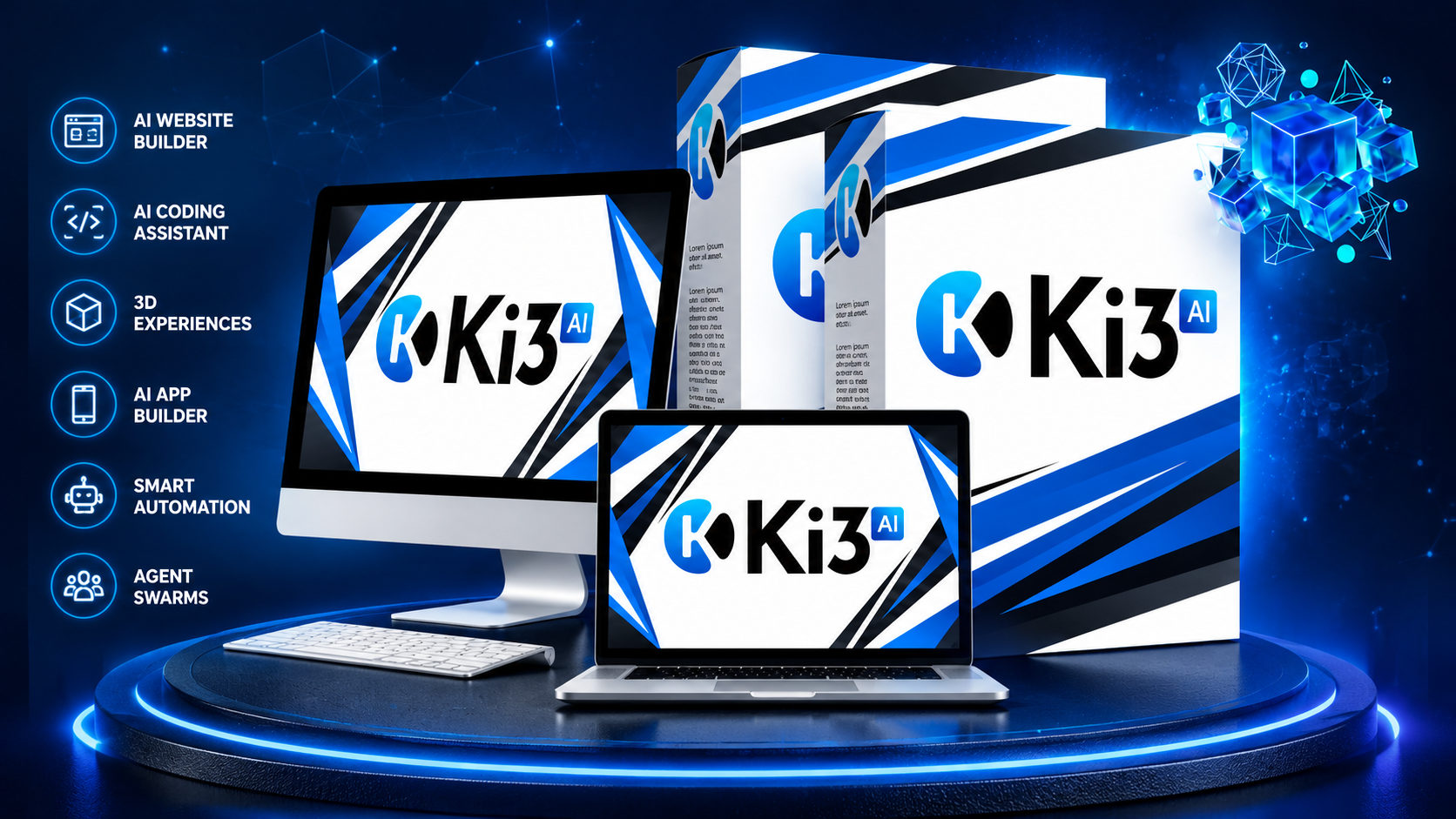
Start with Ki3 AI for $16
$16 Front End • 30-Day Money-Back Guarantee • Commercial License Included
Use coupon code KI3AI4 for $4 OFF • Use coupon code KI3AI30 for 30% OFF
Verify the applicable coupon, final price and offer terms at checkout.
Ki3 AI is supplied with a 30-day money-back guarantee according to the product information provided for this review. Always check the current refund terms and applicable conditions on the seller’s checkout page before purchasing.
🚀 AI-Powered Digital Creation
The supplied Ki3 AI information positions the platform around AI-assisted creation, coding and development, including websites, interactive 3D experiences, browser games, apps, software, dashboards, research, data analysis and other digital projects.
💻 Build From Natural-Language Instructions
Ki3 AI is presented as a platform where users can describe what they want to create and use AI-assisted workflows for coding, development and project execution. Actual output quality, speed and available capabilities may vary by project and account level.
💰 Launch Pricing
The supplied offer information lists the Ki3 AI Front-End price at $16. Pricing, upgrades, bonuses, access levels and promotional terms can change, so verify the current offer before purchasing.
🎁 Discount Coupons
The supplied promotion lists KI3AI4 for $4 off and KI3AI30 for 30% off. Coupon availability and applicable terms may change. Enter the applicable code at checkout and confirm that the discount has been applied.
🚀 Launch Information
Ki3 AI is scheduled to launch on August 20, 2026 at 11:00 AM EDT. Pricing and promotional terms may change after launch.
⚡ Honest Review Disclaimer
This Ki3 AI product snapshot is based on the product, pricing and promotional information supplied for this review. Features, pricing, bonuses, access levels, license terms, promotions and other offer details may change. Vendor claims should not be interpreted as guaranteed results. Your results will depend on factors such as your skills, implementation, project requirements, audience and other circumstances.
💼 Affiliate Disclosure
This section contains an affiliate link. If you purchase Ki3 AI through my affiliate link, RidhTek Reviews may earn a commission at no additional cost to you. This does not increase the price you pay and does not change my commitment to providing an honest evaluation of the product.
I recommend reviewing the current product details, pricing, refund policy, coupon terms and applicable license conditions before making a purchase.
Ki3 AI Review : Who Created It?

Meet The Ki3 AI Creators
Ki3 AI is presented by Venkatesh Kumar & Visves, the creators behind this AI-powered platform designed to help users turn natural-language ideas into websites, applications, software, 3D experiences and other digital projects.
Ki3 AI Review : What Is Ki3 AI?
Ki3 AI is presented as a next-generation AI workspace designed to help users build digital experiences from natural-language instructions.
Instead of beginning with:
- a blank HTML document,
- an empty JavaScript project,
- a design tool,
- a development environment,
- a database,
- a research notebook,
- a video editor,
- or several disconnected AI applications,
the basic idea is that you tell Ki3 AI what you want to create and allow its AI capabilities to assist with the process.
The supplied description positions Ki3 AI around several major areas:
- 3D experiences
- websites
- coding
- autonomous agents
- agent swarms
- reasoning
- vision
- image creation
- video creation
- research
- data analysis
- dashboards
- documents
- presentations
- Python and computational workflows
- games
- product experiences
- long-running projects
That is an unusually broad feature set.
It also creates the first major question in this Ki3 AI Review:
Can one AI workspace genuinely be useful across all of these categories, or does breadth come at the expense of depth?
That is the central issue I would keep in mind before buying.
The concept is compelling because modern digital projects rarely involve only one type of task.
Consider a simple example.
Suppose you want to create an interactive product website.
You may need to:
- Research the target market.
- Analyze competitor positioning.
- Write the website copy.
- Create the layout.
- Generate product visuals.
- Develop the front-end.
- Add animations.
- Build an interactive product demonstration.
- Test the interface.
- Analyze data.
- Create marketing assets.
- Prepare a presentation.
- Publish the project.
Traditionally, that can involve several applications and potentially several people.
An AI workspace that can assist with multiple stages could therefore be extremely useful.
That does not mean it eliminates the need for human oversight.
In fact, the more complex the project becomes, the more important human review becomes.
Ki3 AI Review : The Main Idea Behind Ki3 AI
The simplest way to understand Ki3 AI is to think of it as an attempt to move AI from answer generation toward project execution and digital creation.
Traditional chatbot workflow:
Question → AI response
Ki3 AI’s proposed workflow:
Idea → Planning → Coding → Creation → Iteration → Working digital experience
That difference is important.
For example, a conventional AI chatbot might answer:
“Here is the HTML and CSS for a product landing page.”
An AI development environment could potentially go further:
“Build me a product landing page with a dark futuristic design, animated product cards, an interactive pricing section and a 3D product visualization.”
The intended result is not merely text describing the solution.
It is a working digital artifact.
That is why the AI website builder positioning is one of the more interesting parts of Ki3 AI.
Ki3 AI Review : How It Works Step by Step
Step 1: Start With Your Idea
You don’t necessarily need to know how to code before starting.
You begin by telling Ki3 AI what you want to create in normal language.
For example:
“Create a modern landing page for an AI software product with a dark design, animated hero section, pricing table, testimonials, FAQ and a responsive mobile layout.”
The more specific your description is, the easier it is for the AI to understand your intended result.
Step 2: Describe What You Want to Build
Instead of giving Ki3 AI only a one-line instruction, you can provide details such as:
- What the project is
- Who will use it
- What features it needs
- How it should look
- What pages or sections it should contain
- What interactions you want
- What technology or functionality is required
For example:
“Build a browser-based productivity dashboard for freelancers. Include a sidebar, project cards, task management, revenue tracking, charts and a dark responsive interface.”
This gives the AI a clearer specification.
Step 3: It Understands and Plans the Task
This is where the AI reasoning and agent capabilities become important.
For a simple request, Ki3 AI may be able to move relatively quickly toward creation.
For a more complicated project, the intended workflow is to break the request into multiple tasks.
For example:
Your goal:
“Build an interactive product website.”
The AI may need to handle:
- Page structure
- Visual design
- Components
- Content
- Code
- Interactions
- Responsive behavior
- Testing and corrections
The idea is that you provide the objective while the AI handles much of the implementation work.
Step 4: It Generates the Initial Project
Once the requirements are understood, Ki3 AI can generate the initial result.
Depending on what you asked for, this could be:
- Website
- Web application
- Dashboard
- Browser game
- 3D experience
- Product showcase
- Software prototype
- Interactive webpage
This is where Ki3 AI differs from a conventional chatbot.
Instead of simply responding:
“Here’s some code you could use.”
the intended workflow is to create an actual working project or experience.
Step 5: Review the First Version
This is an important step.
Don’t assume the first generated version is perfect.
Look at:
- Design
- Functionality
- Layout
- Navigation
- Mobile responsiveness
- Buttons
- Forms
- Animations
- Content
- Code behavior
If something isn’t right, tell Ki3 AI exactly what needs to change.
For example:
“The pricing cards are too small. Make them wider, add more spacing and make the CTA buttons more prominent.”
Step 6: Give It Follow-Up Instructions
One of the major advantages of an AI development workflow is iteration.
You don’t necessarily have to start over.
You can continue giving instructions.
For example:
“Add a comparison section below the pricing table.”
Then:
“Add an animated FAQ accordion.”
Then:
“Make the entire page responsive for mobile devices.”
Then:
“Change the design to a futuristic blue and black theme.”
This creates an iterative workflow:
Build → Review → Instruct → Modify → Review again
Step 7: Use Vision to Work From Existing Designs
If you already have a design, screenshot or visual reference, Ki3 AI’s vision capabilities can potentially be used.
For example, you could provide a screenshot and ask:
“Recreate this layout as a responsive webpage.”
The AI can analyze visual elements such as:
- Layout
- Sections
- Buttons
- Cards
- Images
- Spacing
- Visual hierarchy
You can then ask it to modify the result.
This could be particularly useful if you have a design reference but don’t want to manually reproduce every element.
Step 8: Add Images and Visual Assets
You can also use the AI image-generation capabilities to create supporting visuals.
For example:
“Create a futuristic 3D illustration representing an AI automation platform.”
That image could potentially be incorporated into the website or project.
This creates another integrated workflow:
Idea → Image → Website → Interactive Experience
rather than requiring separate tools for every stage.
Step 9: Add 3D Experiences
If your project requires 3D functionality, you can describe the desired experience.
For example:
“Create an interactive 3D product showcase where visitors can rotate the product and click different areas to see its features.”
The platform is specifically marketed around creating:
- 3D scenes
- 3D environments
- interactive product showcases
- immersive web experiences
This is one of the more distinctive parts of Ki3 AI.
Step 10: Create Interactive Features
You can then ask Ki3 AI to add functionality.
For example:
“Add a working pricing calculator.”
Or:
“Add a contact form.”
Or:
“Create an interactive product comparison.”
Or:
“Add a dashboard showing monthly revenue and conversion rates.”
The AI coding capabilities are intended to handle much of the implementation.
Step 11: Use AI Agents for Larger Tasks
For a larger project, you can give the AI a broader objective rather than specifying every individual step.
For example:
“Research the best features for a modern affiliate marketing dashboard and create a working prototype with those features.”
The autonomous-agent concept is designed around handling multiple stages such as:
Research → Planning → Coding → Execution
This is potentially much more powerful than using AI only for individual prompts.
Step 12: Use Agent Swarms for Complex Projects
For particularly large workflows, the supplied Ki3 AI information describes an AI agent swarm.
Conceptually, the work could be divided into separate areas.
For example:
Agent 1: Market research
Agent 2: Competitor analysis
Agent 3: Website structure
Agent 4: Coding
Agent 5: Data analysis
The outputs can then potentially be combined into the larger project.
The advantage is parallel work.
However, you should still review the combined results because multiple AI agents can also introduce conflicting or inaccurate information.
Step 13: Test the Project
Once the project is generated, test it.
For a website, check:
- Desktop
- Mobile
- Navigation
- Links
- Forms
- Buttons
- Images
- Loading speed
- Responsive behavior
For an application, check:
- Functionality
- User input
- Error handling
- Authentication
- Data handling
For a game, check:
- Controls
- Scoring
- Gameplay
- Bugs
- Mobile behavior
This is where human involvement remains important.
Step 14: Ask It to Debug Problems
If you find a problem, describe it.
For example:
“When I click the Submit button, nothing happens. Find the problem and fix it.”
Or:
“The page looks correct on desktop but the navigation overlaps the content on mobile. Fix the responsive layout.”
The AI coding capabilities can then be used to investigate and modify the project.
Step 15: Refine and Improve
Once the project works, you can improve it further.
You might ask Ki3 AI to:
- Improve the UI
- Optimize the code
- Add animations
- Improve accessibility
- Improve mobile responsiveness
- Add features
- Refactor code
- Fix bugs
- Improve performance
This is where an iterative AI workflow can become much more useful than simply generating a project once.
Step 16: Use AI for Research and Data
Ki3 AI isn’t limited to development.
You can also use it to analyze:
- Documents
- Spreadsheets
- Research material
- Charts
- Data
For example:
“Analyze this spreadsheet and identify the three products with the fastest sales growth.”
Or:
“Compare these three competitor reports and identify the major differences.”
The system can potentially turn the analysis into:
- Insights
- Tables
- Charts
- Reports
- Dashboards
Step 17: Turn the Results Into a Dashboard or Presentation
Once the information is analyzed, you can potentially ask Ki3 AI to turn it into something visual.
For example:
Spreadsheet → Analysis → Charts → Interactive Dashboard
or:
Research → Summary → Presentation
This is another example of the platform’s broader “one workspace” concept.
Step 18: Final Human Review
Before publishing or deploying anything important, do a final review.
This is especially important for:
- Websites
- Software
- Client projects
- Business dashboards
- Financial analysis
- Security-sensitive applications
Check the generated output yourself.
AI can accelerate development, but it doesn’t remove the need for quality control.
The Entire Ki3 AI Workflow in One Line
Describe your idea → Give detailed instructions → Ki3 AI plans the work → Generates the project → Review the result → Give corrections → AI modifies it → Test → Refine → Publish/use
Simple Example
Let’s say you want to create a 3D product landing page.
You could go through this process:
1. Tell Ki3 AI what the product is.
2. Describe the target audience.
3. Describe the website structure.
4. Specify the visual style.
5. Ask it to create the initial website.
6. Ask it to add a 3D product model/experience.
7. Ask it to add animations.
8. Ask it to add pricing and CTA sections.
9. Upload a screenshot if you want it to follow a particular design.
10. Review the generated website.
11. Tell it what needs changing.
12. Ask it to fix bugs and responsive issues.
13. Test the finished project.
14. Make the final refinements.
15. Deploy or use the finished project.
So the key idea behind It is not simply “ask AI a question.”
It is closer to:
“Give AI a project, let it work through the project, inspect what it creates, and keep directing it until the result matches what you need.”
That is also the most realistic way to approach It. Treat it as an AI-assisted builder and development environment, not as a completely autonomous replacement for human review.
Ki3 AI Review : Ki3 AI Features Explained
1. AI Website Builder
The AI website builder functionality is arguably the most immediately understandable use case.
The product information says users can describe the website they want and have Ki3 AI assist with:
- design
- layout
- functionality
- code
- interactive components
This could be useful for entrepreneurs who want to create landing pages without manually writing every line of code.
It could also be useful for developers who want to accelerate prototyping.
For example, instead of manually setting up a basic project, a user could potentially begin with a prompt such as:
“Create a responsive SaaS landing page with a dark interface, animated hero section, feature cards, pricing table, FAQ accordion, testimonials and a responsive mobile layout.”
The AI could then generate the initial structure.
The important phrase here is initial structure.
AI-generated websites still need review.
You should inspect:
- responsiveness
- accessibility
- semantic HTML
- JavaScript behavior
- page speed
- security
- form handling
- tracking
- SEO
- browser compatibility
- integrations
- error handling
An AI website builder can reduce the amount of manual development required, but it does not automatically make human quality assurance unnecessary.
That is one of the most important practical considerations in this Ki3 AI Review.
2. AI Coding Tool
Ki3 AI also positions itself as an AI coding tool.
According to the supplied information, it can help with:
- generating code
- explaining code
- debugging
- refactoring
- improving existing code
- building applications
- creating games
- creating automation tools
This could make it useful even for users who already know how to code.
AI coding tools are particularly valuable when used as development accelerators rather than unquestioned replacements for developers.
For example, a developer might use AI to generate:
- boilerplate
- API integration examples
- UI components
- database queries
- utility functions
- test cases
- documentation
- debugging suggestions
- refactoring ideas
The developer then reviews the output.
This approach is usually more realistic than expecting an AI to autonomously create a large production system with zero human involvement.
Why this matters
The word “build” can mean very different things.
Building a prototype is not the same as building a production application.
A prototype might only need:
- a working interface
- basic interactions
- sample data
- a few screens
A production application might require:
- authentication
- authorization
- database architecture
- backups
- monitoring
- logging
- security controls
- rate limiting
- testing
- deployment
- compliance
- scalability
Therefore, when evaluating it as an AI coding tool, I would judge it primarily on how much development work it can reliably accelerate rather than whether it magically eliminates software engineering.
3. Autonomous AI Agent
One of the more ambitious Ki3 AI features is the autonomous AI agent.
The supplied description says users can provide a goal and allow the system to:
- research
- plan
- code
- execute tasks
- work through complex multi-step projects
This is an important development in the AI industry.
An ordinary chatbot waits for instructions one message at a time.
An AI agent is designed to operate more like a task-oriented system.
For example:
Goal:
“Research the top five competitors in this market, compare their pricing, identify their major features, organize the information into a table, and create a summary.”
An agent-oriented workflow could potentially break that into smaller steps.
That is more useful than simply asking a chatbot a single question.
However, autonomy introduces new risks.
The more freedom an AI has to execute tasks, the more important it becomes to control:
- permissions
- data access
- external actions
- API access
- financial actions
- file modification
- code execution
- accuracy
- hallucinations
- security
So I see the autonomous agent feature as potentially powerful, but it is also an area where users should avoid assuming that “autonomous” means “always correct.”
It does not.
4. AI Agent Swarm
Ki3 AI goes one step further with its agent swarm concept.
Instead of one AI agent handling everything, multiple agents can theoretically work on different parts of a large task.
This is particularly interesting for:
- research
- coding
- data processing
- large projects
- multi-step analysis
Imagine a research project involving:
- market research
- competitor analysis
- keyword analysis
- customer research
- pricing analysis
Different agents could theoretically work on different components.
The benefit is parallelization.
The challenge is coordination.
Multiple agents do not automatically mean better results.
If the underlying agents produce inaccurate information, parallelizing them can simply produce more information that needs verification.
Therefore, the value of agent swarms depends heavily on:
- task decomposition
- coordination
- context sharing
- result verification
- conflict resolution
- human review
This is an exciting feature concept, but it deserves practical testing before someone relies on it for mission-critical work.
5. Advanced AI Reasoning
Ki3 AI also promotes advanced reasoning capabilities.
The stated use cases include:
- complex problem solving
- difficult analysis
- brainstorming
- deeper reasoning
- challenging tasks
Reasoning is increasingly important because users are asking AI systems to solve problems rather than simply generate text.
However, reasoning quality should always be evaluated against the actual task.
A system can provide a long explanation and still be wrong.
For serious work, users should verify:
- calculations
- assumptions
- source information
- technical decisions
- financial conclusions
- factual claims
In other words, deeper reasoning is useful, but it should not be confused with guaranteed correctness.
6. Native Vision Intelligence
Ki3 AI reportedly supports visual understanding.
Users can upload:
- screenshots
- images
- designs
- charts
- visual references
and ask the AI to analyze them.
This could be particularly useful for website development.
For example, you could provide a screenshot of a website design and ask the AI to:
- identify layout components
- reproduce the visual hierarchy
- describe spacing
- identify colors
- create a similar structure
- suggest responsive behavior
- convert the design into code
It could also be useful for debugging.
A developer might upload a screenshot showing a broken layout and ask the AI to identify what appears to be wrong.
Again, the important distinction is between visual interpretation and pixel-perfect reproduction.
Those are not necessarily the same thing.
7. AI Image Creation
Ki3 AI also includes AI image creation.
This can potentially support:
- product visuals
- illustrations
- marketing graphics
- website assets
- creative concepts
- promotional material
The advantage of having image creation inside the same workspace is workflow continuity.
Instead of generating a concept in one platform, downloading it, moving it somewhere else, and then incorporating it into your project, the intended workflow is more integrated.
For marketers and creators, that could save time.
But image generation quality can vary significantly depending on:
- prompt quality
- model capabilities
- style requirements
- typography needs
- consistency requirements
- editing controls
Therefore, I would treat this as a useful supporting capability rather than the sole reason to purchase It.
8. AI Video Creation
The platform also claims AI video creation capabilities.
The stated applications include:
- short videos
- animations
- product clips
- creative content
This could be useful for marketers who need promotional material.
For example, a product creator could potentially move from:
product concept → website → image → promotional video
inside one environment.
That workflow is attractive.
However, video generation has its own technical limitations.
Users should evaluate:
- output quality
- resolution
- generation time
- consistency
- duration limits
- editing capabilities
- watermarking
- commercial rights
- export formats
Those details are not sufficiently established in the supplied material, so I would verify them before buying specifically for professional video production.
9. Video Understanding and Editing
Ki3 AI also describes video understanding and editing assistance.
Potential uses include:
- analyzing footage
- identifying scenes
- finding useful clips
- understanding video content
- supporting editing workflows
- assisting with storytelling
This could be useful for content creators working with large quantities of footage.
Imagine uploading a long recording and asking the system to identify:
- key moments
- product demonstrations
- strong quotes
- potential short-form clips
- scene changes
That could potentially reduce manual review time.
But again, this is an area where real-world testing matters.
10. Deep AI Research
Research is another major component of Ki3 AI.
The product description says it can research complex subjects across multiple sources and organize findings into useful reports.
That makes sense as an integrated workflow.
For example:
Research → analysis → writing → presentation
could happen within the same environment.
But research quality should never be measured simply by how much information an AI collects.
The important questions are:
- Are sources actually relevant?
- Are citations accurate?
- Does the system distinguish primary from secondary sources?
- Does it identify conflicting information?
- Does it hallucinate references?
- Can the user inspect source material?
- How current is the information?
- Does it clearly separate facts from assumptions?
For serious research, these questions matter more than the number of sources returned.
11. AI Data Analysis
Ki3 AI also claims data-analysis functionality.
Users can reportedly upload datasets or spreadsheets and use AI to:
- identify patterns
- calculate insights
- create visualizations
- analyze information
- simplify complex datasets
This could be useful for small businesses and marketers who have data but do not have advanced data-analysis skills.
A simple example might be a sales spreadsheet.
The user could ask:
“Analyze monthly sales by product and identify the products with the highest growth.”
The AI could potentially produce:
- calculations
- summaries
- charts
- trends
- observations
However, financial or operational decisions should still be checked against the underlying data.
A small error in data interpretation can produce a completely different conclusion.
12. Interactive Dashboard Creation
Dashboard creation is another interesting Ki3 AI use case.
Instead of simply producing a static report, the platform is positioned to create interactive dashboards containing:
- charts
- visual reports
- interactive elements
- data-driven displays
This is particularly attractive for:
- marketers
- agencies
- SaaS businesses
- analysts
- entrepreneurs
- educators
For example, a marketer could potentially create a dashboard showing:
- traffic
- conversions
- campaign performance
- revenue
- customer acquisition
- product performance
The real value would come from how easily the dashboard can be customized and connected to actual data.
That is something I would verify carefully before relying on Ki3 AI it for business-critical reporting.
13. AI Document Intelligence
Document intelligence allows users to upload large files and ask AI to:
- summarize them
- compare documents
- extract information
- answer questions
- identify important sections
This can be useful for:
- PDFs
- reports
- research documents
- business documents
- technical documentation
- project files
For people who regularly work with long documents, this could save considerable time.
However, sensitive documents deserve special consideration.
Before uploading confidential information to any AI service, you should understand:
- data retention
- privacy policy
- training usage
- storage
- access controls
- account security
Those are not details that should be assumed from the product’s marketing page.
14. AI Presentation Creation
Ki3 AI also positions itself as a presentation creation tool.
Users can potentially transform:
idea → research → presentation
within the same workspace.
This could be useful for:
- business presentations
- product pitches
- educational material
- reports
- client presentations
- marketing decks
The key question is whether the system produces presentations that are genuinely presentation-ready or merely structured outlines.
Again, that distinction should be verified with hands-on testing.
15. Python and Computational Tools
Python support is particularly relevant for technically inclined users.
Python is widely used for:
- data analysis
- automation
- calculations
- visualization
- scientific computing
- machine learning
- scripting
An AI system that can help users write and execute Python workflows could make complex analysis more accessible.
For example, someone could provide a dataset and request:
- cleaning
- calculations
- statistical analysis
- visualization
The AI could potentially generate the required code and explain the results.
This is one of the areas where it could appeal to both technical and non-technical users.
16. AI Game Creation
Game creation is another standout feature.
The supplied materials say Ki3 AI can help create playable browser experiences with:
- mechanics
- environments
- characters
- interfaces
This is especially interesting for rapid prototyping.
A user could potentially describe a basic game concept and receive an interactive browser prototype.
For example:
“Create a simple browser game where a spaceship avoids incoming objects, collects points, and becomes progressively faster.”
The ability to go from concept to playable prototype could be extremely useful for:
- educators
- indie creators
- marketers
- game designers
- developers
- entrepreneurs
But again, prototype generation should not be confused with professional game development.
A commercial game may require:
- advanced physics
- optimized assets
- multiplayer infrastructure
- backend systems
- anti-cheat mechanisms
- analytics
- monetization
- testing
- platform compliance
It may help accelerate the early stages, but that is different from replacing an entire development team.
17. Interactive Product Experiences
This is another feature that could be particularly relevant to digital marketers.
Instead of displaying a static product image, a marketer could potentially create:
- interactive product demonstrations
- animated showcases
- 3D experiences
- interactive feature displays
This could improve how products are presented online.
For example, instead of showing a static screenshot of software, a landing page could contain an interactive demonstration that lets visitors explore features.
That is a compelling use case for agencies and product marketers.
18. Long-Horizon Project Execution
The product also claims support for larger projects involving:
- multiple files
- extensive codebases
- research material
- connected tasks
This is an important claim because maintaining context across a large project is one of the difficult problems in AI-assisted development.
A short prompt is easy.
A large project is not.
A serious project may include:
- dozens of files
- dependencies
- configuration
- documentation
- business requirements
- design decisions
- testing requirements
- previous code
- data structures
If it can maintain context and reason across those components effectively, it could be much more useful than a basic chatbot.
However, this is precisely the type of feature where I would want hands-on evidence before making a strong performance claim.
Ki3 AI Review : Key Features Summary
Ki3 AI Review : Pricing & Funnel Breakdown
Ki3 AI – Build Anything From A Sentence
The core front-end offer. It is positioned as an AI-powered creation platform for turning natural-language ideas into websites, interactive experiences, code, games, apps and other digital projects.
Ki3 AI + AI Campaign Crusher Add-on
An alternative front-end option combining the main Ki3 AI offer with the AI Campaign Crusher add-on for customers looking for additional campaign-oriented resources.
Ki3 AI Unlimited Silver
The first listed upgrade, presented as the Unlimited Silver tier for customers who want expanded access beyond the front-end offer.
Ki3 AI Unlimited Gold
A higher Unlimited tier positioned above Silver. The supplied launch information identifies this option as the Gold tier.
Ki3 AI Master Workshop
A workshop-style upgrade designed to provide additional guidance and resources for customers who want to get more from their Ki3 AI workflows.
Ki3 AI Prompts Vault
A prompt-focused upgrade providing additional prompt resources intended to support AI creation, coding and productivity workflows.
Ki3 AI Agency Basic
An agency-oriented upgrade for customers interested in applying Ki3 AI to client projects, commercial services and agency workflows.
Ki3 AI Agency Deluxe
The higher agency tier listed in the supplied funnel, positioned above Agency Basic for customers seeking a more extensive agency package.
Ki3 AI YouTube Creator Vault
A creator-focused upgrade aimed at users interested in YouTube content creation and related AI-assisted content workflows.
Ki3 AI ShopTok Pro
A commerce and short-form-content-focused upgrade positioned for users interested in ShopTok-related workflows and digital selling activities.
Ki3 AI TrafficPilot
A traffic-focused upgrade included in the funnel. The supplied launch information identifies the product and price but does not provide a detailed feature breakdown.
Ki3 AI Affiliate Empire
An affiliate-marketing-focused upgrade positioned for customers interested in combining Ki3 AI with affiliate business workflows.
Ki3 AI Reseller Starter
The starter reseller option in the funnel, positioned for customers who want reseller-oriented capabilities.
Ki3 AI Reseller Master
The higher reseller tier positioned above Reseller Starter for customers seeking the more advanced reseller option.
Ki3 AI Whitelabel Lite
The entry-level whitelabel option listed in the funnel, aimed at customers interested in a whitelabel-oriented package.
Ki3 AI Whitelabel Premium
The higher whitelabel tier positioned above Whitelabel Lite for customers seeking the premium whitelabel option.
🎁 Ki3 AI Discount Coupons
KI3AI4 → $4 OFF KI3AI30 → 30% OFFApply the applicable coupon at checkout and verify that the discount appears in the final order total. Coupon availability and terms may change.
🛡️ 30-Day Money-Back Guarantee
The supplied Ki3 AI launch information states that the product comes with a 30-day money-back guarantee. Check the seller’s current refund policy and applicable conditions before purchasing.
Ki3 AI Review : Is It Really $16?
This is an important question.
Technically, the supplied funnel lists a $16 front-end option.
But that does not mean $16 gives you every capability or upgrade listed above.
The funnel contains multiple optional upgrades.
Therefore, prospective buyers should distinguish between:
Entry price
and
Total possible funnel cost.
The supplied materials state that the maximum customer path can reach $1,649, producing a stated maximum affiliate commission of $824.50.
That does not mean every customer will spend $1,649.
It represents the maximum path described in the supplied funnel.
This distinction is important when evaluating affordability.
Ki3 AI Review : Pay Once, Use Forever
One of the strongest promotional claims is:
Pay Once, Use Forever.
The supplied material presents it as a one-time purchase rather than a conventional monthly subscription.
That is attractive because recurring SaaS fees can become expensive.
For example, someone using several AI tools might pay monthly for:
- an AI chatbot
- an AI coding tool
- an image generator
- a video generator
- a research tool
- a dashboard tool
A one-time purchase can potentially reduce long-term software costs.
However, “pay once, use forever” should always be interpreted carefully.
Users should verify:
- which features are included permanently
- whether AI usage has limits
- whether external API costs apply
- whether future versions are included
- whether premium models require additional payments
- whether storage has limits
- whether generated media has quotas
- whether upgrades are optional or necessary
The phrase itself does not answer those questions.
Ki3 AI Review : Advantages
1. Very broad AI feature set
It attempts to combine creation, coding, research, agents, media and data workflows.
2. Strong natural-language creation concept
The idea of describing a project instead of manually starting from scratch is appealing.
3. AI website builder positioning
Website creation is one of the most practical use cases.
4. AI coding capabilities
Code generation, debugging and refactoring could benefit both beginners and experienced developers.
5. Autonomous agent workflows
The ability to assign larger goals instead of individual prompts could improve productivity.
6. Agent swarm concept
Multiple agents working on separate tasks could be useful for large projects.
7. 3D creation
3D experiences provide differentiation from ordinary AI writing tools.
8. Browser game creation
The ability to create interactive games could make the platform useful for prototyping.
9. Data analysis
Spreadsheet and dataset analysis can be valuable for business users.
10. Dashboard creation
Interactive dashboards can turn raw information into something easier to understand.
11. Document intelligence
Large documents can potentially be processed much faster.
12. Vision capabilities
Screenshots and visual references can become part of the AI workflow.
13. Commercial license stated as included
This may be particularly attractive to freelancers and agencies.
14. One-time pricing positioning
A one-time purchase can be attractive compared with multiple monthly subscriptions.
15. 30-day guarantee
The stated refund period reduces some purchasing risk.
Ki3 AI Review : Disadvantages
1. Extremely broad feature set
The biggest strength may also be a weakness.
When one platform promises:
- coding
- websites
- games
- 3D
- images
- video
- research
- agents
- data analysis
- dashboards
- presentations
the obvious question becomes:
How deep is each capability?
A specialized tool may outperform a general platform in a specific category.
2. Marketing claims need practical verification
Some claims in the supplied JV materials are promotional.
For example:
- conversion claims
- average cart values
- maximum affiliate commissions
- sales reciprocation
- “convert like crazy”
- broad capability claims
These are not the same thing as independent performance measurements.
I would therefore treat them as vendor claims.
3. AI-generated code still needs review
Even excellent AI coding systems can generate:
- incorrect code
- inefficient code
- insecure code
- outdated approaches
- missing edge cases
Human review remains important.
4. Autonomous does not mean infallible
An autonomous agent can make decisions.
That does not mean those decisions are always correct.
The more authority an agent has, the more important verification becomes.
5. Feature limits are important
The supplied information does not fully establish all potential limits around:
- usage
- generation
- storage
- compute
- model access
- project size
- video duration
- image generation
- API usage
Those should be verified before purchase.
6. Multiple upgrades can increase total cost
The front-end price is relatively low, but the full funnel contains numerous upgrades.
You should not assume that buying every upgrade is necessary.
Ki3 AI Review : Who Is It Best For?
Entrepreneurs
Entrepreneurs can use AI to accelerate:
- landing pages
- prototypes
- product demonstrations
- research
- marketing assets
- internal tools
It could be particularly interesting if you have many ideas but limited development resources.
Freelancers
Freelancers could potentially use it to speed up client work.
For example:
- website prototypes
- landing pages
- dashboards
- interactive demos
- marketing assets
- custom tools
However, freelancers should verify the exact commercial licensing terms for every type of client deliverable.
Agencies
The agency-oriented upgrades make this audience particularly relevant.
An agency could potentially use it for:
- client websites
- prototypes
- marketing assets
- interactive experiences
- dashboards
- campaign concepts
- research
The ability to create prototypes quickly could be valuable when pitching clients.
Developers
Developers are another strong audience.
The platform could potentially function as an AI coding assistant combined with:
- research
- vision
- agents
- data analysis
- project management
Experienced developers are also better positioned to recognize when AI-generated code needs modification.
Marketers
Marketers could use the platform for:
- landing pages
- campaign assets
- product visuals
- dashboards
- research
- presentations
- content experiments
This is potentially one of the strongest target audiences.
Content Creators
The image, video, research and YouTube-oriented capabilities could make it useful for content creators.
The YouTube Creator Vault listed in the funnel also indicates that the vendor is targeting this audience.
However, creators should compare the actual output quality and quotas against specialized video and image platforms.
Beginners
It’s natural-language approach could appeal to beginners.
A person who does not know HTML, CSS or JavaScript may find it easier to say:
“Build me a responsive landing page for my online course.”
than to start learning front-end development from scratch.
But beginners should still understand that AI-generated projects can contain errors.
Ki3 AI Review : Who May Not Need It?
It may not be necessary for someone who only wants:
- simple text generation
- basic brainstorming
- occasional summaries
- straightforward email writing
- simple chatbot conversations
A basic AI assistant may already cover those needs.
The value of it increases when you want to build and execute, not simply ask questions.
Ki3 AI Review : Ki3 AI vs Traditional AI Chatbots
Traditional chatbot:
Input → Answer
It’s intended model:
Input → Plan → Build → Iterate
That difference is significant.
If you only need answers, a traditional chatbot may be sufficient.
If you want a digital artifact, prototype, application or interactive experience, an AI development workspace becomes more interesting.
Ki3 AI Review : Ki3 AI vs Dedicated AI Coding Tools
A dedicated coding platform may offer deeper development features.
But it’s advantage is breadth.
You may be able to move between:
- coding
- research
- images
- data
- dashboards
- agents
without changing environments.
The tradeoff is specialization.
A professional developer should compare:
- code quality
- repository management
- debugging
- testing
- integrations
- deployment
- model selection
- context handling
before choosing one platform.
Ki3 AI Review : Ki3 AI vs No-Code Platforms
No-code platforms traditionally rely on:
- visual builders
- templates
- drag-and-drop interfaces
- predefined components
It takes a more conversational approach.
Instead of assembling every component manually, you describe what you want.
That can be faster.
But visual builders can provide more predictable control.
Therefore:
Ki3 AI = conversational creation
while traditional no-code tools often emphasize:
visual configuration
Neither approach is automatically better for every project.
Ki3 AI Review : Ki3 AI and 3D Web Experiences
The 3D component deserves special attention.
Most AI productivity tools focus on:
- text
- images
- code
It adds 3D experiences to its positioning.
That opens interesting possibilities.
For example:
Product showcases
Imagine an interactive product model that users can rotate.
Digital environments
A company could potentially create an immersive brand environment.
Educational experiences
Teachers could create interactive simulations.
Game prototypes
Creators could develop browser-based experiments.
Interactive landing pages
Brands could create more immersive web experiences.
The limitation is that 3D development can become technically demanding very quickly.
Professional 3D projects may require:
- optimization
- lighting
- textures
- models
- physics
- animation
- WebGL/WebGPU knowledge
- mobile optimization
Therefore, I would view it’s 3D capabilities as particularly interesting for experimentation and prototyping until independently tested at production scale.
Ki3 AI Review : It for Building a Website
Let’s consider a practical example.
Suppose you want a website for a new software product.
You could potentially provide a prompt describing:
- brand identity
- target audience
- color palette
- layout
- features
- pricing
- FAQ
- testimonials
- CTA
- mobile responsiveness
The AI could then create a starting point.
The process could become:
Prompt → Website draft → Review → Modify → Test → Publish
That is much faster than starting from a blank project.
But I would still manually check:
SEO
- title
- meta description
- headings
- canonical URL
- schema
- internal links
- image alt text
Performance
- JavaScript
- CSS
- images
- fonts
- third-party scripts
Accessibility
- keyboard navigation
- contrast
- labels
- semantic structure
Security
- forms
- authentication
- user input
- APIs
Mobile
- responsive layout
- touch interactions
- performance
AI can assist with these tasks, but quality assurance remains necessary.
Ki3 AI Review : It for Building an App
The same concept applies to applications.
Suppose you want:
“A customer dashboard showing sales, traffic, conversions and recent orders.”
The AI could potentially generate:
- UI
- charts
- navigation
- sample data
- interaction logic
But a real application may require:
- database
- user authentication
- permissions
- API integrations
- backend
- error handling
- deployment
That means it may be excellent for reducing the initial development burden, but you should not automatically assume that a generated prototype equals a production SaaS application.
Ki3 AI Review : It for Browser Games
Browser games are another compelling use case.
A beginner could describe:
“Create a simple endless runner game.”
The AI could potentially generate:
- game canvas
- controls
- scoring
- obstacles
- animation
- UI
That could turn a game idea into a prototype quickly.
For educators and marketers, this could also create interactive campaigns.
Again, professional games require much more.
Ki3 AI Review : It for Business Research
Research workflows are another practical application.
For example:
“Analyze the market for AI-powered website builders.”
A useful research workflow could include:
- Identify competitors.
- Compare pricing.
- Compare features.
- Identify target audiences.
- Analyze positioning.
- Find market gaps.
- Summarize findings.
- Build a visual report.
This is exactly the kind of multi-step workflow where an AI agent could potentially provide significant value.
But sources should be checked.
Google’s guidance for helpful content emphasizes original analysis and substantial value rather than simply rewriting what other websites say.
That principle applies to AI research as well.
Ki3 AI Review : It for Affiliate Marketers
This is particularly relevant to readers of RidhTekReviews.com.
Affiliate marketers constantly need:
- research
- landing pages
- graphics
- content
- campaign ideas
- data analysis
- dashboards
- product comparisons
- promotional assets
An AI workspace that combines those functions could potentially reduce the number of separate tools required.
For readers interested in learning the broader affiliate marketing process, I also recommend reviewing the site’s dedicated Affiliate Marketing Tutorials section.
The key is to use AI as an accelerator rather than a replacement for judgment.
Ki3 AI Review : It for Product Review Websites
There is another interesting use case for sites like RidhTekReviews.
An AI platform with research, coding, image, data and content capabilities could potentially assist with:
- product research
- comparison tables
- custom review widgets
- interactive pricing calculators
- product demonstrations
- charts
- landing pages
For example, a review site could potentially create an interactive tool allowing visitors to compare several software products.
That would be more useful than simply adding another paragraph of generic AI-generated text.
Google’s review guidance specifically encourages reviews to provide original analysis, explain differences, discuss pros and cons, and help users make decisions.
That is an important standard for any Ki3 AI review.
Ki3 AI Review : Related Reviews on RidhTekReviews
If you are researching other digital products and AI tools, you may also find these recent reviews useful:
- MagicFlix AI 2.0 Review
- ClickDesigns Review
- Claw AI Army Review
- CourseClaw AI Review
- WP Sync Review
- StudioCut Review
These products address different parts of the broader digital-product and AI ecosystem, so comparing their specific purposes can be more useful than assuming one platform should replace everything.
Ki3 AI Review : Ki3 AI and the Changing AI Tool Market
The broader AI market is clearly moving toward systems that can do more than generate text.
Businesses increasingly want AI that understands context, connects information, and performs useful tasks.
For example, HubSpot has been highlighting the importance of context in AI-powered business workflows, particularly as AI agents become more integrated into marketing, sales and service operations.
That trend is relevant to it.
Its value proposition is not simply:
“Here is another chatbot.”
Instead, it is:
“Here is an AI workspace that can help you create and execute projects.”
That is a much more ambitious proposition.
Ki3 AI Review : Is It a Scam?
Based on the information provided for this review, I would not label it a scam.
There is a defined product proposition, launch information, funnel, pricing structure, affiliate documentation, support information and stated money-back guarantee.
However, “not a scam” should not be confused with:
“Guaranteed to be perfect for everyone.”
No software product deserves that assumption.
A sensible buyer should evaluate:
- what the core purchase includes
- which features require upgrades
- usage limitations
- licensing
- refund conditions
- actual output quality
- support
- future availability
The vendor’s promotional claims should also be distinguished from independently verified results.
That is a much more useful way to evaluate software.
Ki3 AI Review : Is It Worth It?
This depends on what you want from it.
It may be worth considering if you want:
- AI-assisted website creation
- AI coding
- rapid prototypes
- browser games
- 3D experiences
- research
- AI agents
- data analysis
- dashboards
- image generation
- video workflows
- document analysis
- presentations
- multiple AI capabilities in one workspace
It may not be worth it if you:
- only want a basic chatbot
- already have specialized tools you love
- need enterprise-grade software development infrastructure
- require guaranteed production-ready code
- need highly specialized professional video production
- expect autonomous AI to operate without human supervision
Ki3 AI Review : How I Would Evaluate It Before Buying
If I were evaluating it personally, I would test it using a structured process.
Test 1: Simple Website
Ask it to create a responsive landing page.
Check:
- layout
- mobile responsiveness
- typography
- navigation
- CTA
- code quality
Test 2: Complex Website
Ask for:
- multiple pages
- reusable components
- forms
- animations
- responsive design
See how well it maintains consistency.
Test 3: Debugging
Give it deliberately broken code.
See whether it can:
- identify the problem
- explain the problem
- fix the problem
- avoid introducing new issues
Test 4: Vision
Upload a screenshot.
Ask it to recreate the layout.
Compare the result with the original.
Test 5: Data
Upload a spreadsheet.
Ask it to:
- clean the data
- analyze trends
- create charts
- explain findings
Verify the calculations manually.
Test 6: Research
Give it a research question.
Check every major source.
Test 7: Agent
Give it a multi-step project.
Observe whether it:
- plans correctly
- maintains context
- handles errors
- verifies results
Test 8: Game
Ask it to build a simple browser game.
Check:
- controls
- scoring
- responsiveness
- code
- bugs
Test 9: Long Project
Give it multiple related files.
See whether it can maintain consistency across them.
This kind of testing would produce much stronger evidence than simply repeating the sales page.
Ki3 AI Review : Ki3 AI and SEO
An important point for website owners is that AI-generated websites are not automatically SEO-friendly.
SEO requires more than generating a page.
You still need:
- keyword targeting
- search intent
- useful content
- internal linking
- technical SEO
- structured data where appropriate
- image optimization
- page performance
- crawlability
- indexability
- authoritative references
- user satisfaction
Google’s current guidance emphasizes helpful, reliable, people-first content and explicitly warns against creating content primarily for search-engine manipulation.
Google also says there are no special additional technical requirements for appearing in AI Overviews or AI Mode beyond the normal Search eligibility and best practices.
That means it can potentially help create an SEO foundation, but it cannot guarantee search rankings.
Ki3 AI Review : Can It Help With Google AI Search?
Potentially, but indirectly.
The important thing is not whether content was created by it.
The important question is whether the final content is:
- useful
- original
- accurate
- well structured
- relevant
- trustworthy
- satisfying to readers
Google’s current guidance specifically emphasizes unique viewpoints and first-hand experience as valuable characteristics for content appearing in modern Search and generative AI experiences.
That is why an AI-generated website should not simply publish raw AI output.
Human editing and verification remain important.
Ki3 AI Review : External Resources for Readers
Readers who want to understand Google’s approach to helpful content can consult the official Google Search Central guide on creating helpful, reliable, people-first content.
For Google’s specific guidance about writing high-quality product reviews, see Google Search Central’s product review guidance.
Google’s documentation is especially useful because it makes clear that reviews should provide original analysis and help readers make decisions rather than simply summarizing information found elsewhere.
For broader business-AI context, HubSpot has also published recent material examining how businesses are using AI and AI agents across marketing, sales and service workflows.
Additional Reading From Around the Web
Readers interested in broader discussions about AI tools and digital products may also find these independent resources useful:
- AI Tools Review for Smart Automation and Productivity Enhancement
- Digital Products Review Guide for Choosing the Best Online Solutions
- In-Depth AI Tools Review and Digital Products Review for Marketers
These links are provided as additional reading rather than as independent verification of it’s specific claims.
Ki3 AI Review : My Honest Assessment
After looking at the product positioning, feature set, pricing structure and intended audience, I think it is an interesting example of where AI software is heading.
The most compelling aspect is not that it can “chat.”
The more interesting proposition is that it can potentially help users create things.
That includes:
- websites
- applications
- 3D experiences
- games
- dashboards
- product showcases
- code
- images
- videos
- presentations
- research reports
This is a much broader concept than an ordinary AI writing assistant.
But the broad scope is also the biggest reason I would recommend a measured approach.
A platform can advertise twenty capabilities and still have only a few that are excellent.
That is why I would not buy it simply because the feature list is long.
I would buy it because one or more of its workflows solve a real problem for me.
If you frequently build websites, prototype applications, create interactive experiences, analyze data or work with AI-assisted development, the proposition becomes much stronger.
If you only want a chatbot, there are simpler options.
Ki3 AI Review : Pros & Cons
✅ Pros
- Broad AI Creation Capabilities: The supplied feature list covers websites, 3D experiences, browser games, apps, software, dashboards, images, video and other digital projects.
- Natural-Language Building: The platform is designed around describing what you want to build rather than starting every project from scratch.
- AI Coding Assistance: It can generate, explain, debug, refactor and improve code according to the supplied product information.
- Autonomous AI Agent: The advertised workflow can research, plan, code and execute multi-step tasks toward a specified goal.
- Agent Swarm Concept: Multiple AI agents can reportedly be assigned to different parts of larger research, coding or data-processing projects.
- Vision Intelligence: Users can provide screenshots, images, designs and charts for AI-assisted visual understanding and analysis.
- Research and Data Workflows: The feature set includes deep research, document analysis, spreadsheet processing, data analysis and visualization.
- Interactive Experiences: The emphasis on 3D scenes, games, dashboards and product showcases makes it broader than a conventional text-only AI assistant.
- Commercial License Included: The supplied launch information states that a commercial license is included.
- 30-Day Money-Back Guarantee: The supplied offer includes a 30-day money-back guarantee, giving buyers a stated refund window to evaluate the product.
- One-Time Purchase Positioning: The launch material promotes a pay-once, use-forever model rather than a recurring subscription for the core offer.
⚠️ Cons
- Very Broad Feature Scope: Ki3 AI attempts to cover coding, research, 3D, images, video, data, documents and more. That breadth may mean users need time to learn which workflows actually work best.
- Output Quality Can Vary: AI-generated code, designs and content still require human review, testing and refinement before being used in important projects.
- Not a Complete Replacement for Developers: Complex production software can still require technical expertise, debugging, security review, deployment knowledge and maintenance.
- Learning Curve for Advanced Features: Autonomous agents, agent swarms, coding workflows and long-horizon projects may require more experimentation than simple chat prompts.
- Feature Details Are Not Equally Specific: The supplied launch material names many capabilities, but it does not provide detailed technical specifications for every feature.
- Multiple Upgrades: The sales funnel contains numerous optional OTOs covering unlimited access, workshops, prompts, agency, YouTube, traffic, affiliate, reseller and whitelabel options.
- Actual Usage Limits Need Verification: Buyers should confirm current limits, quotas, supported models, generation allowances and other restrictions before purchasing.
- Video and 3D Workflows May Require Testing: The advertised capabilities sound broad, but users should evaluate actual output quality against their specific creative requirements.
- Long Projects Still Need Oversight: Autonomous or long-horizon execution does not eliminate the need to check intermediate results, errors, dependencies and final outputs.
- Pricing and Funnel Terms Can Change: Launch pricing, coupons, bonuses, upgrade availability and refund conditions should be verified at checkout.
Ki3 AI Review : Comparison With Alternatives
| Platform | Ki3 AI | Claude | Google Gemini | Replit | Lovable |
|---|---|---|---|---|---|
| Primary Focus | AI creation, coding, research & interactive experiences | AI reasoning, writing & coding | AI assistant, research, multimodal work & coding | AI-assisted software development | AI-powered web application development |
| Natural-Language Building | Yes | Yes | Yes | Yes | Yes |
| AI Coding | Yes | Yes | Yes | Yes | Yes |
| Website Creation | Yes | With coding | With coding | Yes | Yes |
| 3D / Interactive Experiences | Core Feature | Possible via code | Possible via code | Possible via code | Project dependent |
| Browser Game Creation | Yes | With coding | With coding | Yes | Possible |
| Autonomous Agents | Yes | Yes | Yes | Workflow dependent | Limited |
| AI Agent Swarm | Advertised | Not primary focus | Not primary focus | Not primary focus | No |
| Image Generation | Yes | Model dependent | Yes | Project dependent | Project dependent |
| Video Creation | Advertised | Limited / model dependent | Available in ecosystem | Not core focus | Not core focus |
| Deep Research | Yes | Yes | Yes | Not primary focus | Not primary focus |
| Data Analysis | Yes | Yes | Yes | Developer focused | Project dependent |
| Interactive Dashboards | Yes | With coding | With coding | Yes | Yes |
| Commercial / Agency Use | Commercial License | Yes | Yes | Yes | Yes |
| Entry Pricing Model |
$16 Launch offer |
Subscription | Free + paid plans | Free + paid plans | Free + paid plans |
| One-Time Purchase | Advertised | No | No | No | No |
| Money-Back Guarantee | 30 Days | Plan dependent | Plan dependent | Plan dependent | Plan dependent |
Ki3 AI Review : How I Would Use It in a Real Business
Imagine I am launching a new digital product.
I could potentially use the platform for:
Phase 1: Research
Ask the AI agent to research the market.
Phase 2: Strategy
Analyze competitors and identify positioning opportunities.
Phase 3: Branding
Generate creative directions and visual assets.
Phase 4: Website
Build a landing page.
Phase 5: Interactive experience
Add an interactive product demonstration.
Phase 6: Content
Create supporting materials.
Phase 7: Data
Create a dashboard for campaign results.
Phase 8: Optimization
Use analytics to identify areas that need improvement.
That is the type of workflow where an integrated AI workspace becomes much more compelling.
Ki3 AI Review : Does It Actually Deliver?
This is the question I would not answer with marketing language.
The product’s proposition is impressive.
But a serious review should distinguish:
What the product says it can do
from
What independent testing proves it can do.
The supplied material gives us extensive information about the first category.
It does not provide enough independent evidence for the second.
That is why this review remains cautious.
If I receive access to the platform and conduct hands-on tests, I would update this article with:
- screenshots
- prompts
- output examples
- performance observations
- workflow timings
- failures
- limitations
- actual generated projects
That would make the evaluation significantly stronger.
Ki3 AI Review : Should You Buy It?
My answer is:
Potentially yes, if you have a real use case for its creation and development capabilities.
I would not recommend buying it simply because it has a huge feature list.
I would consider it if I wanted:
- an AI website builder
- an AI coding tool
- autonomous AI agents
- 3D creation
- browser game creation
- research
- data analysis
- dashboards
- visual content
- a broader AI project workspace
The $16 front-end price described in the supplied launch material also makes the entry point relatively accessible compared with the total potential cost of assembling several separate tools.
But remember that the front-end price is not the same as the cost of every optional upgrade.
Ki3 AI Review : Final Verdict
It is an ambitious AI platform aimed at a much bigger goal than answering questions.
Its central promise is simple:
Describe what you want to build, and let AI help turn the idea into a working digital experience.
That proposition is compelling.
The combination of an AI website builder, AI coding tool, autonomous AI agent, agent swarms, 3D creation, game development, research, data analysis, dashboards, document intelligence, image generation and video capabilities makes it considerably broader than a traditional chatbot.
For entrepreneurs, developers, marketers, agencies and creators, that breadth could be valuable.
The one-time purchase positioning and stated 30-day money-back guarantee also make the offer easier to consider than an expensive recurring software commitment.
But there is an equally important caution.
Do not confuse a large feature list with proven excellence in every category.
The more capabilities a platform claims to provide, the more important real-world testing becomes.
I would particularly want to verify:
- generated code quality
- website quality
- project size limits
- agent reliability
- agent-swarm coordination
- 3D output
- game functionality
- image quality
- video quality
- research accuracy
- data-analysis accuracy
- usage limits
- commercial licensing details
- long-term access conditions
Those are the factors that will ultimately determine whether it is merely an impressive AI concept or a genuinely useful everyday tool.
My bottom line
It is worth investigating if you want AI to help you build rather than simply chat.
Its strongest potential is the combination of creation, coding, agents and research inside one workspace.
Its biggest weakness is that its feature breadth creates a lot of questions that marketing material alone cannot answer.
So my recommendation is:
Consider it if you have a concrete project in mind.
Use the guarantee period to evaluate the workflows that actually matter to you.
Do not purchase every upgrade automatically.
And do not rely on vendor income or conversion claims when deciding whether the product is suitable for your business.
For someone who wants to experiment with AI-assisted websites, software, interactive experiences, games, research and digital creation, it is an interesting proposition.
For someone who simply wants a chatbot, it is probably unnecessary.
That distinction is ultimately what makes the buying decision much clearer.
Conclusion
The AI industry is moving from systems that merely generate answers toward systems that can help people research, create, code, analyze and execute.
It is clearly positioned around that transition.
Its combination of an AI website builder, AI coding capabilities, autonomous AI agents, agent swarms, 3D creation, game development, research, data analysis, dashboards, image generation and video workflows makes it an unusually ambitious platform.
Whether it becomes an indispensable tool or simply another large AI toolbox will ultimately depend on execution.
For buyers, the best approach is not to ask whether it can do everything.
Ask whether it can do the specific things you need well enough to save you time, money or development effort.
If the answer is yes, the product deserves serious consideration.
If you only need basic AI chat, there is little reason to pay for a much broader platform.
For everyone in between, the 30-day guarantee provides an opportunity to test the workflows that matter most, subject to the vendor’s current refund terms.
Recommended for: entrepreneurs, developers, marketers, agencies, freelancers, creators, researchers and users interested in AI-assisted digital creation.
Use caution if: you need guaranteed production-ready software, enterprise-grade infrastructure, highly specialized creative tools or independently verified performance across every advertised feature.
Most importantly, remember that the strongest reason to consider it is not its long feature list.
It is the underlying idea:
Turn an idea into something you can actually build.
That is where it could become genuinely useful.
Ki3 AI Review : Get Instant Access + Premium Bonuses Worth $43,000 FREE!
Get Ki3 AI + 17 Exclusive Bonuses
Purchase Ki3 AI through my qualifying affiliate link and get my complete package of 17 Exclusive Premium Bonuses. These bonuses are designed to complement your content creation, traffic generation, affiliate marketing, automation and digital business workflow.
A practical framework for planning AI-assisted traffic generation campaigns and content promotion.
Guidance for finding relevant keywords and building a stronger search-focused content strategy.
A structured approach to developing content designed to engage visitors and encourage action.
Strategies for building traffic through organic and non-paid growth channels.
A framework for turning relevant content and traffic into affiliate marketing opportunities.
Guidance for developing a stronger authority-focused website and content ecosystem.
Workflow ideas for using AI and automation to reduce repetitive online business tasks.
A practical playbook covering approaches for attracting and capturing potential leads.
Strategies for building a recognizable personal brand across online channels.
A framework for identifying practical ways to monetize a content-driven website.
A useful checklist for organizing the major steps involved in launching an online product or offer.
Methods for transforming existing content into additional formats and distribution opportunities.
A framework for reviewing pages, offers and funnels with conversion improvement in mind.
A collection of copywriting ideas and reference structures for AI-assisted marketing content.
Guidance for understanding key measurements and tracking performance across online activities.
A framework for organizing and scaling agency-style services, workflows and client operations.
Strategies focused on building sustainable digital assets, diversified online income streams, automation and long-term online business growth.
🚀 Ready To Try Ki3 AI?
Get Ki3 AI through my qualifying affiliate link and unlock my complete package of 17 Exclusive Bonuses. Use the available coupon code that gives you the best current discount.
🚀 Get Ki3 AI + 17 Exclusive Bonuses🎁 Special Ki3 AI Discounts: Use KI3AI4 for $4 OFF or use KI3AI30 for 30% OFF.
Ki3 AI Review : ❓ Frequently Asked Questions
What is Ki3 AI?
Ki3 AI is presented as an AI workspace designed to help users create, code, research and develop digital projects from natural-language instructions. According to the product information provided, it can be used for projects such as websites, interactive web experiences, browser games, applications, dashboards and 3D experiences. It also combines AI coding, autonomous agents, research, image and video capabilities, data analysis and document-related workflows.
How does Ki3 AI work?
The basic workflow is to describe what you want to create and then use Ki3 AI to help plan, generate and develop the requested project. Depending on the task, the platform is described as being able to research, generate code, analyze visual references, work with data and assist with multi-step development. The actual result can vary depending on the complexity of the project, the quality of the instructions and the capabilities available in the specific version or offer purchased.
Do I need coding experience to use Ki3 AI?
Ki3 AI is marketed as a no-code-friendly solution, so coding experience is not presented as a requirement. The platform is designed around describing the desired result in natural language. However, users who understand HTML, CSS, JavaScript, programming concepts or software development may have an easier time reviewing generated code, troubleshooting complex projects and making technical adjustments when necessary.
What can I build with Ki3 AI?
The supplied product information lists several possible applications, including 3D websites, interactive landing pages, browser games, AI-powered applications, software, dashboards, product showcases and other interactive web experiences. It also describes capabilities for coding, data analysis, presentations, documents, research, images and video. These should be viewed as advertised use cases rather than a guarantee that every project will be produced perfectly without human refinement.
Does Ki3 AI include autonomous AI agents?
Yes. According to the supplied information, Ki3 AI includes an autonomous AI agent designed to research, plan, code and execute multi-step tasks. The product information also describes an AI agent swarm that can involve multiple agents working on different parts of larger research, coding or data-processing projects. The usefulness of these features will depend on the complexity of the task and the specific capabilities available in the user’s plan.
Can Ki3 AI create 3D websites and browser games?
3D experiences and browser games are among the use cases specifically described in the supplied Ki3 AI material. The platform is presented as capable of helping create interactive 3D scenes, environments, product showcases and playable browser experiences. However, complex games and advanced 3D applications may still require testing, refinement and potentially manual development work.
Is Ki3 AI a good option for beginners?
It may be suitable for beginners who want to experiment with AI-assisted website, application or content creation without starting with traditional coding. The natural-language workflow can reduce the technical barrier. That said, beginners should not assume that every complex project will be completely automatic. Learning how to write clear prompts, evaluate outputs and make basic edits can still be valuable.
How much does Ki3 AI cost?
The supplied launch information lists the Ki3 AI front-end option at $16. The funnel also lists additional upgrades, including Ki3 AI Unlimited Silver at $47, Unlimited Gold at $147, Master Workshop at $37, Prompts Vault at $39, Agency Basic at $97 and other optional upgrades. Prices and availability can change, so prospective buyers should confirm the current checkout price before purchasing.
Does Ki3 AI have a money-back guarantee?
The launch information provided for this review states that Ki3 AI comes with a 30-day money-back guarantee. Buyers should still review the current official refund terms and eligibility requirements before purchasing because refund policies, conditions or offer details can change.
Is Ki3 AI worth buying?
That depends on what you need from an AI creation platform. Ki3 AI may be worth considering if you want one workspace for AI-assisted coding, websites, interactive experiences, research, data analysis and creative projects. Its broader feature set may be less important if you only need a simple chatbot or a single specialized AI tool. Before buying, compare the current features, pricing, usage limits, included upgrades and refund terms with your actual requirements.
Turn a topic or idea into a complete AI-powered podcast with minimal production work. Read our full PodShorts review.
Discover what our VisualSpark AI review reveals about its AI-powered visual content creation features.
Want to simplify comic and children’s content creation? Our ComicAgent AI Review breaks down what the platform offers.
Looking for more AI tools and digital product reviews? Check out our latest reviews.